
Last Updated on August 13, 2025 3:25 pm by INDIAN AWAAZ

Afsar Ahmed
The politics of polarisation has flared up once again in the state, this time centring on the centuries-old tomb of Nawab Abdul Samad. On August 11, as the national capital reeled from protests over alleged vote theft, the quiet town of Fatehpur witnessed a different kind of unrest.
A group of saffron activists descended on the historic site, claiming it was not a tomb but an ancient Hindu temple. Despite a significant police presence in the area, parts of the shrine were vandalised and provocative slogans echoed through the locality.
The sudden targeting of the site has left many asking: Why now? And more importantly — what is the actual history of this monument? The claims of Hindu nationalist groups have raised eyebrows among historians and locals alike.
To separate fact from political rhetoric, we launched an independent fact-check into the origins and legacy of Nawab Abdul Samad’s tomb — probing archival records, local oral histories, and official archaeological documentation.
Historical Background
Nawab Abdus Samad was the military commander of this region during Emperor Aurangzeb’s reign. The area known as “Abu Nagar” is named after his son, Abu Muhammad.
During British rule, detailed district records were compiled in gazetteers. One such gazetteer from 1908 titled Imperial Gazetteer of India – United Provinces of Agra and Oudh, Vol. II mentions on page 31:
- In 1901, the population of the area was 19,281.
- The early history of the region is unclear, but Nawab Abdus Samad Khan reshaped it during Aurangzeb’s time.
- Most houses were made of mud.
Crucially, the gazetteer lists only three significant historical structures:
- The tomb of Nawab Abdus Samad Khan
- The tomb of Nawab Baqar Ali Khan
- A mosque
There is no mention of any temple at the site, raising doubts about the recent claims.
🧾 Additional Evidence from 1906 Gazetteer
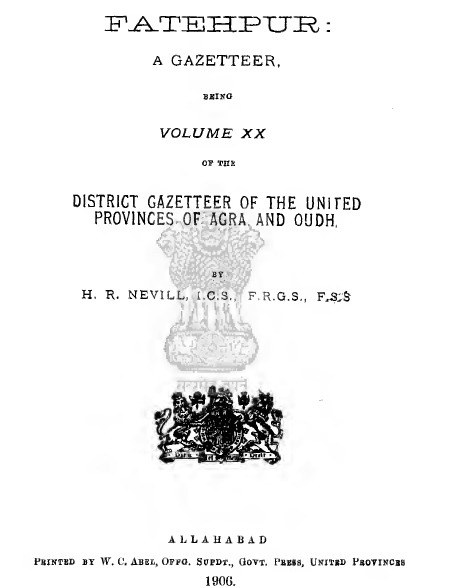
The 1906 Fatehpur Gazetteer, Volume 20 provides detailed information about Abdus Samad Khan’s tomb:
- It states that no other structure in Fatehpur holds historical or archaeological significance except this tomb.
- Located in Abu Nagar, near the ruins of his fort, the tomb is north of GT Road.
- It is a massive, irregularly designed building with domes at each corner matching the central dome’s height.
- The windows have double lattices—outer ones of stone, inner ones of brick.
- Two inscriptions mention Abdus Samad Khan’s death in 1699 and his son Abu Muhammad’s in 1704.
Treasure Rumors and Vandalism
The gazetteer notes that at one point, locals believed treasure was buried at the tomb. In search of it, several houses were demolished, but nothing was found. The debris was sold to a railway contractor. Now, only the entrance remains—a large brick structure resembling a simple grave.
Post-Independence Proof
A 1980 gazetteer prepared by Paramanand Mishra includes a photograph of the tomb, further confirming its identity and historical significance
The historical records and physical evidence overwhelmingly support that the structure is a tomb—not a temple. The recent claims appear to be part of a politically motivated attempt to seize land and incite communal unrest.
Afsar Ahmed is a senior journalist and author. He is currently working on a six-volume series on Emperor Aurangzeb, of which three volumes have already been published. His work aims to critically examine and demystify the legacy of one of India’s most debated rulers. Readers can contact the author at [email protected].