
Last Updated on July 30, 2025 9:57 pm by INDIAN AWAAZ
Staff Reporters / New Delhi
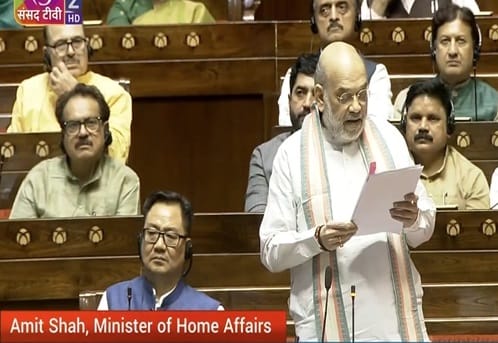
Union Home Minister Amit Shah on Wednesday declared in the Rajya Sabha that Jammu and Kashmir will be completely rid of terrorism under Prime Minister Narendra Modi’s leadership. Speaking during a debate on the Centre’s retaliatory Operation Sindoor, launched in response to the recent Pahalgam terror attack, Shah said the government had given full operational freedom to armed forces to demolish terrorist hideouts in Pakistan and Pakistan-occupied Kashmir (PoK).
“Terrorist infrastructure has been flattened and over a hundred terrorists were neutralised during Operation Sindoor,” Shah asserted, adding that Pakistan’s strike capabilities were dismantled, and the country was forced to plead with India to stop the operation.
Shah lauded the security forces for their precision in Operation Mahadev, which neutralised the three attackers responsible for the Pahalgam attack. He also highlighted swift punitive actions taken by the government post-attack — including the suspension of the Indus Water Treaty and visa services to Pakistan.
Targeting the Congress, Shah accused the opposition party of adopting a soft approach on terrorism for vote bank politics. He criticised former Home Minister P. Chidambaram for demanding proof of the attackers’ Pakistani identity, calling it a reflection of Congress’s “terror-shielding mindset.”
Meanwhile, Opposition parties, including Congress and TMC, staged a walkout, demanding a response directly from Prime Minister Modi.
Jaishankar Debunks Ceasefire Mediation Claims
External Affairs Minister Dr. S. Jaishankar, participating in the discussion, refuted allegations of foreign mediation. He clarified that no communication occurred between PM Modi and US President Donald Trump from 22 April to 16 June. “No global leader requested us to halt Operation Sindoor,” he stated firmly, underlining that India had communicated its clear stance to the US that any aggression from Pakistan would trigger a decisive response.
“Operation Sindoor inflicted massive damage on key terrorist hubs in Bahawalpur and Muridke. Pakistani airfields were destroyed, and funerals of terrorists across Pakistan serve as proof of the operation’s success,” he said.
Jaishankar asserted that the Pahalgam attack aimed to destabilise Kashmir’s economy, which has regained normalcy since the abrogation of Article 370. He also mentioned that the Cabinet Committee on Security’s first post-attack decision was to suspend the Indus Water Treaty unless Pakistan stops sponsoring terrorism.
He noted that India has succeeded in internationalising the issue of cross-border terrorism, with the US designating The Resistance Front (TRF)—which was behind the Pahalgam attack—as a terrorist outfit. He added, “India will neither accept mediation nor nuclear blackmail.”
Cross-Party Reactions
JP Nadda, Leader of the House, condemned the Pahalgam attack and praised the Centre’s swift response — including Shah’s immediate visit to Srinagar and Modi cutting short his Saudi Arabia trip. He accused the previous UPA regime of continuing trade with Pakistan even as terror attacks occurred.
NR Elango (DMK) affirmed that no form of terrorism should be tolerated and stressed India’s sovereignty must remain untouched.
Dola Sen (TMC) raised concerns over an intelligence failure, stating that Baisaran valley was inadequately secured.
Masthan Rao (TDP) praised the operation’s speed, precision, and strategy, while Manoj Jha (RJD) emphasised that national security is a moral duty, not a slogan.
Dr K. Laxman (BJP) praised India’s defence capabilities, asserting that the Modi government has significantly strengthened the defence ecosystem.
Akhilesh Prasad Singh (Congress), however, claimed that India’s diplomacy failed during the crisis.
Niranjan Bishi (BJD) said, “India is the mother of democracy, while Pakistan is the mother of terrorism,” describing Operation Sindoor as a display of India’s largest military might in recent times.
Jaya Bachchan (SP) offered condolences to the families of those killed in Pahalgam. John Brittas (CPI-M) urged for diplomatic solutions over military posturing, cautioning against war jingoism.
Sasmit Patra (BJD) questioned the US President’s repeated references to a ceasefire in which Washington played no formal role.
Other MPs including Upendra Kushwaha (RLM), Satnam Singh Sandhu (BJP), Dr. Fauzia Khan (NCP-SCP), Renuka Chowdhury (Congress), Sushmita Dev (TMC), and Sanjay Raut (Shiv Sena – UBT) also contributed to the debate, largely focusing on national security, regional stability, and the geopolitical implications of Operation Sindoor.