
Last Updated on February 14, 2026 4:36 pm by INDIAN AWAAZ
By Zakir Hossain
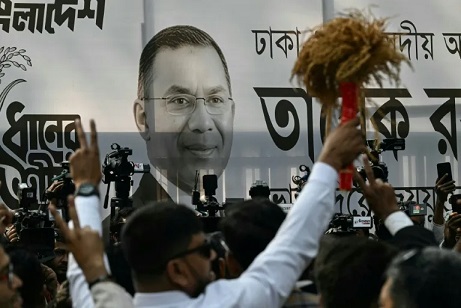
Tarique Rahman, chairman of the Bangladesh Nationalist Party (BNP), is set to become the next Prime Minister of Bangladesh after his party secured a landslide victory in the general elections held on February 12, 2026. Tarique personally won both constituencies he contested, Dhaka-17 and Bogura-6, by comfortable margins.
The election was the first national poll since the previous Sheikh Hasina-led Awami League government was toppled by a student-led mass uprising in 2024. Unofficial results showed that the party won more than a two-thirds majority in Parliament.
“The BNP is a tested democratic force. It is almost certain that the people are handing over the responsibility of governing the country to us,” senior BNP leader Nazrul Islam Khan said in Dhaka. “Everything indicates that the people have placed their trust in the BNP.”
A scion of Bangladesh’s most powerful political dynasty: Tarique, 60, hails from one of Bangladesh’s most influential political families. He is the son of former president Ziaur Rahman Bir Uttam, a military ruler-turned-president who founded the BNP in 1978, and former prime minister Khaleda Zia, who led the party for over three decades and served three terms as head of government.
Born on November 20, 1965, in Dhaka, when Bangladesh was still East Pakistan, Tarique was briefly detained as a child during the 1971 Liberation War. His party has often described him as “one of the youngest prisoners of war”.
His father, a key figure in Bangladesh’s independence struggle, was assassinated in a military coup in 1981. Tarique grew up within his mother’s political orbit as Khaleda Zia went on to become the country’s first female prime minister, alternating in power for years with rival leader Sheikh Hasina.
The rivalry between the Zia and Hasina families has dominated Bangladesh’s politics for decades.
Education and early political career: Tarique studied at BAF Shaheen College before enrolling at the University of Dhaka, where he pursued law and international relations. He later moved into business, with interests in textiles and shipping.
He formally entered politics in 1988, joining the BNP at the upazila level in Gabtali, Bogra. His rise within the party accelerated during Khaleda Zia’s second term as prime minister (2001–2006). In 2002, he was promoted to a senior party position, a move criticised by opponents as nepotism.
Tarique later acquired a reputation as a tough organiser and disciplinarian within the BNP. “In her (Khaleda Zia) seats, I used to go and I used to campaign. So this is how slowly and gradually I started getting involved in politics,” he said.
Arrest, exile and years abroad: Tarique’s career has been repeatedly overshadowed by allegations of corruption and abuse of power, which he has consistently denied.
In 2007, during an anti-corruption drive by a military-backed caretaker government, Tarique was arrested and spent 18 months in prison. He has claimed he was tortured while in custody. In 2008, he was released on medical grounds and travelled to London for treatment, alleging that his condition was so severe he had to be taken to the aircraft in a wheelchair.
Before leaving Bangladesh, Tarique submitted a handwritten resignation letter at the airport, announcing his withdrawal from active politics.
He would remain in self-imposed exile in London for nearly 17 years, living in Kingston with his wife Zubaida Rahman, a cardiologist, and their daughter Zaima Rahman, a lawyer.
Despite his absence, Tarique continued to shape BNP strategy from abroad and became the party’s acting chairman after Khaleda Zia was imprisoned in 2018.
Legal cases and political turnaround: During the 15-year rule of Sheikh Hasina and the Awami League, Tarique was convicted in multiple cases, including corruption, money laundering and terrorism-related charges. He was also sentenced in absentia for his alleged role in the 2004 grenade attack on a political rally.
Tarique and the BNP have consistently maintained that all cases against him were politically motivated.
Following Hasina’s ouster in the 2024 uprising, which left up to 1,400 people dead, according to the United Nations, the verdicts against Tarique were overturned during an interim administration led by Nobel laureate Muhammad Yunus.
The legal clearances paved the way for Tarique’s return to Bangladesh on December 25 last year. Five days later, Khaleda Zia died. On January 9, Tarique formally assumed leadership of the BNP.
Election campaign and victory: Since his return, Tarique has been the face of the BNP’s election campaign. His rallies drew large crowds and helped revive a party weakened by years of arrests, internal splits and organisational decline.
However, the campaign was not without controversy. Several of Tarique’s statements were fact-checked, including a claim that Faridpur district produced soybeans in large quantities, which later proved incorrect. Party insiders acknowledged the missteps but said his performance would improve with time.
Tarique faced a significant challenge from Jamaat-e-Islami, which contested the polls as part of an 11-party alliance that included the student-led National Citizen Party (NCP).

Challenges ahead: Tarique now faces the task of governing a nation of nearly 180 million people grappling with high inflation, unemployment and the growing impact of climate change. Bangladesh is the world’s eighth-most populous country and the second-largest garment exporter after China, supplying major brands in Europe and the United States.
Independent political analyst and former US diplomat Jon Danilowicz said Tarique’s rise was inevitable but warned that public expectations had changed.
“Tarique Rahman would not be in the position he is in had he not been Khaleda Zia and Ziaur Rahman’s son,” Danilowicz told NPR. “But it seems he has understood what has changed in the country. He has acknowledged the July revolution and the sacrifices of those who were on the front line.”
On governance, Danilowicz noted fiscal constraints. “There have been a lot of promises made in terms of social welfare programmes and family cards,” he said. “But there’s a fiscal reality. Bangladesh has one of the lowest taxation rates, and there are limits to how much revenue it can generate.”
Foreign policy and reforms: The Bangladesh Nationalist Party has said it intends to strengthen relations with both the United States and China, Bangladesh’s largest trading partner. However, ties with India are expected to be more complicated.
New Delhi maintained close relations with the former Awami League government and has been sheltering former prime minister Sheikh Hasina since she fled Bangladesh. India has not responded to Dhaka’s requests for her extradition after a Bangladeshi court sentenced Hasina to death in November 2025 for crimes against humanity linked to the 2024 uprising, a charge she has denied.
Senior BNP leader Nazrul Islam Khan on Friday expressed confidence that India-Bangladesh relations would improve under the leadership of Tarique Rahman, as the party moved closer to forming the next government following its landslide victory in the 13th parliamentary elections.
Speaking to reporters in Dhaka, Khan, a BNP Standing Committee member and head of the party’s election management committee, described polling day as a “significant moment” in the country’s political history.
Political analyst Danilowicz said public sentiment towards India had shifted sharply. “Bangladesh’s population has turned against India over the past 18 months,” he said, adding that the key challenge for Rahman would be restoring bilateral ties without triggering domestic backlash.
The incoming government will also be tasked with implementing the July National Charter, a package of constitutional and institutional reforms designed to prevent a return to authoritarian rule. The charter was approved in a referendum held alongside the parliamentary elections.
“With a reasonably robust opposition in Parliament, the BNP government is likely to face closer scrutiny than its predecessor,” Danilowicz said. “That was a fundamental issue that needed to be addressed.”
After returning to Dhaka, Tarique acknowledged the scale of the challenge ahead, calling the task “immense.” “If there were any mistakes that were unintended, we are sorry for that,” he said, describing Bangladesh as having been “destroyed” by the previous regime.
Zakir Hossain is Dhaka based Senior journalist