
Last Updated on July 7, 2025 6:14 pm by INDIAN AWAAZ
ANDALIB AKHTER / NEW DELHI
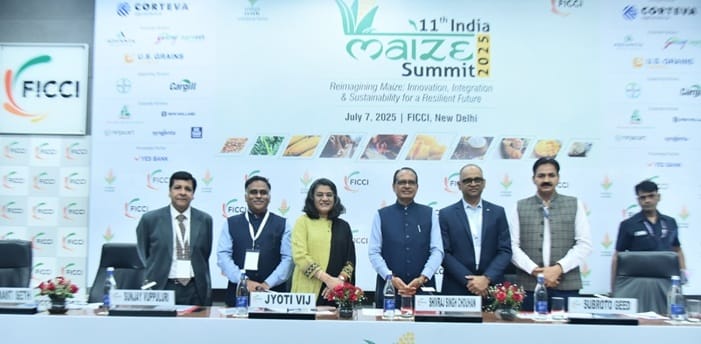
The 11th India Maize Summit, organized by FICCI in partnership with the Indian Institute of Maize Research (IIMR), was inaugurated by Union Minister of Agriculture and Farmers Welfare & Rural Development, Mr. Shivraj Singh Chouhan.
In his keynote speech, Mr. Chouhan reaffirmed the government’s unwavering commitment to farmers, calling “service to farmers” the core principle of their agenda. He outlined a robust, multi-faceted plan aimed at significantly boosting maize production, enhancing farmer incomes, and promoting sustainable agriculture for future generations.
Highlighting India’s maize growth from 10 million tonnes in the 1990s to over 42 million tonnes today, Mr. Chouhan set an ambitious target of 86 million tonnes by 2047. He stressed the need to improve productivity—currently 3.7 tonnes per hectare, below global benchmarks—with states like Bihar and West Bengal leading the way.
Under the ‘Viksit Krishi Sankalp Abhiyan’ (Lab to Land Campaign), the government has mobilized nearly 11,000 scientists and officials to work directly with farmers in over 7,000 villages, bridging research and practical farming. “Scientists will work right in the fields,” Mr. Chouhan emphasized.
Uttar Pradesh Agriculture Minister, Mr. Surya Pratap Shahi, spotlighted the state’s remarkable maize expansion through the Accelerated Maize Development Program. This five-year initiative has expanded cultivation to 540,000 hectares across 24 districts, with yields soaring to 34 quintals per hectare and projections exceeding 40 quintals this season. UP now hosts 15 maize-processing companies and is pioneering value-added products like biodegradable fiber alternatives to plastic. The government supports farmers through minimum support price schemes and improved seed availability, positioning UP as a key player in India’s maize revolution.
Mr. Subroto Geed, Co-Chairman of FICCI’s Agriculture Committee, described maize as a “national imperative,” urging a strategic push for cutting-edge technology, resilient seed systems, and digital agriculture to unlock its full potential across food, feed, and biofuel sectors. He called for a collaborative ecosystem uniting farmers, government, industry, and researchers to build a climate-smart and globally competitive maize economy.
Dr. H.S. Jat, Director of IIMR, outlined bold targets for maize production to grow at 8-9% annually, aiming for 65-70 million tonnes by 2030 to support India’s ambitious ethanol blending goals. He highlighted the need to develop hybrids with higher starch content to increase ethanol recovery and detailed advances in high-yield, high-fermentable maize varieties tailored for different cropping seasons.
Sunjay Vuppuluri, National Head of Food & Agribusiness at YES BANK, presented compelling market insights showing maize as India’s fastest-growing cereal. Over the last decade, acreage increased by 31% to 12 million hectares, with production surging 75% to over 40 million tonnes. However, rising consumption—especially by the poultry and ethanol sectors—is outpacing production, signaling a critical demand-supply gap.
The summit concluded with the minister honoring pioneering farmers for their exceptional contributions, underscoring the vital role they play in India’s maize sector transformation.