
Last Updated on October 15, 2026 6:41 pm by INDIAN AWAAZ
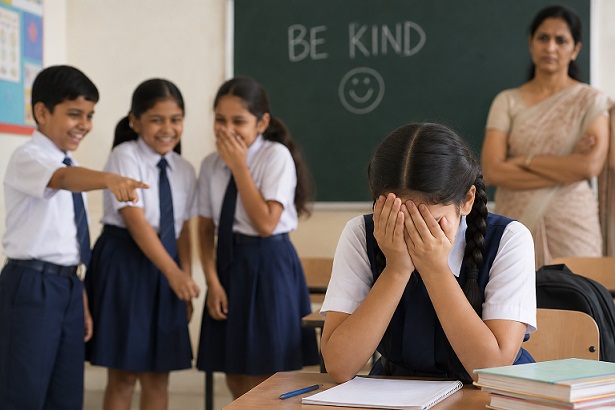
AI representative photo
By Aafreen Hussain
On October 9, 2026, a two-and-a-half-year-old boy in Kolkata allegedly suffered a fractured leg after his teacher threw him to the floor for crying. Months earlier, a three-year-old girl was reportedly locked inside a cupboard as punishment. These disturbing cases out of West Bengal raise a terrifying question for every parent: what is actually happening behind closed classroom doors? While Section 17 of the RTE Act and the Juvenile Justice Act explicitly outlaw corporal punishment and cruelty, the ground reality tells a different story. In the absence of transparent district-wise data, clear accountability, and strict enforcement, the line between school discipline and institutional violence continues to blur, leaving the state’s youngest learners at risk.
Earlier, in February 2026, a three-and-a-half-year-old girl at a preschool in Salt Lake was allegedly locked inside a cupboard by two teachers as punishment. Her family complained to the police, and the West Bengal Commission for Protection of Child Rights ordered an inquiry. An Indian Express report published on March 3 stated that no FIR had been registered at that stage.
These allegations raise a fundamental question: if children barely old enough to understand school discipline can allegedly experience such treatment, what safeguards are actually operating inside their classrooms?
Five Years of Cases: Where Are the Numbers?
Determining whether these incidents are isolated cases or part of a wider pattern requires reliable statistics. However, publicly accessible records reviewed for this report do not establish a consolidated, verified annual count of school corporal-punishment FIRs across West Bengal for 2022–2026, broken down by district.
An important historical indicator comes from a Union government statement published by the Press Information Bureau. The National Commission for Protection of Child Rights received 763 complaints from West Bengal between 2016–17 and 2020–21. Of these, 370 were recorded as disposed of.
The annual complaints received were:
– 2016–17: 68
– 2017–18: 94
– 2018–19: 132
– 2019–20: 374
– 2020–21: 95
These figures concern complaints received by the national child-rights commission from West Bengal across child-rights issues. They are not exclusively school corporal-punishment complaints and must not be mistaken for police FIRs.
Nevertheless, the figures demonstrate why transparent reporting matters. How many complaints concerned violence in schools? How many resulted in formal investigations, disciplinary proceedings or criminal prosecutions? Without these details, the effectiveness of existing safeguards cannot be properly assessed.
Kolkata, Alipurduar and Beyond
Kolkata’s New Alipore and Salt Lake incidents involve two different allegations: physical injury and confinement. In July 2025, parents of a Class IV student in Maniktala, Kolkata, also complained that a teacher had allegedly struck their daughter with an umbrella and slapped her. The school reportedly denied that corporal punishment had occurred.
In another case involving Alipurduar, a teacher faced proceedings under the Protection of Children from Sexual Offences (POCSO) Act following allegations of physical punishment involving two Class X girls. The Supreme Court subsequently quashed the proceedings after finding that the material did not establish the sexual intent required for the alleged offence. This legal decision must not be interpreted as a general endorsement of corporal punishment.
These reports indicate that allegations have emerged in different educational settings. However, they do not establish the statewide prevalence of school violence or prove that every allegation resulted in a criminal offence.
The Law Is Clear. Is Enforcement Equally Clear?
Section 17 of the Right of Children to Free and Compulsory Education Act, 2009, prohibits physical punishment and mental harassment of children covered by the Act. Section 75 of the Juvenile Justice Act addresses cruelty to children by persons having actual charge of or control over them.
The legal framework exists, but legislation alone cannot guarantee safety. Are schools training teachers to manage children’s behaviour without violence? Do institutions have independent complaint mechanisms? Are allegations investigated promptly, and are appropriate disciplinary measures taken when misconduct is established?
The West Bengal Commission for Protection of Child Rights publishes annual reports, offering a route for examining its activities. However, the publicly available information reviewed for this report does not establish a complete five-year, district-wise series of school corporal-punishment complaints, FIRs and case outcomes.
Parents Need Answers, Not Assurances
Parents cannot supervise their children throughout the school day. They entrust them to educational institutions expecting protection, discipline and responsible teaching. When allegations of violence emerge, families need accessible complaint procedures, timely investigations and clear information about the action taken.
West Bengal should publish an annual, district-wise dashboard recording complaints, FIRs, investigations, departmental action, prosecutions and court outcomes. The data should distinguish government and private schools and identify the age groups affected. Schools should maintain child-protection policies, train staff, establish confidential reporting channels and preserve CCTV footage when allegations arise.
The real question is not whether West Bengal has laws against corporal punishment, but whether those laws protect every child in practice. Parents cannot simply abandon education because they fear for their children’s safety. Every child deserves access to learning without intimidation or violence. A classroom must nurture curiosity, confidence and dignity—not fear. Until authorities can demonstrate effective enforcement through transparent figures and accountable action, the question of who protects children when their parents are absent will remain unanswered.