
Last Updated on October 8, 2026 8:29 pm by INDIAN AWAAZ
Curriculum renewal should be welcomed with curiosity, not judged before the book is even read.
By Dr. Richa Pandey
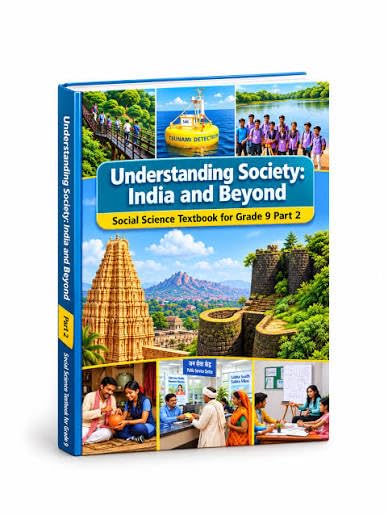
A new school textbook does not usually become a matter of public discussion unless it is surrounded by controversy. Yet textbooks quietly shape a large part of a child’s educational experience. They influence what students learn, the questions they ask and the ways in which they begin to understand society. This is why the release of NCERT’s new Class 9 Social Science textbook, Understanding Society: India and Beyond , deserves a fair and constructive welcome.
NCERT has been undertaking a wider revision of school textbooks in keeping with the National Education Policy 2020 and the changing needs of Indian education. The latest Class 9 Social Science book is part of this continuing exercise. Instead of judging the revision through headlines, social media reactions or assumptions about what may have changed, we should begin with a simpler step: read the book.
Supporting NCERT and engaging critically with its textbooks are not opposing positions. In fact, a strong education system requires both institutional confidence and informed academic discussion. Curriculum cannot remain unchanged Every generation of students grows up in a different social and technological environment. The curriculum that worked for one generation cannot simply be carried forward unchanged for another.
Social Science, in particular, has an important role to play. It should not be limited to memorising dates, definitions and institutional structures. Students should be encouraged to understand how communities function, how societies change, how institutions affect everyday life and how different perspectives can coexist.This makes textbook revision necessary.
The real question, therefore, should not be whether NCERT has changed a textbook. The question should be whether the changes help students understand their society better and engage with it more thoughtfully. That assessment will require time and serious reading.
Read the book before judging it
Public debate around textbooks can sometimes begin even before teachers and students have had an opportunity to engage with the material. That is not particularly helpful. A textbook should be assessed through its actual chapters, explanations, examples, illustrations, activities and questions. If there are concerns about representation, historical interpretation, pedagogy or omissions, these should be identified from the text itself and discussed with evidence. The same principle should apply to praise. There is little value in declaring a textbook either a complete success or a failure without examining how it actually works in classrooms.
NCERT’s work deserves the benefit of a fair reading. At the same time, the institution, like any educational body, benefits from thoughtful feedback from teachers, academics and students.
Teachers are central to curriculum renewal
A textbook, however well designed, cannot transform learning on its own. The teacher remains central to how students encounter knowledge. The introduction of a new textbook should therefore be accompanied by opportunities for teachers to read, discuss and interpret it. Teacher study groups, orientation programmes and professional conversations can help educators understand the intention behind new material and adapt it to the needs of their classrooms.
This is especially important in Social Science. A good lesson does not have to end with students reproducing what is written on a page. Teachers can use the textbook to encourage students to observe their own neighbourhoods, ask questions about their communities, compare different accounts and connect classroom ideas with everyday experiences.
The textbook can provide a foundation. The teacher brings it alive. Constructive criticism is part of educational reform Welcoming NCERT’s new textbook does not mean suggesting that every page must be accepted without question. Educational reform becomes stronger when teachers and academics are able to point out what works, what needs clarification and what could be improved.But criticism is most useful when it is specific and grounded in the material. Instead of asking whether a new textbook fits an already formed political or ideological position, we should ask more educational questions. Does it encourage curiosity? Does it help students make connections? Does it provide sufficient context? Does it represent India’s diversity responsibly?
Does it encourage students to think rather than merely remember? These are questions worth asking because they put the learner at the centre of the discussion.
NCERT’s continuing textbook revision should therefore be seen as an opportunity rather than something to be resisted simply because it is new. Curriculum renewal is difficult, and no textbook can be expected to answer every educational question perfectly. What matters is that the process remains open to evidence, classroom experience and constructive feedback.The new Understanding Society: India and Beyond deserves precisely that opportunity.Let teachers read it. Let students engage with it. Let academics examine it carefully. Let arentsunderstand what their children are learning. And let criticism, where necessary, emerge from thetext and from classroom experience rather than from assumptions made before either has taken place.
If we genuinely want Indian education to evolve, we must also become comfortable with the idea of curriculum renewal.
The most meaningful way to support NCERT is not to applaud every change uncritically. It is to engage seriously with the work, recognise its intent, identify what can be strengthened and help ensure that the final beneficiary of curriculum reform remains where it should be: the learner.

Dr Richa Pandey is an education researcher and educator currently working with the Ravi J. Matthai Centre for Educational Innovation at IIM Ahmedabad. She holds a PhD in Education from the Tata Institute of Social Sciences (TISS), Mumbai. Her research interests include children’s literature, educational equity, inclusion and learning.