
Last Updated on October 8, 2026 7:50 pm by INDIAN AWAAZ
By Our Business Correspondent
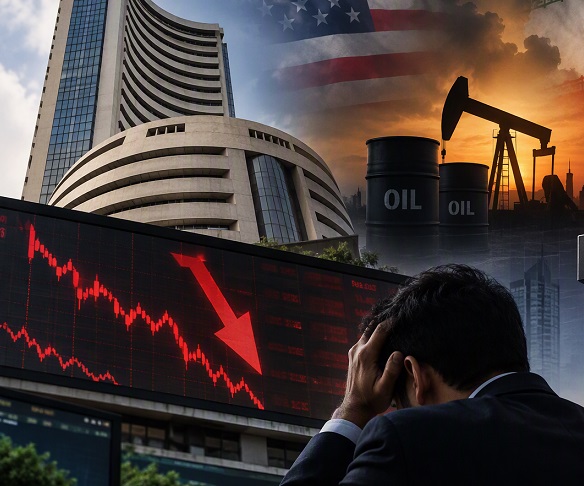
Indian equity markets witnessed a severe selloff on Thursday, extending losses for a second consecutive session as investors grappled with a combination of rising crude oil prices, tightening monetary conditions, persistent foreign fund outflows and growing uncertainty in global financial markets. Benchmark indices plunged to their lowest levels in nearly 18 months, reflecting a sharp deterioration in risk appetite across market segments.
The weakness was widespread, with selling pressure visible across large-cap, mid-cap and small-cap stocks. Although select information technology shares showed relative resilience following better-than-expected earnings updates, the overall market mood remained distinctly bearish as investors reassessed growth and inflation risks.
The BSE Sensex tumbled 1,045.46 points, or 1.44%, to close at 71,593.24, while the Nifty 50 dropped 371.25 points, or 1.64%, to settle at 22,231.80, slipping below the psychologically important 22,250 level. Over the past two trading sessions, the Sensex has lost more than 2%, while the Nifty has declined nearly 2.4%, highlighting the intensity of the current correction.
Crude Oil Emerges as Biggest Concern
A major trigger for Thursday’s fall was the sharp surge in global crude oil prices. Brent crude futures climbed above the $104-per-barrel mark amid renewed geopolitical tensions in the Middle East, fuelling fears of potential supply disruptions.
Higher crude prices pose a significant challenge for the Indian economy, which imports more than 80% of its oil requirements. Market participants fear that sustained elevated oil prices could increase imported inflation, widen the current account deficit, weaken the rupee and raise input costs for businesses.
Sectors heavily dependent on fuel and energy costs, including aviation, paints, chemicals, logistics and automobiles, are expected to face margin pressures if crude prices remain elevated. Investors therefore adopted a cautious stance, leading to widespread profit booking across sectors.
In commodities trading, Brent crude for December 2026 settlement surged 4.28% to $104.49 per barrel, underscoring the inflationary risks confronting both emerging and developed economies.
RBI’s Hawkish Turn Weighs on Sentiment
Investor sentiment was further dampened by the Reserve Bank of India‘s monetary policy decision announced a day earlier.
The central bank raised the benchmark repo rate by 25 basis points to 5.50% and shifted its policy stance to “calibrated tightening,” signalling a stronger commitment to controlling inflation. While the move reflects RBI’s concern over inflation risks, the market interpreted it as a warning that interest rates could remain higher for longer.
Higher rates generally increase borrowing costs for companies and consumers, potentially slowing demand and corporate investment. They also affect equity valuations by raising discount rates used for future earnings calculations.
Rate-sensitive sectors such as banking, financial services, real estate and automobiles came under notable pressure as investors adjusted expectations for future earnings growth.
Market participants also remain concerned that tighter liquidity conditions could limit the availability of capital and reduce risk-taking across financial markets.
Global Factors Intensify Pressure
Weak global cues added to domestic concerns.
Asian markets closed sharply lower after US Treasury yields continued their upward trajectory, reflecting expectations that the US Federal Reserve may maintain a restrictive policy stance for an extended period. Higher US yields often reduce the attractiveness of emerging-market assets and encourage capital flows toward dollar-denominated instruments.
The yield on the benchmark US 10-year Treasury note rose to 5.345%, reinforcing concerns about tighter financial conditions worldwide.
The minutes of the US Federal Reserve’s September policy meeting revealed broad support among policymakers for the latest rate hike. The record of discussions also suggested that another increase in interest rates before year-end remains a possibility, although differences persist regarding the inflation outlook.
European markets also traded lower amid growing concerns regarding France’s fiscal position. Rising borrowing costs, a widening budget deficit and political uncertainty surrounding the country’s 2027 budget have intensified concerns among investors regarding the stability of public finances in the Eurozone’s second-largest economy.
US equity futures pointed to another weak session on Wall Street, with Dow Jones futures indicating losses of nearly 500 points ahead of the opening bell.
Broader Markets Witness Heavy Damage
While benchmark indices suffered significant losses, the decline was even more severe in the broader market.
The BSE MidCap Index fell 2.48%, while the BSE SmallCap Index declined 2.49%, indicating strong selling pressure among retail and domestic institutional investors.
Market breadth remained decisively negative. On the BSE, only 1,003 shares advanced, while 3,426 shares declined, with 225 stocks remaining unchanged. Such weak breadth highlights the extent of the market correction and confirms that selling was not restricted to a few heavyweight stocks.
Volatility also surged sharply. The India VIX, often called the market’s fear gauge, jumped 10.38% to 15.33, suggesting heightened uncertainty and expectations of larger market swings in the near term.
Heavyweights Drag Indices Lower
Among the biggest contributors to the Nifty’s decline were heavyweight stocks from consumption, banking and energy segments.
ITC emerged as one of the largest drags, falling 4.03%, as investors booked profits in defensive consumer stocks. Reliance Industries declined 2.46%, impacted by concerns regarding higher energy costs and overall market weakness. HDFC Bank slipped 1.49%, reflecting concerns over interest-rate sensitivity and broader financial-sector weakness.
The combination of declines in these market heavyweights exerted considerable pressure on benchmark indices.
TCS Earnings Offer Limited Relief
The commencement of the second-quarter earnings season remained a key focus area for investors.
Tata Consultancy Services (TCS) reported a mixed but broadly steady performance for Q2 FY27. The company posted consolidated revenue of Rs 73,188 crore, representing a 1.3% sequential increase and an 11.2% year-on-year rise.
Net profit rose to Rs 13,884 crore, up 4.01% quarter-on-quarter and 14.98% year-on-year, while operating margins stood at 24%.
The company reported total contract value (TCV) of $9.6 billion, marginally higher than the previous quarter but lower than the level recorded in Q4 FY26.
TCS also announced an interim dividend of Rs 12 per share, providing some comfort to shareholders. However, despite healthy financial performance, the stock ended marginally lower as investors remained focused on broader macroeconomic concerns.
Stocks in Focus
Several individual stocks attracted investor attention based on business updates and quarterly performance announcements.
Paytm parent One 97 Communications fell 5.23% after the Reserve Bank of India disclosed that Paytm Payments Bank had been excluded from the Second Schedule of the RBI Act.
PC Jeweller gained nearly 6% after reporting approximately 28% year-on-year revenue growth during the September quarter, aided by healthy consumer demand.
Fino Payments Bank rallied 11.46% after reporting a 13% rise in average deposits, demonstrating improving operational momentum.
Senco Gold advanced over 3% following strong festive-season demand, with retail revenue rising 29% year-on-year and same-store sales growth reaching 19%.
On the downside, GM Breweries declined nearly 10% despite recording double-digit growth in revenue and profit, suggesting concerns over valuations or future demand outlook.
Matrimony.com ended marginally lower after surrendering early gains, while Interarch Building Solutions slipped despite securing a Rs 59-crore order for a pre-engineered steel building project in South India.
Mixed IPO Debuts
The primary market delivered a mixed picture.
Nityas Gems & Jewellery ended its debut day at Rs 84.15, representing a gain of over 12% compared with its issue price of Rs 75, indicating healthy investor interest.
In contrast, Vishal Nirmiti closed at Rs 204.25, nearly 7% below its issue price of Rs 220, reflecting a cautious response from investors amid weak market conditions.
Currency and Bond Markets Reflect Risk Aversion
The stress visible in equities was also reflected across currency and debt markets.
The Indian rupee weakened to 96.85 against the US dollar, compared with 96.755 in the previous session, highlighting pressure from rising crude prices and foreign fund outflows.
Meanwhile, India’s benchmark 10-year government bond yield rose to 7.285%, indicating declining bond prices and expectations of tighter monetary conditions.
Gold prices remained firm, with MCX December futures rising to Rs 1,49,319, as investors sought safe-haven assets amid rising market uncertainty.
Outlook
Market participants are expected to closely monitor the unfolding earnings season, particularly commentary from corporate managements on demand conditions, margin outlook and global growth trends. Alongside earnings, crude oil prices, movements in Treasury yields, geopolitical developments, currency volatility and signals from major central banks will remain critical drivers of market direction.
With volatility rising and risk sentiment fragile, analysts believe investors may continue to adopt a selective and defensive approach until greater clarity emerges on inflation trends, interest-rate trajectories and global economic growth prospects. For now, the sharp correction underscores the market’s sensitivity to macroeconomic shocks and the growing caution among investors navigating an increasingly uncertain global environment.
Disclaimer: This report is based entirely on market data, exchange filings, and corporate disclosures for informational purposes only and does not constitute financial or investment advice.