
Last Updated on March 13, 2026 12:52 am by INDIAN AWAAZ
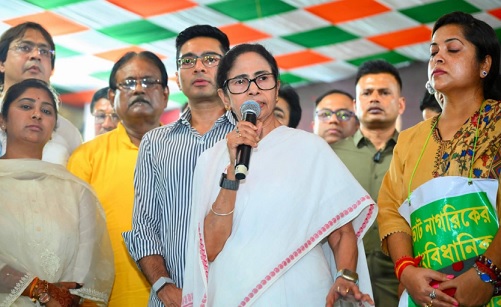
Aafreen Hussain / KOLKATA
For the last few days, Kolkata’s Metro Channel has turned into a new political stage. The ruling Trinamool Congress (TMC), led by West Bengal Chief Minister Mamata Banerjee, has been protesting against the Election Commission, accusing it of acting in a biased manner ahead of the upcoming Assembly elections. The unusual sight of a party in power staging a street protest has naturally triggered sharp reactions from the opposition and a fair amount of public curiosity.
Chief Minister Mamata Banerjee, addressing supporters at the protest site, alleged that the Election Commission was functioning under pressure from the BJP-led central government. She claimed that the Commission’s decisions regarding election administration and security arrangements were politically motivated and aimed at benefiting the BJP. Banerjee asserted that her party would not remain silent if democratic institutions were “misused” to influence the electoral process.
Her nephew and TMC’s national general secretary, Abhishek Banerjee, also spoke strongly at the protest. He argued that the Election Commission was trying to intimidate the state government and manipulate the election environment. According to him, the protest was meant to defend democracy and ensure that the people of West Bengal could vote freely without interference from the Centre.
But this protest has also revived memories of another agitation that shaped West Bengal’s political history the Singur movement. Back in the mid-2000s, Mamata Banerjee sat on a prolonged protest against land acquisition for the Tata Nano project in Singur. That movement eventually became a symbol of resistance against the then Left Front government and played a crucial role in the Trinamool Congress coming to power in 2011 after 34 years of Left rule.
And that comparison raises a series of uncomfortable and perhaps ironic questions.
Back then, Mamata Banerjee was the voice of the opposition fighting a powerful government. Today, she herself is the Chief Minister. When the ruling party occupies the streets to protest, who exactly are they protesting as the government or the opposition?
If the Election Commission is accused of bias today, why was the same institution accepted without question when TMC won massive victories in earlier elections? Did the Commission suddenly lose its neutrality, or did its neutrality become questionable only when its decisions were inconvenient?
Opposition parties have been quick to seize on this contradiction.
The BJP has sharply criticized the protest, accusing Mamata Banerjee of trying to create “drama” to pressure constitutional institutions. BJP leaders argue that the Election Commission is simply performing its duty to ensure a free and fair election. According to them, the Chief Minister’s protest is an attempt to intimidate the Commission and distract from allegations of corruption and governance failures in the state.
The Congress has taken a more measured but still critical stance. Congress leaders say it is unusual and troubling for a ruling party to protest against institutions that are constitutionally mandated to conduct elections. They argue that if every ruling party begins to protest against the Election Commission whenever decisions go against them, the credibility of processes could be seriously undermined.
The CPI(M), once Mamata Banerjee’s principal political rival, has been particularly sharp in its remarks. Left leaders have pointed out what they describe as the “ultimate irony”: the same Mamata Banerjee who built her political career through protests against a government is now staging protests while being the government. According to them, the protest is less about democracy and more about political optics.
And that brings us back to the larger question.
Is this protest truly about protecting democracy, or is it about controlling the narrative before a high-stakes election? Is the ruling party fighting for institutional independence? or challenging it because it no longer suits their political strategy?
The Singur protest once symbolized a movement against power. The Metro Channel protest, however, represents something entirely different: power protesting against another institution of power.
Perhaps the most intriguing question of all is this when the ruling party sits on the streets demanding justice, who exactly is expected to deliver that justice?
And more importantly, who is the opposition now?