
Last Updated on March 12, 2026 11:47 pm by INDIAN AWAAZ
Staff Reporter / New Delhi
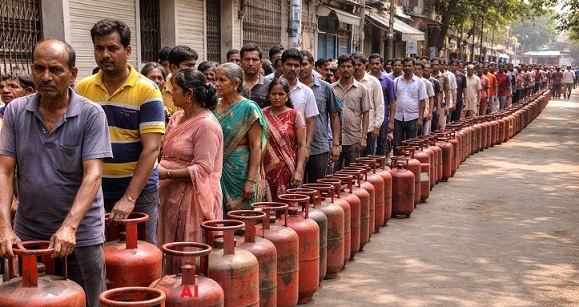
India is grappling with a sharp shortage of liquefied petroleum gas (LPG) after the ongoing conflict in West Asia disrupted a significant portion of the country’s imports passing through the strategic Strait of Hormuz. Officials say more than half of India’s LPG shipments, traditionally routed through the Gulf region, have been affected, triggering urgent measures by both the government and industry.
To ease the supply crunch, the government has moved swiftly to increase domestic production. Oil refining companies have been directed to divert C3–C4 hydrocarbon streams to maximise LPG output, boosting production by nearly 25–28 percent in recent weeks. Authorities are also expanding procurement beyond Gulf suppliers, sourcing additional cargoes from countries including the United States, Norway, Canada, Algeria and Russia to stabilise supplies.
Emergency Measures to Protect Essential Supply
The government has introduced temporary measures to ensure that essential services and households continue receiving cooking gas. Hospitals, educational institutions and critical commercial establishments have been placed on priority supply lists. Restaurants, however, will receive only about 20 percent of their usual monthly LPG allocation.
To conserve LPG for priority users, small and medium enterprises, restaurants and hotels have been permitted to switch to alternative fuels such as coal, kerosene, biomass and refuse-derived fuel (RDF) pellets for a limited period of one month.
Authorities have also released about 48,000 kilolitres of kerosene to states and allowed the use of fuel oil by certain industrial and commercial consumers as a substitute energy source.
Government Monitoring and State Role
The situation is being closely monitored at the highest levels. Prime Minister Narendra Modi and senior cabinet ministers are receiving regular briefings, while a committee of executive directors from oil marketing companies has been formed to track commercial LPG supplies and distribution.
State governments have been asked to identify priority beneficiaries and oversee cylinder distribution to prevent hoarding or black-market activity during the supply disruption.
Businesses Forced to Adapt
Large institutional kitchens and corporate catering services are adjusting operations to cope with the shortage. Companies such as HCLTech and Infosys have begun using induction cooking systems, industrial boilers and biofuels to reduce dependence on LPG. Some organisations have simplified cafeteria menus to minimise fuel consumption, while HCLTech has even advised employees to work from home on days when canteen services are affected.
Impact on Informal Sector
The LPG shortage is also hitting the informal economy. Food delivery workers and street vendors who rely on commercial cylinders are facing rising costs and supply uncertainty. Many vendors have been forced to turn to cheaper and sometimes environmentally harmful fuels to continue operating.
Industry experts warn that if supply disruptions in the Gulf region continue, the pressure on LPG availability and prices could intensify, making it one of the most immediate energy challenges facing India’s household and commercial sectors.