
Last Updated on January 22, 2026 1:38 am by INDIAN AWAAZ
AMN / DAVOS
India’s Minister for New and Renewable Energy Shri Pralhad Joshi held a series of high-level engagements at the World Economic Forum Annual Meeting 2026 in Davos Wednesday, underscoring India’s leadership in driving a just, affordable and inclusive global energy transition.
Addressing multiple sessions and roundtables, Joshi highlighted that India’s clean energy journey demonstrates how rapid economic growth, affordability and sustainability can progress together. Guided by the vision of Prime Minister Narendra Modi, he said India’s transition model offers scalable and practical solutions, particularly for developing countries and the Global South.
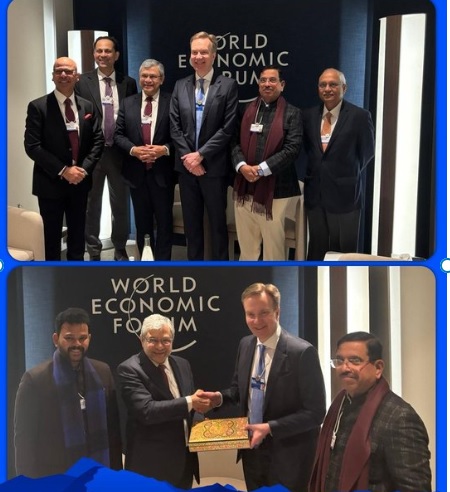
During a meeting with WEF President and CEO Borge Brende, Joshi, along with Union Minister for Railways, Electronics & IT and Information & Broadcasting Ashwini Vaishnaw, discussed the importance of global cooperation in addressing shared economic and developmental challenges. The discussions underlined the role of multilateral platforms like the WEF in building global consensus and fostering sustained dialogue between governments, industry and stakeholders to promote inclusive and resilient growth.
At a WEF roundtable on decentralised renewable energy, Joshi shared India’s experience in rapidly scaling rooftop, agricultural and decentralised clean energy solutions. The session, attended by Maharashtra Chief Minister Devendra Fadnavis and Zimbabwe’s Minister of Foreign Affairs and International Trade Amon Murwira, focused on models relevant for the Global South. The Minister highlighted flagship initiatives such as the PM Surya Ghar Muft Bijli Yojana and PM-KUSUM, which are expanding access to clean energy for households and farmers while reducing costs. He also underlined the role of decentralised systems and mini-grids in improving energy reliability in remote and weak-grid regions.
Chief Minister Devendra Fadnavis lauded India’s clean energy initiatives and said the renewable sector has seen rapid progress under the leadership of Prime Minister Modi and the guidance of Joshi.
Reaffirming India’s commitment to inclusive energy transitions and South–South cooperation, Joshi said India would continue sharing its experience through platforms such as the International Solar Alliance as the global community works towards a climate-secure future.
Speaking at a session on “De-Risking the Green Leap: Subnational Blueprints for Utility-Scale Energy Transition,” Joshi said India stands in the global spotlight for driving the renewable energy transition, with States playing a critical role in translating national policy into tangible outcomes. He cited Madhya Pradesh as a leading example, highlighting its strong execution, among the lowest solar and battery storage costs in the country, and globally competitive green hydrogen prices. The key challenge globally, he said, lies not in ambition or capital but in effective execution.
On the sidelines of WEF 2026, the Union Minister also met Mr. Guillaume Vermersch, Group CFO of Mercuria Group, to discuss collaboration in clean energy, carbon markets, climate finance, green hydrogen, biofuels and energy storage. He welcomed Mercuria’s commitment to invest nearly 50 per cent in green energy and its interest in India’s expanding clean energy ecosystem.
Earlier, on January 20, Joshi presented the Country Strategy Dialogue on India at the WEF Congress Centre, alongside Union Ministers Ashwini Vaishnaw and Ram Mohan Naidu Kinjarapu. Emphasising India’s scale and speed of execution, he noted that solar tariffs have declined by nearly 80 per cent, renewable energy with storage has become cost-competitive, and green hydrogen and green ammonia prices discovered in India are among the most competitive globally. He added that India’s renewable energy manufacturing capacity has expanded to 144 GW, positioning the country as a major clean energy market and a reliable global manufacturing hub on the path to Viksit Bharat 2047.
Joshi also delivered the keynote address at a WEF session on the “Global Mission on AI for Energy,” highlighting the transformative role of artificial intelligence in the energy sector. He said AI can improve forecasting, reduce losses, lower costs and strengthen grid reliability, and outlined India’s shift towards platform-based deployment through Digital Public Infrastructure for Energy to enable large-scale adoption of AI-driven solutions.
Through these engagements, the Union Minister said, India reaffirmed its commitment to leading a collaborative, technology-driven and inclusive global clean energy transition