
Last Updated on January 3, 2026 1:01 am by INDIAN AWAAZ
New Year Strike, Old Injustices: Gig Workers Demand Dignity
If gig work is developed with dignity, security, and stability, it can evolve from a symbol of compulsion into a humane and exemplary employment model—one where convenience serves not only the consumer, but honour and justice are extended to the worker as well.
By Lalit Gargg
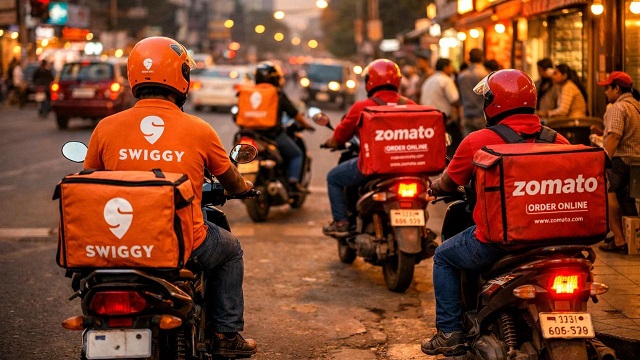
In an era of online marketplaces and instant services, gig workers have become the invisible backbone of urban life. Without them, the idea of “ten-minute delivery” or “one-click convenience” would be unthinkable. These young workers free consumers from the hassle of visiting markets, delivering goods door to door in every season, at every hour, and under constant risk. Yet the irony is stark: those whose labour sustains the towering edifice of the digital economy endure the greatest insecurity, exploitation, and neglect.
The strike by gig workers on the eve of the New Year may not have paralysed the national supply chain, but it certainly drew the country’s attention to their grim working conditions. This protest was not the outcome of political provocation; it was a natural response to mounting work pressure, shrinking earnings, job uncertainty, and the persistent denial of dignity. These young workers, who support themselves and their families, are routinely seen racing through traffic on motorcycles, lugging heavy bags up the staircases of high-rise buildings. The pressure of strict time limits is so intense that even a minor delay invites financial penalties. Accidents, illness, or technical glitches immediately affect their income. Customer behaviour is often insensitive—rebukes for delays, humiliation over trivial issues, occasional abuse, and punitive ratings that directly impact future earnings are part of their daily reality. Despite working 12 to 14 hours a day, most earn only seven to eight hundred rupees, without adequate insurance or social security—clear evidence of systemic exploitation.
Gig workers are individuals who perform temporary, flexible, task-based work instead of holding traditional jobs. Their work is typically mediated through digital platforms such as Uber, Swiggy, Zomato, and similar apps. They are paid per task or project rather than receiving a regular salary, and they do not have permanent employment contracts. Although described as “independent” and portrayed as their own bosses, they are excluded from basic social security benefits such as health insurance, accident coverage, or pensions. Their challenges are many: unstable income, excessive workloads, low pay, long working hours, and frequent disputes over wages and conditions. The gig economy differs from the conventional nine-to-five model, yet in practice it often offers less security and fewer rights.
Undeniably, the gig economy has demonstrated its capacity to generate employment. India today has over 12.5 million gig workers, a number expected to rise to nearly 23.5 million by 2030. However, in an era of rising unemployment, educated youth are entering this system not by choice, but out of compulsion. In a country that prides itself on its demographic dividend, the trapping of educated young people in insecure, temporary, and undignified work is not only worrying but deeply shameful. It exposes a development model focused on the quantity of jobs rather than their quality.
The central contradiction of the gig economy is that companies extract full labour from workers while refusing to recognise them within a formal employer-employee relationship. By labelling them “independent contractors,” companies evade responsibilities related to job security, minimum wages, insurance, and social protection. Hire-and-fire practices, algorithmic surveillance, rating systems, and incentive-based manipulation together create an invisible cage: workers appear free, but in reality are tightly controlled. Even during strikes, worker solidarity is weakened through bonus offers and increased order volumes. The recording of record-high orders by a major food delivery company on 31 December starkly illustrates this paradox. In recent times, the issue of gig worker exploitation has also been raised in Parliament. Leaders such as Raghav Chadha and Manoj Kumar Jha have drawn attention to the precarious conditions of this workforce, a welcome development. Without the inclusion of gig workers’ voices in policymaking, reforms will remain incomplete.

For the first time, recent labour reforms by the Government of India have provided a legal definition for gig and platform workers. Provisions such as a one to two percent contribution by aggregator companies from their turnover to a social security fund, and the creation of a universal account number linked to Aadhaar, mark long-awaited steps forward. Yet the critical question remains: will these measures bring tangible change to workers’ lives, or will they remain symbolic gestures on paper? Without guaranteed minimum income, limits on working hours, accident insurance, healthcare protection, and effective grievance-redress mechanisms, these reforms cannot be considered transformative.
The strike of 31 December may not have achieved complete operational success, but it was morally and socially justified. It sought less to disrupt the system than to expose the injustice, exploitation, and hypocrisy embedded within it. Gig workers asserted that they are not merely “delivery boys,” but working citizens whose rights can no longer be ignored.
The future of the digital economy is inconceivable without gig workers. Policymakers, companies, and consumers must all engage in serious self-reflection. Corporations must accept responsibility alongside profit, governments must ensure strict enforcement of labour laws, and consumers must pair convenience with empathy. If gig workers continue to be treated merely as instruments of convenience, deprived of dignity, security, and stability, the crisis will extend beyond labour to the very idea of development itself. It will stand as a blemish on the vision of a developed and prosperous India.
The true test of Digital India lies in how safely and respectfully it treats its fastest-moving workers. In the rapidly expanding world of online services, gig work must no longer be seen as informal or expendable, but recognised as organised, legitimate, and dignified labour. Fair and assured wages, safe working conditions, and social security are not acts of charity—they are fundamental rights that demand decisive government intervention. Corporate giants driven by profit must realise that labour is not merely a cost, but the soul of the system. Without sensitivity and accountability, digital growth cannot be sustainable. If gig work is developed with dignity, security, and stability, it can evolve from a symbol of compulsion into a humane and exemplary employment model—one where convenience serves not only the consumer, but honour and justice are extended to the worker as well.