
Last Updated on August 16, 2025 12:09 pm by INDIAN AWAAZ
AMN / Anchorage, Alaska
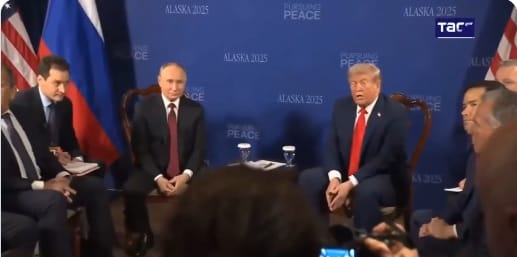
In a meeting heavy on optics but light on tangible outcomes, U.S. President Donald Trump and Russian President Vladimir Putin concluded their high-profile summit in Anchorage on Friday, offering a show of diplomacy but little progress on the most urgent issue at hand: the war in Ukraine.
The summit, which drew global attention for its unusual location and the long-standing personal rapport between the two leaders, was initially billed as a potential breakthrough in de-escalating tensions. However, analysts and officials say the talks produced no substantive agreements, especially on the future of Ukraine, which remained conspicuously absent from the negotiation table.
A Carefully Choreographed Display
The two leaders greeted each other warmly, exchanged pleasantries in front of the press, and held a joint press conference in which both emphasized the importance of dialogue over confrontation. “We had a good meeting,” Trump said. “We understand each other. It’s time for peace.”
Putin, in turn, praised Trump for “taking initiative” and said that “relations between Russia and the United States deserve stability.”
But behind the cameras, the atmosphere was far less conclusive. While Trump had initially proposed a trilateral discussion involving Ukrainian President Volodymyr Zelenskyy if the initial meeting went well, that scenario never materialized. White House officials later clarified that Ukraine was “not part of this phase of diplomacy.”
No Concrete Roadmap
Some news agencies quoting diplomatic sources, say the two sides discussed a range of global issues including arms control, energy markets, and cyber threats. However, the war in Ukraine—a conflict now in its fourth year since Russia’s 2022 invasion—was addressed only in broad strokes, with no commitment to a ceasefire, no talks on territorial integrity, and no mention of Russian withdrawal from occupied zones.
Trump reportedly floated the idea of a “grand peace bargain” involving frozen conflict zones, but officials said there was no consensus on implementation. Putin, meanwhile, reiterated Russia’s long-standing claims about NATO’s eastward expansion and “provocations by Kyiv,” drawing no public rebuttal from Trump.
Reaction from Kyiv and Beyond
Ukrainian officials expressed disappointment over being sidelined. In a sharply worded statement, the Ukrainian Foreign Ministry said, “No decisions about Ukraine can be made without Ukraine.” President Zelenskyy, speaking from Kyiv, said Ukraine remains committed to a just peace—but not one negotiated “behind closed doors.”
European allies also appeared uneasy. German Chancellor Annalena Baerbock warned against “deals that ignore Ukrainian sovereignty,” while French President Emmanuel Macron said any real peace must be “anchored in international law.”
Critics Point to Political Optics
Critics of the summit say it played more into Trump’s political brand than into serious statecraft. “This was about theater, not diplomacy,” said former U.S. National Security Advisor H.R. McMaster. “We saw symbolic gestures with no follow-through, and the absence of Ukraine from the dialogue makes it even more troubling.”
Others noted that the presence of Trump’s close advisers—Secretary of State Marco Rubio and special envoy Steve Witkoff—did little to alter the perception that the summit lacked policy depth.
What Next?
With no joint statement, no agreement, and no follow-up mechanism announced, the Anchorage summit leaves more questions than answers. Whether it paves the way for future negotiations—or merely becomes another chapter in performative diplomacy—remains to be seen.
For now, Ukraine remains caught in the fog of war, and the world is left watching for the next move—still hoping, but not expecting, a breakthrough.