
Last Updated on September 10, 2022 12:50 pm by INDIAN AWAAZ
In India’s case, the UNHD said, the drop in HDI from 0.645 in 2019 to 0.633 in 2021 can be attributed to falling life expectancy – 69.7 to 67.2 years. The Gross National Income (GNI) per capita level is $6,590.
WEB DESK
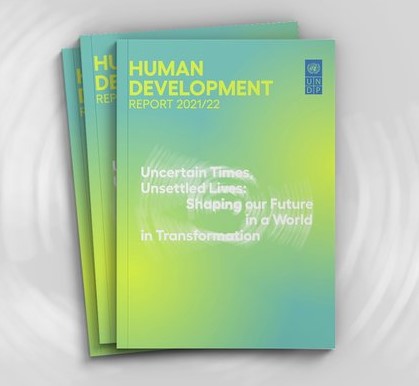
India’s rank on the Human Development Index has slipped from 130 in 2020 to 132 in 2021, in line with a global fall in HDI scores in the wake of the Covid-19 pandemic, shows the Human Development Report 2021-22 released Thursday.
According to the report, released by the United Nations Development Programme (UNDP), India’s HDI value stood at 0.633 during 2021, which was lower than the world average of 0.732. In 2020, too, India recorded a decline in its HDI value (0.642) in comparison to the pre-Covid level of 2019 (0.645).
HDI measures progress on three key dimensions of human development – a long and healthy life, access to education, and a decent standard of living. It is calculated using 4 indicators – life expectancy at birth, mean years of schooling, expected years of schooling, and the Gross National Income (GNI) per capita.
In India’s case, the UN said, the drop in HDI from 0.645 in 2019 to 0.633 in 2021 can be attributed to falling life expectancy – 69.7 to 67.2 years. India’s expected years of schooling stand at 11.9 years, and the mean years of schooling are at 6.7 years. The Gross National Income (GNI) per capita level is $6,590.
“The Human Development Report shows that progress globally is in reverse. India’s decline in human development mirrors this trend – impacted by intersecting crises. But there is good news. Compared to 2019, the impact of inequality on human development is lower,” said Shoko Noda, UNDP Resident Representative in India.
“India is bridging the human development gap between men and women faster than the world. This development has come at a smaller cost to the environment. India’s growth story reflects the country’s investments in inclusive growth, social protection, gender-responsive policies, and push towards renewables to ensure no one is left behind,” said Noda.
The UN report showed that 90% of countries have registered a reduction in their Human Development Index (HDI) value in 2020 or 2021, reversing much of the progress toward the Sustainable Development Goals. Human Development – a measure of a nation’s health, education, and average income – has declined for two years in a row – 2020 and 2021, reversing five years of progress. The report indicated that human development across the world has stalled for the first time in 32 years.
While some countries are beginning to get back on their feet, recovery is uneven and partial, further widening inequalities in human development. Despite a significant economic recovery in 2021, the health crisis intensified, with two-thirds of countries recording even further reductions in life expectancy at birth. A large contributor to the Human Development Index’s recent decline is a global drop in life expectancy, down from 72.8 years in 2019 to 71.4 years in 2021, the report said.
It showed that the global trend is toward a continued decline in human development, with many countries stagnating or moving down through the human development categories: High human development economies like the Philippines and Venezuela have slipped to a medium development category. Latin America, the Caribbean, Sub-Saharan Africa, and South Asia have been hit particularly hard.
The Index is part of the Human Development Report 2021-2022 released by the United Nations Development Programme on Thursday. The HDI measures average achievement of a country in three basic dimensions of human development — a long and healthy life, education and a decent standard of living.It is calculated using four indicators — life expectancy at birth, mean years of schooling, expected years of schooling, and the Gross National Income (GNI) per capita. The world over, nine out of 10 countries have slipped in their human development performance due to multiple crises such as COVID-19, the war in Ukraine and environmental challenges, indicating that human development globally has stalled for the first time in 32 years.
Ranking of countries over different years is not comparable. A large contributor to the HDI’s recent decline is a global drop in life expectancy, down from 72.8 years in 2019 to 71.4 years in 2021.
India’s HDI score of 0.633 places it in the medium human development category, lower than its value of 0.645 in 2018,indicating a reversal in progress.
Like global trends, in India’s case, the drop in HDI from 0.645 in 2018 to 0.633 in 2021 can be attributed to falling life expectancy at birth — 70.7 years to 67.2 years. India’s expected years of schooling stand at 11.9 years, and the mean years of schooling are at 6.7 years. The GNI per capita level is $6,590.
Gender inequality
The COVID-19 pandemic has also exacerbated gender inequality, which increased 6.7% globally.
India has, however, shown a slight improvement in its Gender Inequality Index value in the latest report as compared to the 2020 index (0.490 vs 0.493), after gender inequality worsened between 2019 and 2020 (0.486 vs 0.493). The index measures inequality in achievement between women and men in three dimensions — reproductive health, empowerment and the labour market.
The report notes that the uncertainty due to multiple global crises has fuelled support for polarisation in many parts of the world which is detrimental for democratic freedom and human rights.
Conflicts arising from polarisation can then divert policy attention and resources.
It identifies worsening mental distress since COVID-19 as another factor that can impede human development and suggests that stress, sadness, anger, and worry had reached record levels. On average, countries spend less than 2% of their healthcare budgets on mental health, which limits access to mental health services for citizens globally.