
Last Updated on April 27, 2026 8:04 pm by INDIAN AWAAZ
R. Suryamurthy
India and New Zealand on Monday signed a sweeping free trade agreement (FTA) that promises to eliminate tariffs on virtually all Indian exports while opening new pathways in services, investment and labor mobility, in what both governments described as a “once-in-a-generation” reset of economic ties.
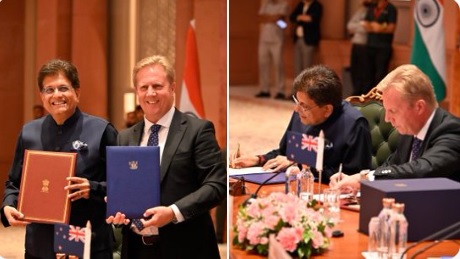
The agreement, signed at Bharat Mandapam by Commerce and Industry Minister Piyush Goyal and New Zealand’s Trade and Investment Minister Todd McClay, was concluded in under a year after negotiations resumed in March 2025—making it one of India’s fastest trade deals with a developed economy. Prime Minister Narendra Modi and his counterpart Christopher Luxon framed the pact as a strategic milestone aimed at expanding trade, strengthening supply chains and deepening people-to-people linkages.
At its core lies New Zealand’s commitment to grant 100% duty-free access across all 8,284 tariff lines for Indian exports from day one—an unusually expansive concession expected to sharpen India’s competitiveness in labor-intensive sectors such as textiles, leather, footwear, engineering goods and processed foods, where tariffs previously ranged up to 10%.
India, in contrast, has adopted a calibrated approach, liberalizing about 70% of tariff lines covering 95% of bilateral trade value, while ring-fencing nearly 30% of sensitive sectors—including dairy, edible oils and key farm products—through exclusions, tariff-rate quotas (TRQs) and minimum import prices. Officials said the asymmetry reflects domestic political economy considerations, particularly the need to protect small farmers and rural livelihoods.
Bilateral trade remains modest—around $1.3 billion in goods and $2.4 billion including services (2024–25)—but policymakers on both sides expect the agreement to significantly scale these numbers. Industry bodies such as the Federation of Indian Export Organizations estimate that trade volumes could more than double over the medium term, driven by tariff elimination and improved market access.
A key pillar of the pact is a $20 billion investment facilitation commitment, targeting sectors such as agri-tech, food processing, logistics, renewable energy and advanced manufacturing. The inclusion of a “rebalancing clause” to track investment delivery signals a shift in India’s FTA architecture—from tariff-led liberalization to outcome-based economic cooperation.
Gulzar Didwania, Partner at Deloitte India, said the agreement “marks a transition toward productivity, capability building and long-term cooperation,” noting that while tariff cuts will boost manufacturing and services exports, the real gains may accrue through technology transfer, farm-level efficiency and supply chain integration.
The services chapter is among the most expansive India has secured in a bilateral pact. New Zealand has opened 118 service sectors, with Most-Favored Nation commitments across 139 sub-sectors, covering IT, telecom, education, tourism and professional services.
Equally significant are mobility provisions: a dedicated visa pathway will allow up to 5,000 skilled Indian professionals to work in New Zealand for up to three years at any given time, alongside expanded post-study work rights of up to four years and an annual quota of 1,000 working holiday visas.
Industry stakeholders say these provisions could strengthen India’s positioning as a global talent hub. Pavan Choudary of the Medical Technology Association of India described the FTA as “a statement of intent as much as a trade agreement,” highlighting faster regulatory pathways for pharmaceuticals and medical devices through recognition of inspections by major global regulators such as the US FDA and Europe’s EMA.
However, he flagged a gap: the absence of India’s own regulator, the CDSCO, from mutual recognition frameworks— “a commercial and strategic imperative” for future revisions.
Agriculture—traditionally a sticking point in India’s FTAs—has been handled through a hybrid model of protection and partnership. While dairy and key staples remain excluded, India will allow limited imports of products such as apples, kiwifruit and manuka honey under TRQs. At the same time, both countries have agreed to collaborate on productivity enhancement, quality standards and supply chain efficiencies.
Mohit Singla, Chairman of the Trade Promotion Council of India, said the deal could unlock high-value opportunities in agri-food exports, particularly in processed foods, spices, marine products and health-oriented segments. India’s food and beverage exports to New Zealand, currently about $101.85 million with a five-year CAGR of 6.4%, remain underpenetrated in a market with imports exceeding $5.1 billion.
New Zealand’s expertise in food safety, traceability and cold-chain logistics could complement India’s scale in production, enabling deeper integration into global value chains, Singla added.
Sector-specific gains are already being projected. The Gem & Jeweler Export Promotion Council expects exports to New Zealand to rise from $16.6 million to nearly $50 million within three years, aided by duty-free access and improved competitiveness against rivals such as China and Thailand.
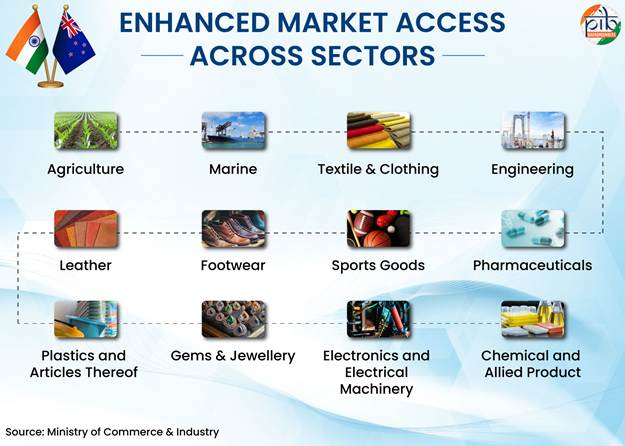
Similarly, the Electronics and Computer Software Export Promotion Council sees the agreement as a catalyst for India’s technology sectors, with opportunities in precision manufacturing, IT services and digital trade. Industry executives argue that beyond incremental gains, the FTA could help reposition India within high-value global supply chains.
The agreement also places notable emphasis on MSMEs, startups and women-led enterprises, with provisions for simplified customs procedures, digital trade facilitation and cargo clearance timelines of 24–48 hours—measures aimed at lowering transaction costs and improving export readiness.
Strategically, the pact fits into India’s broader push to diversify export markets and reduce reliance on traditional geographies such as the United States and the Gulf. Coming after the India–Australia trade agreement, it strengthens India’s economic footprint in the Oceania region—still relatively underexplored by Indian exporters.
Yet, challenges remain. Exporters will need to navigate rules of origin, compliance requirements and non-tariff barriers, while domestic industries—particularly in agriculture—will closely watch import trends under the TRQ regime. FIEO has urged the government to invest in trade facilitation infrastructure and capacity-building to ensure that smaller firms can actually utilize the agreement.
For now, the India–New Zealand FTA stands out not just for its speed of negotiation, but for its architecture—combining full tariff elimination on one side with calibrated safeguards on the other, alongside investment commitments, services liberalization and talent mobility.
If effectively implemented, it could serve as a template for India’s next generation of trade agreements—less about headline tariff cuts, and more about embedding the country deeper into global production networks while balancing domestic sensitivities.
Key Takeaways
- India- New Zealand FTA eliminates duty on 100% of Indian Exports
- USD 20 billion investment commitment, strengthening long-term economic and strategic cooperation.
- The agreement places special emphasis on strengthening MSMEs and women-led enterprises.
- India protects its key interests in dairy and agriculture; Huge win for labour intensive sectors like textile and leather.
- New Zealand facilitates Health and Traditional Medicine Services for the first time.
- Student Mobility and Post Study Work Visa for STEM Graduates, Skilled Professionals; opens new visa pathway for 5,000 skilled occupations.