
Last Updated on December 10, 2025 1:14 pm by INDIAN AWAAZ
SHOBHA SHUKLA
The World Health Organization’s establishment of its first-ever Civil Society Task Force on Antimicrobial Resistance (AMR) in October 2025 signals a transformative shift in the global response to one of today’s most urgent health threats. AMR is eroding the effectiveness of life-saving medicines across human health, animal health, food systems, and the environment—yet lasting change is only possible when people and communities are placed at the centre. By bringing together 81 civil society organisations under a unified platform, the WHO seeks to turn global commitments into local action, strengthen accountability, and elevate the voices of those most affected by drug-resistant infections.
AMR is making infections – that were earlier easier to treat – difficult (or even impossible) to treat because disease-causing pathogens (like bacteria, virus, fungi or parasites) become drug-resistant – as a result of which medicines no longer work on them. We cannot afford to undo the century of advancements in modern science and lose the medicines that protect us when we get sick.
AMR warrants an inter-sectoral response because misuse and overuse of medicines is not only rampant in human health sector but also in other sectors like animal health and livestock, food and agriculture, and even polluting our environment.
UNAIDS former head Michel Sidibe had said to CNS in 2009 that “when a bacteria (TB) and virus (HIV) can work together, why cannot we?” Akin to the mantra, AMR too calls for a united response to prevent it.
#WomenLead as Co-Chairs
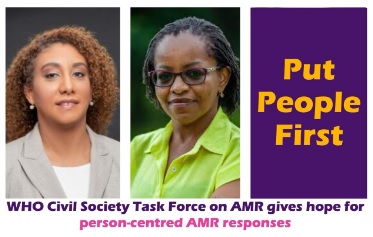
CNS and Global AMR Media Alliance (GAMA) got an exclusive opportunity to speak with Katherine Urbaez and Tracie Muraya- the two Co-Chairs of the first-ever WHO Civil Society Task Force on AMR:
Katherine Urbaez founded and directs Health Diplomacy Alliance and is a former diplomat from the Dominican Republic, who has been instrumental throughout her career in numerous negotiations and in developing public policies within various multilateral processes, with a specific focus on health, human rights, and environmental issues. She also served on the Executive Board Membership to WHO.
Tracie Muraya is the Deputy Director for Policy & Strategy for ReAct Africa. She engages with policymakers, AMR stakeholders, and national and local AMR Coordinating Committees, including at the Regional Quadripartite and Africa CDC. Tracie coordinates in-country projects in Africa which are implementing National Action Plans on AMR.
WHO Civil Society Task Force on AMR has 81 organisations (including CNS) and is overseen by a 12-member steering committee. Dr Philip Mathew, AMR expert with the WHO HQ serves as its coordinator.
Translate global promises into local actions to prevent AMR
The task force is not a mechanism to engage only civil society for AMR awareness, campaigns and advocacy but also to engage people in influencing AMR strategies and policies, says Katherine Urbaez. This task force will help coordinate work with the civil society as organisations and networks come from different focus areas, backgrounds and contexts, and help collectively address AMR at different levels, she said.
Tracie Muraya prioritises health systems strengthening as well as fortifying capacities of civil society networks to help address AMR. She votes for upping transparency and accountability in the task force.
Speaking of accountability, Tracie Muraya calls for a check list so that all sectors, including civil society, can monitor progress towards addressing AMR in an accountable manner. “When our leaders go to different forums where AMR related declarations are passed or different frameworks adopted, we need to follow up on these promises. We need a follow up through monitoring and accountability so that we can translate promises into actions and address AMR effectively.”
Tracie says we need civil society on the decision-making tables with the government and other stakeholders at all levels, be it global, regional, national or sub-national. “We must ensure there is a whole-of-society involvement in addressing AMR.”
Tracie shares an example from Kenya: Sub-national or local forums, such as County AMR Steering Interagency Committee, may not have the same capacity as forums or platforms at the national level. We need to ensure that what local realities feed into national and global policies can be effectively translated into public health realities on the ground.
Listen to the people we serve
We need to listen to and learn from the underserved communities when it comes to health responses including those of AMR. People with lived experiences and affected communities must play a central role in person-centred AMR responses.
Katherine Urbaez calls for understanding communities and local realities and contexts and factor them into AMR responses at all levels. “Civil society engagement at the community level is the biggest asset. It is important to have a direct engagement with local communities (via local civil society groups).”
Accountability and transparency go together. “We see the WHO Civil Society Task Force on AMR not as a mechanism of blaming or shaming but for truly supporting and engaging civil society into the AMR processes and commitments. This also includes financial mechanisms,” said Katherine Urbaez. Communities can play a more proactive role in not only impacting change for more domestic resource allocation but also amplify the demand for fully financing the global AMR response.
Gender responsive and transformative AMR responses
One of the missions of WHO Civil Society Task Force on AMR is to amplify the voices of affected communities (including AMR survivors), and ensure equitable access to prevention, treatment, and care, especially for vulnerable populations.
Tracie Muraya calls for gender parity when it comes to AMR responses. Gender inequalities and gender-based injustices are among the biggest barriers for women, girls and persons in all their gender diversities that block equitable access to existing health and social welfare services. She also prioritised older persons, and persons with disabilities, when co-designing and implementing community-led AMR responses.
In addition to doing household work, women and girls are primary carers in many communities, even when they themselves might be sick – said Tracie. “Also, biologically (and for a range of other reasons), we tend to be more at risk of urinary tract infections, and sexually transmitted infections, and struggle for sexual and reproductive health services. So, women are more likely to be receiving antibiotics.”
In patriarchal societies, women often do not have any say in household finances. “So, if they have an infection, they are less likely to access much-needed treatment,” said Tracie.
Tracie shared that “It is not unusual to find that a woman is washing dishes by a river or local water body and children are playing there. They may be using the same water for domestic use or even for drinking purposes. Livestock, like cattle or others, may also be using the same water source. So, exposure to infections and AMR is different for them.”
Importantly, Tracie underlines that an overwhelming majority of health workforce (especially frontline healthcare workers and nurses) are women.
Do not forget indigenous peoples, migrants and refugees
Katherine Urbaez reminds us that we must tailor AMR responses for indigenous communities and peoples, migrants and refugees – including those in conflict settings. She points out the limited access to healthcare services when it comes to these population groups.
Katherine calls for aligning AMR responses with those that are addressing social, economic, cultural and other forms of inequalities. Addressing social determinants that are related to AMR is key, she said.
“People-centred AMR response should not be a tokenistic or transactional affair. It must mean that the people are literally in the centre of designing AMR policies and implementing them. That is where we go wrong, I think,” cautioned Tracie.
We all are at risk of AMR but are all engaged?
Both Katherine and Tracie call for tailoring AMR messaging and communications so that different communities and organisations can be effectively engaged in AMR responses at all levels.
AMR connects multiple sectors of human health, animal health and livestock, food and agriculture, and environment. Even within these sectors there are several sub-sectors focussed on specific health and development issues. We need to engage them meaningfully in united AMR responses with One Health approach.
Thanks to the WHO and other agencies including Quadripartite Joint Secretariat on AMR (which unites WHO, FAO, UNEP and WOAH to address AMR, using One Health approach), World AMR Awareness Week is observed worldwide at all levels during 18-24 November every year.
But AMR awareness campaigns and advocacy to impact change must be a year-round perennial activity, says Tracie.
International Human Rights Day – 10th December and Universal Health Coverage Day 12th December
“AMR is not just a health and scientific issue, rather it is both a justice and developmental issue. Right antimicrobial for the right patient at the right time –this is actually a justice issue – it is a human rights issue,” said Tracie Muraya. She called for leveraging upon Universal Health Coverage push in all countries to improve AMR responses.
“We have come a long way in advancing progress on the right to health with equity, although challenges remain. All populations have the right to have access to affordable disease prevention, diagnostics, medicines and other health services in a rights-based equitable manner,” said Katherine Urbaez. “We must respect, protect, and act on the human right to health. We cannot leave anyone behind, including those in the conflict zones who are at a higher risk of AMR.” – CNS