
Last Updated on September 2, 2026 10:02 pm by INDIAN AWAAZ
By Richa Pandey
An 11-year-old Class 6 student in Virudhunagar, a Class 11 student in Faridabad, a 10-year-old girl in Delhi and a UKG child in Visakhapatnam — each became part of a disturbing pattern in which allegations of bullying, humiliation or harsh school punishment have accompanied tragedies involving children. In Virudhunagar, reports said an 11-year-old was mocked by classmates and reprimanded over incomplete homework.
In Faridabad, a student’s family alleged that she had been made to stand for hours as punishment, while in Delhi, a child reportedly faced punishment in the sun for not bringing a book. In Visakhapatnam, a young student allegedly suffered humiliation and a slap in the classroom. While these cases remain subject to investigation, they raise an urgent question: are Indian schools doing enough to protect children from fear, humiliation and emotional distress?
These cases are still being investigated. But they raise a larger question: what can schools do before humiliation and harmful disciplinary practices become a crisis?
The question is particularly urgent given India’s wider student mental health crisis. National Crime Records Bureau data show that 14,488 students died by suicide in 2024, compared with 13,892 in 2023. Students accounted for 8.5 per cent of all recorded suicide deaths in the country. Among those below 18, 1,071 deaths by suicide were attributed to examination failure4. These figures do not establish that bullying, punishment or school pressure causes suicide. But they should make schools rethink an education system in which academic performance and discipline can sometimes take precedence over a child’s emotional well-being.
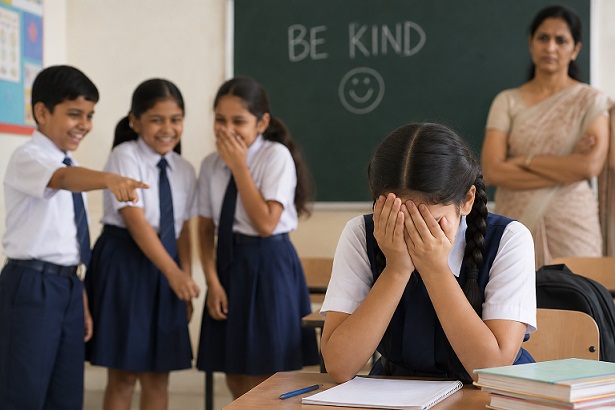
Too often, bullying is dealt with through a familiar routine: identify the child who bullied someone, punish them, speak to the child who was targeted and move on. But bullying rarely begins and ends with one incident. It can grow through classroom hierarchies, peer pressure, prejudice, exclusion and a culture in which making fun of another child is treated as harmless fun.
Punishment may be necessary in cases of serious misconduct, but punishment is not the same as prevention. When schools respond only by identifying and disciplining individual children, they may address an incident without addressing the culture that allowed it to happen. Prevention requires children to understand why humiliation, exclusion and cruelty are harmful, while also ensuring that they know where to turn for help and feel safe enough to speak up when something is wrong.
Mental health education should therefore become a regular part of school life. Schools could have a weekly, age-appropriate mental health class where children learn to recognise and express emotions, deal with rejection and academic pressure, ask for help and recognise signs of distress in themselves and their peers. Counselling should not appear only after a tragedy. Students should have access to counsellors and confidential ways of reporting bullying or other forms of distress.
Schools also need to rethink what discipline looks like. A child who has not completed homework needs to be held accountable, but there is a difference between addressing the lapse and shaming the child in front of classmates. Teacher education and professional development should give teachers practical strategies for setting expectations, addressing misconduct and maintaining classroom discipline without undermining a child’s dignity.
Schools must also create opportunities for children to understand how their actions affect others, rather than assuming that empathy will develop automatically. Stories, role play, classroom discussions and cooperative activities can help children recognise the harm caused by exclusion, teasing and public humiliation. Discussions around caste, gender, disability, class and language can further help children identify forms of prejudice that are often normalised in everyday school life.
There is also room for simple practices such as mindfulness. A few minutes of breathing, quiet reflection or guided attention at the beginning of the school day cannot solve the deeper problems children face. But it can give them a small space to pause, regulate their emotions and begin the day with greater awareness. More importantly, it tells children that how they feel matters.
Schools should also encourage what is often described as a scientific temper: the willingness to question assumptions, examine evidence and challenge stereotypes. Children should learn that something does not become acceptable simply because “everyone does it” or because it is presented as a joke or tradition. They should have the confidence to question group behaviour when it becomes cruel.
Anti-ragging rules and punitive policies are necessary, but rules alone cannot eliminate bullying or harmful disciplinary practices. Bullying and humiliation are not simply matters of individual misconduct. They are also shaped by the culture of a school.
A safe school is one where children know that their concerns will be heard and taken seriously. It is a school where teachers can enforce rules without humiliating students, where asking for help does not invite ridicule or shame, and where respect for others is part of everyday school life.
If schools want children to grow into confident, thoughtful and responsible adults, they must begin by making classrooms places where children themselves feel safe, respected and valued.

Richa Pandey is an education researcher and educator currently working with the Ravi J. Matthai Centre for Educational Innovation at IIM Ahmedabad. She holds a PhD in Education from the Tata Institute of Social Sciences (TISS), Mumbai. Her research interests include children’s literature, educational equity, inclusion and learning.