
Last Updated on August 28, 2026 4:23 pm by INDIAN AWAAZ
Companies comply abroad but block reforms at home
By Andalib Akhter & Javed Akhtar
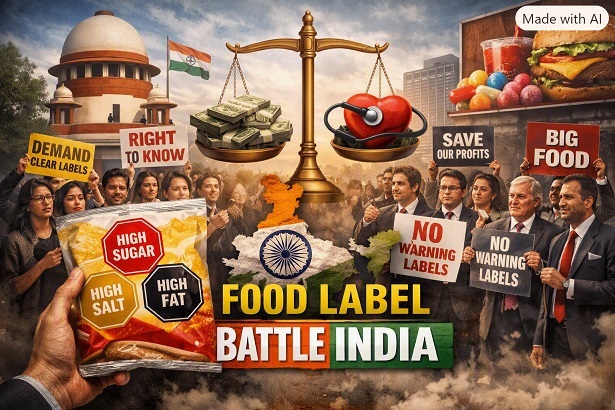
India’s long-running battle over front-of-pack health warnings is entering a sharper phase, pitting public-health advocates against some of the world’s biggest food and beverage companies over how consumers should be alerted to products high in sugar, salt and fat. A Reuters investigation has brought fresh scrutiny to the dispute, revealing how industry resistance helped derail earlier plans for prominent colour-coded warnings even as similar systems are used by some companies in overseas markets. With the Supreme Court examining the issue and obesity and diet-related diseases rising, the fight is increasingly about more than labels—it is about consumer protection, corporate accountability and the future of India’s food policy.
Different products, different labels
One example cited in the Reuters investigation is Fanta. A can sold in London contains about 63 calories, while the Indian version contains considerably more sugar. The Indian product also contains an artificial colour that would require prominent health-related labelling on certain food products in Europe.
In India, however, the presence of the colouring agent is disclosed in relatively small print on the back of the package.
The comparison illustrates a broader issue confronting India’s food-label regime: consumers often have access to ingredient and nutrition information, but they may have to read the fine print and understand technical nutritional terminology to determine whether a product is high in sugar, salt or fat.
Health advocates argue that this puts too much responsibility on consumers and that front-of-pack warning labels would make potentially unhealthy products easier to identify.
The industry takes a different view.
FSSAI changes course
The Food Safety and Standards Authority of India (FSSAI) has been considering front-of-pack nutritional labelling for years. In August, the regulator told the Supreme Court that it had moved away from its earlier proposal for coloured warning labels on the front of packaged foods. Instead, it proposed displaying information on sugar, fat and salt in a black-and-white format.
The regulator argued that a colour-based warning system may not adequately account for the characteristics of Indian cuisine, where stronger flavours and different dietary patterns are common.
The change has triggered concern among public-health campaigners, who have challenged the approach before the Supreme Court.
The dispute comes at a time when the country’s nutritional landscape is changing rapidly. A recent study has estimated that India could have around 450 million people living with overweight or obesity by 2050 if current trends continue.
For health experts, the issue is therefore not merely about packaging design. They see food labelling as a potential preventive-health measure that could influence purchasing decisions and encourage manufacturers to reformulate products.
Around 20 countries have adopted warning systems
India is not the first country to confront the question of how best to communicate nutritional risks to consumers.
Around 20 countries have adopted some form of interpretive front-of-pack labelling, including systems using colours or symbols to make nutritional information easier to understand.
Traffic-light systems, for example, can use red, amber and green indicators to signal high, medium or low levels of nutrients such as sugar, salt and fat.
Supporters say such systems have one major advantage: they communicate information quickly.
A consumer standing in a supermarket does not necessarily have the time—or the nutritional expertise—to compare detailed ingredient lists and calculate whether a product is high in sugar or sodium. A prominent warning or colour-coded symbol can potentially make that decision much easier.
Why the food industry is opposed
The food industry’s objections centre partly on whether front-of-pack warnings would actually alter consumer behaviour.
According to audio recordings of a March meeting reviewed by Reuters, industry representatives argued that prominent warning symbols could confuse consumers and would not necessarily lead to healthier choices.
At the meeting, Milie Bhattacharya, a senior Coca-Cola India executive, reportedly argued that it would be overly simplistic to assume that consumers who do not currently read ingredient lists would suddenly change their diets merely because they saw a symbol or icon on the front of a package.
The industry has also argued that consumers should be encouraged to control portion sizes rather than products being categorised through warning labels.
Another argument advanced by industry representatives is that doctors and healthcare professionals already advise patients about foods that should be limited or avoided.
Public-health advocates reject this reasoning, arguing that consumers should not have to rely on medical advice to understand basic nutritional risks at the point of purchase.
A striking contrast with Europe
One of the most contentious aspects of the debate is that some multinational companies opposing mandatory front-of-pack warnings in India use interpretive nutrition labelling in European markets.
Coca-Cola and its bottling partners voluntarily use traffic-light-style nutrition information across nearly two dozen European markets.
Coca-Cola HBC, based in Switzerland, has said such systems provide consumers with clear and transparent information.
Nestlé presents a similar example. The company is a member of industry associations in India that have previously opposed FSSAI’s proposed labelling framework, while Nestlé has voluntarily used interpretive nutritional labelling in Britain since 2013.
Coca-Cola and Nestlé declined to comment to Reuters on the investigation.
The contrast has fuelled questions from health advocates about whether multinational companies apply different standards depending on the regulatory environment in which they operate.
The profit argument
Behind the technical debate over labels lies a larger commercial question.
If consumers are clearly warned that a product contains high levels of sugar, salt or fat, they may be less inclined to buy it. That could potentially encourage companies to reformulate products, reduce certain ingredients or develop healthier alternatives—but it could also affect sales and profit margins for established products.
Simone Pettigrew, head of food policy at Australia’s George Institute for Global Health, told Reuters that the potential threat to profits gives food companies an incentive to resist such changes for as long as possible.
She argued that lobbying by industry and other interest groups can make it difficult for regulators to introduce stronger public-health standards.
The food industry, meanwhile, maintains that regulation must be based on sound science and should not unfairly stigmatise packaged foods.
The industry’s ‘red label’ concern
India’s packaged food and beverage industry is estimated to be worth more than $100 billion, and industry estimates suggest that a substantial proportion of packaged products could qualify as high in sugar, salt or fat. Deepak Jolly of the India Food and Beverage Association, whose members include companies such as PepsiCo, reportedly argued during the March meeting that a colour-based warning system could result in a proliferation of red warnings across packaged food shelves.
The association has also raised concerns over how the system would treat naturally occurring sugars. For example, it argued that a packaged coconut-water product could potentially attract a “high sugar” warning even when the sugar was naturally present rather than added.
This raises an important technical question for regulators: Should nutritional warnings distinguish between naturally occurring and added sugars, and how should the overall nutritional profile of a product be assessed?
Public-health experts argue that the total nutritional impact of a product matters, while industry groups have called for greater clarity in the proposed rules.
A seven-year regulatory debate
India’s debate over front-of-pack food labelling is not new. Since 2017, regulators have considered different approaches, including prominent coloured warning labels and star-rating systems. Yet manufacturers are currently required primarily to provide ingredient and basic nutritional information on the back of packages.
That means consumers may technically have access to information, but the information is not necessarily presented in a form that allows an immediate comparison between products.
Public-health campaigners have taken the matter to the Supreme Court, arguing that stronger and more transparent warnings are needed.
In February, the court directed regulators to examine the issue and suggested studying Israel’s red-and-green warning system as one possible model.
However, following the March meeting with industry representatives, FSSAI moved away from the earlier interpretive labelling approach. In August, the regulator told the court that aligning India’s packaging requirements with international standards could be difficult.
The Supreme Court expressed strong concern over the government’s position, stressing the importance of demonstrating that India was serious about protecting the overall health of its citizens.
The court’s intervention has effectively kept the issue alive, ensuring that the debate over front-of-pack warnings remains under judicial and public scrutiny.
India becomes more health-conscious
The controversy is unfolding against a broader transformation in Indian consumer behaviour. As incomes rise and urban lifestyles change, concerns about obesity, diabetes and other lifestyle-related diseases are becoming more prominent. At the same time, consumers are increasingly exposed to highly processed foods, sugary beverages and ready-to-eat products.
Market research firm Pharmarack has reported a sharp increase in sales of medicines used for weight management, with monthly sales of appetite-suppressing weight-loss drugs rising by about 400% since the beginning of 2025.
Social media has also become an important battleground.
Influencers, nutrition advocates and consumer activists are increasingly examining the ingredients used in packaged foods and comparing Indian products with their counterparts overseas.
Among the most prominent voices is Revanth Himatsingka, a former McKinsey management consultant who has built a following of more than five million across YouTube and Instagram under the name “Food Pharmer”. His campaigns have occasionally resulted in legal disputes with food companies.
The PepsiCo-Sting controversy
In 2023, Himatsingka criticised the sugar and artificial sweetener content of PepsiCo’s Sting energy drink, a caffeinated beverage marketed in India and popular among young consumers.
PepsiCo subsequently obtained an order from a Delhi court requiring removal of the video, arguing that the claims made in it were incorrect and formed part of an attempt to campaign against the product.
The dispute demonstrated how social media has changed the food-policy debate. Consumers are no longer dependent entirely on government agencies, traditional advertising or medical professionals for information about packaged products.
Independent creators can now analyse labels, compare formulations and reach millions of consumers within hours. In July, Indian regulators ordered PepsiCo and other companies to remove the term “energy drink” from certain products within 90 days, adding another layer to the wider debate over how caffeinated beverages are marketed.
Why the same brand can taste different in different countries
Multinational food companies routinely modify products according to local regulations, consumer preferences, availability of ingredients and purchasing power.
The differences are not unique to India. Coca-Cola’s formulation, for example, varies across markets, while products such as KitKat and instant noodles can also have different formulations in different countries.
Former Mondelez executive Parul Sharma told Reuters that cost and consumers’ ability to pay are among the major reasons companies use different formulations in different markets.
But the differences can become controversial when consumers interpret them as evidence of a lower standard for products sold in developing markets.
Himatsingka has compared Fanta and Nestlé’s KitKat sold in India with versions marketed in Europe and Australia.
According to the comparison cited in the report, the cocoa-solids content in a regular KitKat sold in India is around 4.5%, while the milk chocolate used in an Australian version contains at least 22% cocoa.
Similarly, several varieties of Nestlé’s Maggi instant noodles sold in India use palm oil, while some versions sold in Britain use the comparatively more expensive sunflower oil.
An especially striking point is that some Maggi products sold in Britain are manufactured in India but carry prominent front-of-pack red warnings about their high salt content.
For consumers, such comparisons can create the perception that multinational companies follow different nutritional standards for different markets.
Himatsingka has described this as a feeling of being misled.
The larger question: information or protection?
The food-labelling debate ultimately goes beyond whether a package should carry a red, green or black-and-white symbol. It raises a fundamental question about the balance between consumer choice and corporate responsibility.
Food companies argue that consumers should have access to accurate information and be free to make their own choices. Public-health advocates counter that information is meaningful only when it is understandable, visible and available at the moment of purchase.
There is also a potential incentive for manufacturers to reformulate products. If a red warning appears on a product containing excessive sugar, salt or fat, companies may have a commercial reason to reduce those ingredients and avoid the warning.
Evidence from other countries suggests that food-labelling policies can influence both consumer behaviour and product formulation, although the effectiveness of individual systems varies.
India’s challenge is particularly complex because of its enormous population, diverse dietary traditions and rapidly expanding packaged-food market.
A regulatory decision with far-reaching consequences
The Supreme Court’s scrutiny has ensured that India’s front-of-pack labelling debate is far from over.
For policymakers, the challenge is to create a system that is scientifically credible, easy for consumers to understand and difficult for industry to dilute through technical exemptions.
For food companies, the debate raises questions about how much responsibility they should bear for the nutritional profile and marketing of products.
And for consumers, the issue is ultimately much simpler: when they pick up a packet of chips, a bottle of soft drink or a box of processed food, should the most important health information be hidden in small print on the back—or made immediately visible on the front? That question is now at the centre of India’s increasingly consequential battle over food, public health and corporate accountability.