
Last Updated on January 21, 2026 12:47 pm by INDIAN AWAAZ
By Devsagar Singh
Forty-five-year-old Nitin Nabin’s elevation as the BJP’s national president has prompted debate within political circles, particularly following Prime Minister Narendra Modi’s remark that Nabin is now his “boss.” While the statement was made in a lighter vein, the manner of Nabin’s selection has drawn attention.
A legislator from Bihar, Nabin was not widely known beyond his state unit before his appointment, leading some party workers and observers to express surprise at his sudden rise. His elevation, however, is not being questioned on the basis of his electoral record, as he has won Assembly elections five times, demonstrating political experience at the grassroots level.
The discussion instead centres on the broader process adopted by the party leadership in identifying its top leader. Given the BJP’s size, reach and the depth of its senior leadership, questions are being asked about the criteria and considerations that guided the selection.
Supporters argue that the move reflects the party’s emphasis on organisational experience and fresh leadership, while critics see it as an unexpected choice that departs from established norms.
Ever since Modi took over as Prime Minister in 2014, the party’s graph is on ascendency without a visible curve. Its ideological mentor, RSS, steadily lost control of the party which it once controlled with iron hand. No less than the outgoing President J P Nadda once famously stated in a media interview that the BJP no longer needed RSS. True, Modi’s stature dwarfed the RSS and it is his voice alone that counts in the party set up. Nitin Navin is the result.
It is no secret that the Modi-Shah duo had a final say in the selection of candidates to the last two Lok Sabha polls. During election rallies and public meetings, Modi directly asked for votes in his name. Those who won had no qualms in admitting that they became victorious on account of Modi. Indeed, MPs privately admit that they needed to do nothing as Modi would see to it that they win again if they get party ticket in the next election.
The real power rests with the Prime Minister. There is not an iota of doubt that the PM continues to remain popular to the extent that he has become more powerful than the BJP.
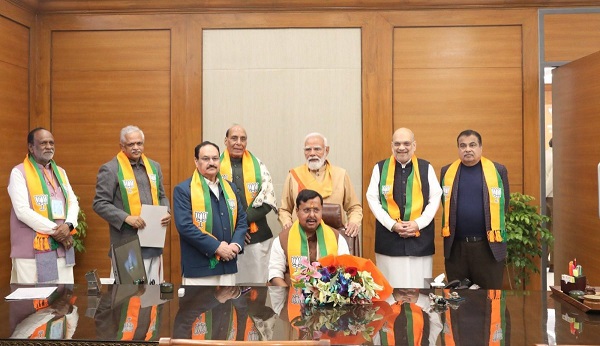
It may not be incorrect to say that Modi is BJP and BJP is Modi much like what a former President of Congress party Dev Kant Baruah used to say during Emergency of 1975 that “Indira (Gandhi) is India and India is Indira”. Modi’s stamp is all over the party, including selection of candidates for Parliament, state legislatures and all key positions which matter. During the official anointment of Nabin as party president at BJP headquarters yesterday, Modi exuberantly said:”When it comes to the party’s matters, the honourable Nitin Nabin ji is my boss and I am a worker.” This happened in the presence of all prominent leaders and ministers, incliuding home minister Amit Shah, defence minister Rajnath Singh, outgoing president and union minister J.P. Nadda and party’s organising secretary and RSS pointsman B.L.Santosh. The signal was clear.
On his part, in his maiden speech, Nabin called Prime Minister Modi an inspiration and urged the youth to heed his call for joining active politics. Sticking to the script, the new chief also emphasized the party’s twin planks of Hindutva and nationalism in his inaugural address.
Some observers have described his election as generational shift and that he embodies the youth in the country who form upto 40 per cent of population. There is little doubt that Modi thinks out of box. It remains to be seen, however, how the new president of the party evolves in the coming days. As expected, he has chosen to raise the issue of “deepam” tradition in Madurai temple indirectly attacking the ruling DMK in Tamil Nadu where assembly elections are due this year.
As the BJP projects itself as a party that does things differently, Nitin Nabin’s appointment is likely to be closely watched, both for its political implications and for what it signals about the party’s future leadership strategy.
Devsagar Singh is a senior journalist and formerly associated with The Indian Express