
Last Updated on September 9, 2026 3:42 pm by INDIAN AWAAZ
Kashmir’s Unani Legacy, Healthcare Needs Make Valley Ideal for AIIMS-Level Institute: Prof. Mushtaq Ahmad
Our Correspondent / Srinagar
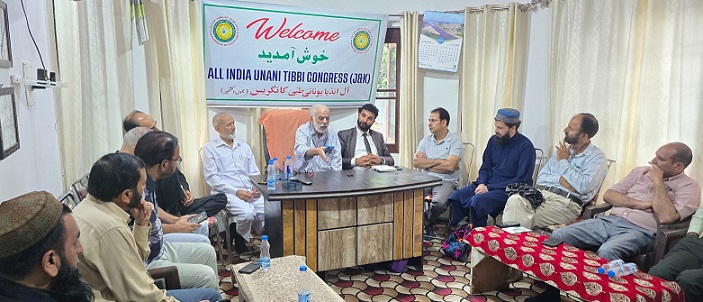
The All India Unani Tibbi Congress (Jammu and Kashmir) has called for the establishment of an All India Institute of Unani Medicine on the lines of AIIMS in Kashmir, saying the region’s historical association with traditional medicine and its growing healthcare needs make it a suitable location for such a premier institution.
The demand was raised at an important meeting of the Jammu and Kashmir unit of the All India Unani Tibbi Congress, held at the organisation’s headquarters at Darulshifa in Sopore on Sept 8. The meeting was chaired by national president Prof. Mushtaq Ahmad and brought together senior office-bearers and members to discuss issues concerning the development of Unani medicine, healthcare delivery, professional opportunities and organisational strengthening in the Union Territory.
The meeting began with the recitation of verses from the Holy Quran by Hakim Mohammad Ashraf Lone.
A major focus of the deliberations was the need to strengthen Unani healthcare infrastructure in Jammu and Kashmir. Prof. Mushtaq Ahmad said the organisation has been consistently pursuing the establishment of a proposed All India Institute of Unani Medicine in Kashmir with the Union Government.
Highlighting Kashmir’s historical significance in the field of medicine, Ahmad said the region had a rich tradition of Unani and indigenous medical practice. He argued that the establishment of a premier Unani institution in Kashmir would not only strengthen healthcare facilities but also promote education, research and specialised treatment in the traditional system of medicine.
He further said the creation of the Union Territory of Jammu and Kashmir had opened up new possibilities for establishing institutions of national importance in the region. The All India Unani Tibbi Congress, he said, would continue to pursue the matter with the government in an effective manner.
The meeting also reviewed several professional and administrative challenges confronting Unani practitioners. Hakim Mohammad Ashraf Lone drew attention to difficulties being faced by NIQs in obtaining registration and pursuing clinical practice. He also discussed issues relating to eligible Registered Medical Practitioners who could not obtain registration after 2019 and the difficulties arising from the closure of the one-time registration avenue.
The participants expressed concern over the employment situation of unemployed BUMS and MD Unani doctors in Jammu and Kashmir. They called for greater opportunities for qualified Unani practitioners and urged the authorities to address vacancies in government institutions.
Particular emphasis was placed on the Government Unani Medical College, Ganderbal. Participants stressed the need for adequate, dedicated and professionally qualified staff at the institution to ensure its effective functioning. It was suggested that academic staff currently serving through internal arrangements should be returned to their respective parent places of posting and that vacant positions at the college should be filled at the earliest.
The meeting also discussed improving patient care through better coordination between different levels of Unani healthcare. The participants proposed establishing a structured referral mechanism linking general practitioners with specialists so that patients can be referred to appropriate doctors and receive more effective and specialised care.
Another important proposal concerned the documentation of Kashmir’s contribution to Unani medicine. Dr Mohammad Yousuf Dainthu suggested that historical medical books and literature should adequately acknowledge physicians and Hakims associated with Kashmir. He also proposed that the All India Unani Tibbi Congress undertake a dedicated initiative to document the lives, contributions and services of Kashmiri Hakims.
Dr Dainthu said such documentation would help preserve the region’s medical heritage and provide future generations with a record of Kashmir’s contribution to the development and practice of traditional medicine.
Dr Shaukat Hussain Aittu, chief patron of the Jammu and Kashmir unit and former Registrar of the Jammu and Kashmir AYUSH Department, appreciated the work being carried out by the state leadership, particularly President Hakim Mohammad Ashraf Lone, General Secretary Dr Mohammad Yousuf Dainthu and their team.
He said the office-bearers had played an important role over the past several years in promoting and developing Unani medicine across Jammu and Kashmir. He also highlighted the need for sustained efforts to address the professional and institutional challenges facing the sector.
The organisation’s national general secretary, Dr Syed Ahmad Khan, also addressed the meeting and elaborated on various organisational matters. He was accorded a traditional welcome with a shawl and bouquet.
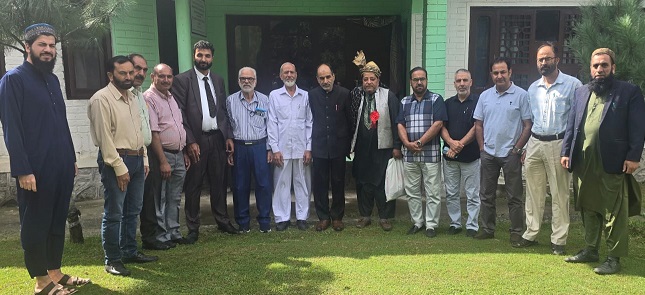
The discussions reflected the organisation’s broader efforts to strengthen Unani medicine in Jammu and Kashmir through better infrastructure, professional development, employment opportunities, academic expansion and preservation of historical knowledge.
The meeting concluded with Dr Shaukat Hussain Aittu expressing gratitude to the national and regional office-bearers, dignitaries and members for their participation. The proceedings were conducted by Dr Mohammad Yousuf Dainthu.
Among those present were Dr Javed Ahmad Ganai, vice-president; Dr Mohammad Ashraf, secretary; Dr Noor Mohammad, organising secretary; Hakim Sanobar Khan, vice-president of the Pharmacy Wing; Hakim Nazir Ahmad Mir, secretary; Hakim Shaukat Ali Peer, secretary; Hakim Mayssar Mohiuddin, office-bearer; Mohammad Hussain Mir, treasurer; Hakim Ashiq Ilahi, adviser; Hakim Rais Ahmad, senior member; and Dr Arsalan Baig, president of the Youth Wing of the All India Unani Tibbi Congress (Jammu and Kashmir), besides other office-bearers and members.