
Last Updated on July 30, 2025 9:47 pm by INDIAN AWAAZ
R. Suryamurthy
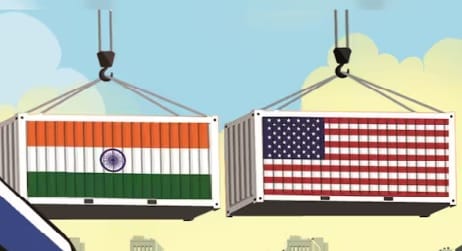
U.S. President Donald Trump has announced a sweeping 25% tariff on a broad range of Indian exports effective August 1, 2025, jolting bilateral ties and deepening geopolitical fissures between the two countries. The move, broadcast via a provocative Truth Social post laced with nationalist rhetoric and an ominous “penalty” clause, has raised alarms in New Delhi and stoked fears of economic fallout.
The Indian Ministry of Commerce issued a cautious statement, acknowledging the development and affirming its commitment to a “fair, balanced and mutually beneficial” trade agreement. “The government will take all steps necessary to secure our national interest,” the statement said, while reiterating the importance of protecting farmers, MSMEs and key domestic sectors.
But officials behind closed doors were less restrained. One senior trade negotiator called the announcement “a shock escalation” that could derail months of delicate dialogue.
Tariffs Cloaked in Strategy
Though framed as retaliation for India’s high tariffs, non-tariff barriers and continued defense and energy engagement with Russia, Indian analysts say the real target is New Delhi’s geopolitical independence. The Trump post, unusually blunt even by his standards, accused India of “obnoxious trade practices” and warned of a penalty “for the above.”
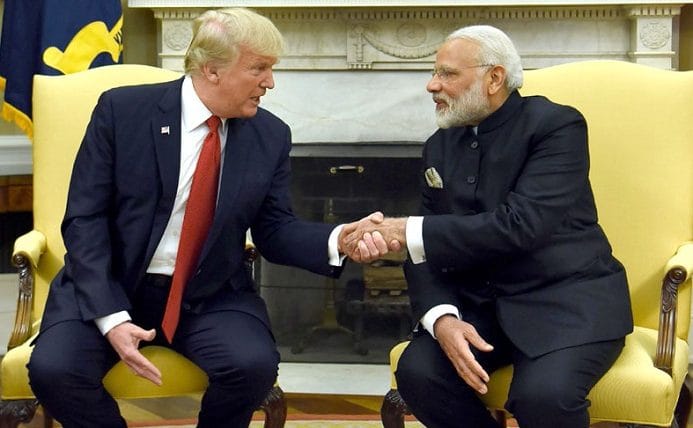
File photo
“This is strategic coercion masquerading as trade enforcement,” said a former Indian commerce secretary. “The penalty clause—vague as it is—crosses into political territory. If tied to Russia, it could violate WTO rules.”
The United States, which posted a $45.7 billion trade deficit with India in 2024, has now placed roughly $87 billion worth of annual Indian merchandise exports under threat. The targeting appears far from arbitrary.
Selective Strike: Sensitive Sectors Hit, Strategic Ones Spared
Trump’s action spares high-tech and health sectors critical to U.S. supply chains—such as pharmaceuticals, semiconductors, and rare earth inputs—but delivers a heavy blow to politically sensitive Indian industries:
Auto Components – Firms like Bharat Forge report cancelled orders.
Electronics & Solar – Clean-tech exporters brace for margin pressure.
Gems & Jewellery – A $9 billion export segment faces a steep downturn.
Marine & Processed Foods – Sectors WTO-compliant but ensnared nonetheless.
“The exclusions make it clear—this is about power, not parity,” said Prof. Biswajit Dhar, a veteran trade economist. “The U.S. is preserving what it needs, while extracting pain where it can.”
“India is being cast in the same light as China and Russia—intentionally or otherwise,” said Pavan Choudary, Chairman of the Medical Technology Association of India. “This is economically shortsighted and strategically misguided.”
Choudary warned that Trump’s rhetoric risks undermining long-standing trust. “Framing a key democratic partner in adversarial terms sends the wrong signal—not just to India, but to other allies watching this unfold.”
Talks Continue, But Confidence Erodes
Despite the turbulence, the sixth round of U.S.-India trade negotiations remains on the calendar for late August. Officials insist the process is not off the rails—yet. But key roadblocks remain:
India’s bans on genetically modified food and dairy imports.
U.S. demands for sweeping tariff eliminations.
India’s insistence on binding safeguards to prevent repeat tariff ambushes—especially on pharmaceuticals.
“The idea of wrapping up a deal by fall 2025 now looks ambitious at best,” a senior Indian official said. “Unless there’s top-level political intervention, we’re looking at 2026.”
Exporters Rattled, Economy Exposed
For Indian exporters, the abrupt tariff spike is more than a diplomatic headache—it’s a business crisis.
“The lack of clarity on the so-called ‘penalty’ makes it impossible to price deals,” said Ajay Sahay, head of the Federation of Indian Export Organisations (FIEO). “This uncertainty has frozen shipments.”
ICRA’s Chief Economist Aditi Nayar estimated the tariff impact could shave up to 0.5 percentage points off India’s FY26 GDP growth, while Goldman Sachs flagged potential volatility in the rupee and bond markets. With Chinese goods flooding European shelves, Indian exporters report softening demand in the EU as well.
“U.S. pressure is pushing India out of one market while China is undercutting it in another,” said a Mumbai-based trade analyst. “This is a squeeze play.”
The Historical Echo
Choudary drew parallels with the infamous Smoot-Hawley Tariff Act of 1930, which deepened the Great Depression and forced the U.S. into decades of tariff liberalization. “History shows protectionism backfires,” he said. “And now it’s being used not against adversaries—but against partners.”
He also hinted that political tensions—such as India’s public denial of Trump’s purported role in the Indo-Pak ceasefire—may have aggravated Washington’s stance. “If straight talk is punished with economic coercion, it raises serious questions about the basis of this partnership.”
Bilateral Ties at an Inflection Point
Trump’s tariff blitz marks the most severe rupture in India-U.S. trade ties since the Generalized System of Preferences (GSP) revocation in 2019. But this time, the implications are broader—blurring lines between trade policy and foreign policy.
Ajay Srivastava, founder of the Global Trade Research Initiative (GTRI), noted that India’s refusal to open sensitive sectors—unlike concessions made by the UK, EU or Japan—was bound to trigger pushback.
“But we must not forget,” he said, “those countries extracted clear gains. India is being told to give ground without any guarantee of relief.”
Prof. Ram Singh of IIFT offered a blunt assessment: “Even a 25% tariff may be preferable to entering a lopsided deal. If this is the price of strategic autonomy, so be it.”
Outlook: High Risk, Fragile Trust
Trump’s latest move has turned trade into a battleground for geopolitical leverage. For India, the challenge now lies in holding its ground without plunging into confrontation.
With U.S. tariffs looming, trade talks fraying, and export confidence shaken, India finds itself navigating a volatile phase in its most consequential bilateral economic relationship. Whether this crisis leads to compromise or collapse may well depend on what happens behind closed doors in the coming weeks—particularly in the corridors of South Block and the West Wing.