
Last Updated on October 1, 2026 9:36 pm by INDIAN AWAAZ
By Our Business Correspondent
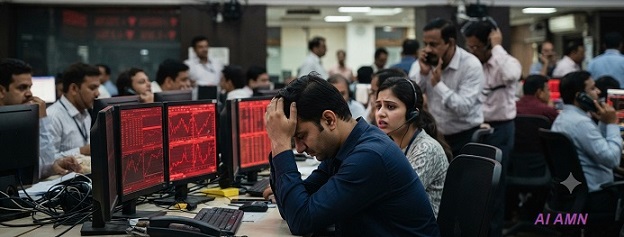
Indian equities extended their losing streak for a fourth consecutive trading session on Thursday, with the benchmark Sensex and Nifty ending sharply lower as persistent foreign institutional investor (FII) selling, elevated global bond yields, a weaker rupee and high crude oil prices continued to weigh on sentiment.
The market remained under pressure throughout the session amid uncertainty over the US-Iran conflict and its potential implications for energy prices and global risk appetite. The Nifty 50 slipped below the 22,450 mark, while broader market indices declined even more sharply, indicating that selling pressure was not confined to large-cap stocks.
The Sensex fell 570.59 points, or 0.79%, to 71,909.70, while the Nifty 50 declined 198.50 points, or 0.88%, to 22,421.95. With Thursday’s decline, the Sensex has lost 2.69% and the Nifty 3.11% over the past four trading sessions.
The weakness was particularly pronounced in auto and metal counters. Among the major Nifty drags, Bajaj Auto fell 7.62%, Mahindra & Mahindra declined 3.05% and Reliance Industries slipped 1.63%. Information technology stocks, however, offered some resilience and bucked the broader negative trend.
Broader market under pressure
The sell-off extended to the broader market, with mid- and small-cap stocks underperforming the frontline indices. The BSE 150 MidCap Index declined 0.99%, while the BSE 250 SmallCap Index dropped 1.23%.
Market breadth remained decisively negative. On the BSE, 1,226 shares advanced, 3,204 declined and 228 remained unchanged. The breadth indicated broad-based selling rather than weakness restricted to a handful of heavyweight stocks.
The Indian equity market will remain closed on Friday, October 2, on account of Mahatma Gandhi Jayanti.
Crude, yields and rupee add to pressure
A combination of external and domestic macroeconomic factors continued to influence investor sentiment.
Brent crude futures for December 2026 delivery rose $2.05, or 2.09%, to $100.08 a barrel, keeping concerns about imported inflation and India’s external balance in focus. Higher crude prices are particularly significant for India because the country remains heavily dependent on imports to meet its oil requirements.
The rise in global bond yields also remained a key concern for equity investors. The US 10-year Treasury yield was quoted at 5.303%, while Japan’s 10-year government bond yield rose 1.51% to 3.097%.
The yield on India’s 10-year benchmark government security increased to 7.206%, from 7.184% in the previous session. Higher bond yields can increase the relative attractiveness of fixed-income assets and raise financing costs, potentially affecting equity valuations.
The rupee also weakened against the US dollar. The partially convertible currency was quoted at 96.2350 per dollar, compared with its previous close of 95.9450. The dollar index gained 0.34% to 101.82.
Gold prices moved higher amid the uncertain global backdrop. MCX Gold futures for October 5, 2026 settlement advanced 0.57% to Rs 1,46,950.
Manufacturing activity rebounds
Despite the weakness in financial markets, India’s manufacturing sector showed signs of renewed momentum in September.
The seasonally adjusted HSBC India Manufacturing PMI rose to 55.1 in September from 52.8 in August, marking the strongest improvement in the sector’s health in seven months.
The September reading pointed to a recovery in growth momentum, supported by faster increases in new orders and output. The improvement in production and demand also contributed to job creation and inventory accumulation.
The manufacturing data provided a relatively positive counterpoint to the weakness in financial markets, although investors remained focused on global risk factors, currency movements and commodity prices.
Global markets remain cautious
European equity markets opened the fourth quarter on a weak footing on Thursday as elevated energy prices, rising government bond yields and uncertainty over stalled US-Iran peace talks reduced risk appetite. Renewed concerns over eurozone inflation also weighed on sentiment after price pressures accelerated unexpectedly in some major economies.
Asian markets, meanwhile, ended mostly higher in holiday-thinned trading. Technology stocks received support following strong results from Micron Technology. Mainland China and Hong Kong markets remained closed for holidays.
Japan’s Nikkei gained after business confidence reached an eight-year high, although the rise in Japanese government bond yields kept investors cautious.
Wall Street had ended mixed in the previous session. The Dow Jones Industrial Average declined 443.87 points, or 0.86%, to 50,906.05, while the S&P 500 fell 19.30 points, or 0.25%, to 7,651.54. The Nasdaq Composite gained 63.52 points, or 0.24%, to 26,861.06.
US markets were influenced by inflation data that showed price pressures rising less than economists had expected in August. The Personal Consumption Expenditures (PCE) price index increased 0.3% month-on-month and 3.4% year-on-year. The annual increase was below the 3.7% expectation cited in the report.
Core PCE inflation rose 3% year-on-year. The softer-than-expected inflation reading reduced expectations of an immediate Federal Reserve rate hike at its October meeting, although elevated Treasury yields continued to limit gains in equities.
Micron outlook supports technology stocks
Technology stocks received support from strong results from Micron Technology. The semiconductor company reported record fiscal fourth-quarter revenue of $54.23 billion and non-GAAP earnings of $33.42 per share.
The company projected adjusted earnings per share of $38.15 at the midpoint for the current quarter, above market expectations. Its shares initially gained in after-hours trading before paring some of the advance.
Investors will now turn their attention to the US nonfarm payrolls report for September, scheduled for Friday, for further indications about the Federal Reserve’s interest-rate trajectory.
New listings
Shares of Moneyview ended at Rs 54.03 on the BSE, representing a 58.91% premium over its issue price of Rs 34. The stock made its debut at Rs 55.61, a premium of 63.56%. During the session, it touched a high of Rs 62 and a low of Rs 50.25. More than 7.51 crore shares changed hands on the BSE.
A-One Steels ended at Rs 417, up 2.96% from its issue price of Rs 405. The stock opened at Rs 462, a premium of 14.07%, and touched a high of Rs 469.45 and a low of Rs 393.45. More than 18.19 lakh shares were traded on the BSE.
Stocks in focus
Sterlite Technologies hit the 5% upper circuit after the company announced that its wholly owned subsidiary had secured a long-term supply agreement from an international hyperscale partner. The company estimated the potential value of the agreement at around $1.2 billion, based on prevailing selling prices of the connectivity products to be supplied.
Kotak Mahindra Bank gained 0.32% after the Reserve Bank of India approved the appointment of Anup Kumar Saha as Managing Director and CEO for three years from January 1, 2027. Saha, who holds a BTech degree from IIT Kharagpur and an MBA from IIM Lucknow, is currently the bank’s whole-time director. He joined Kotak Mahindra Bank in January 2026 and has been overseeing retail banking, data analytics and marketing since March.
Highway Infrastructure advanced 5.26% after securing a Rs 220.66 crore contract from UPEIDA for toll operations on the Gorakhpur Link Expressway. Separately, it received a Letter of Acceptance from NHAI for a Rs 24.46 crore toll operations contract at the Velanchettiyur Fee Plaza in Tamil Nadu.
Surya Roshni edged down 0.17% despite reporting a sharp increase in Steel Pipes & Strips sales volume. Sales volume rose to 2.67 lakh tonnes in Q2 FY27 from 2.18 lakh tonnes in Q2 FY26, representing 23% year-on-year growth.
Steel Strips Wheels declined 4.31%, even as its September 2026 net turnover rose 52.4% year-on-year to Rs 625.81 crore, compared with Rs 410.60 crore in September 2025.
Escorts Kubota slipped 1.48% after its Agri Machinery Business reported a 16.7% decline in tractor sales. Sales fell to 15,214 units in September 2026 from 18,267 units a year earlier.
Mahindra & Mahindra fell 3.05% despite reporting a 15% year-on-year increase in overall auto sales. Total sales stood at 1,14,874 vehicles in September 2026, compared with 1,00,298 vehicles in September 2025.
Hyundai Motor India declined 0.34% even after total monthly sales increased 10.8% to 77,916 units from 70,347 units a year earlier. Domestic sales rose 10.9% to 57,166 units, while exports increased 10.4% to 20,750 units.
IPO activity
The primary market remained active, with two issues witnessing partial subscription on the second day of bidding.
Nityas Gems & Jewellery received bids for 78,88,800 shares against 1,44,56,000 shares on offer as of 4:21 pm, according to stock exchange data. The issue was subscribed 0.55 times. The IPO opened on September 30 and will close on October 5. The price band is Rs 70-75 per share, with a minimum bid of 200 shares and multiples thereafter.
Vishal Nirmiti received bids for 45,70,008 shares against 84,71,153 shares on offer, translating into subscription of 0.54 times. The issue, which opened on September 30 and closes on October 5, has a price band of Rs 208-220 per share. The minimum bid is 68 shares and multiples thereof.
With the domestic market heading into a holiday-shortened period, investors are likely to track crude prices, currency movements, foreign fund flows and US employment data closely. The combination of elevated energy prices, high global yields and geopolitical uncertainty remains central to the near-term market outlook, while domestic manufacturing activity provides a counterpoint through improving economic momentum.
Disclaimer: This article is only for journalistic reporting purposes. It is not investment advice. Readers are advised to consult certified financial professionals before making investment decisions.