
Last Updated on June 11, 2026 5:44 pm by INDIAN AWAAZ
By Our Business Correspondent
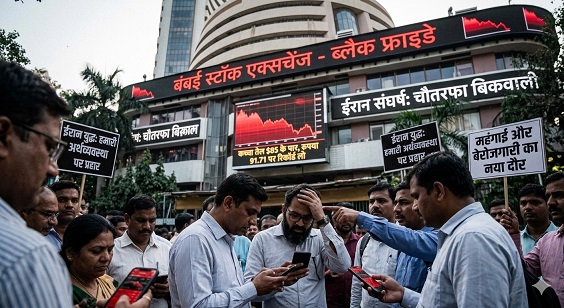
Indian equity benchmarks surrendered early gains and closed lower on Thursday as investors remained cautious amid escalating geopolitical tensions in the Middle East, continued foreign institutional investor (FII) outflows, and concerns over the impact of higher than expected US inflation on global interest rate expectations.
The market witnessed heightened volatility during the session, largely due to the weekly expiry of derivatives contracts. After opening on a positive note and scaling intraday highs, benchmark indices reversed course in the latter half of the session as selling pressure intensified across information technology, chemicals and consumer durable stocks.
The BSE Sensex ended 150.63 points lower at 73,832.55, while the NSE Nifty50 declined 53.35 points to settle at 23,161.60. The Nifty had earlier climbed to an intraday high of 23,327.45 before retreating below the 23,200 level.
Market participants attributed the weakness to a combination of global and domestic factors. Rising tensions between the United States and Iran have increased uncertainty in global financial markets and fuelled concerns about energy supplies and inflationary pressures. At the same time, persistent FII selling has kept investor sentiment subdued despite relatively stable domestic macroeconomic indicators.
Among the major losers on the Nifty were IT bellwether Infosys, which fell 2.25 per cent, followed by Bajaj Finance and Larsen & Toubro, which lost 1.37 per cent and 1.17 per cent, respectively.
The broader market underperformed the benchmark indices, indicating weakness beyond frontline stocks. The BSE MidCap index declined 0.83 per cent, while the SmallCap index fell 0.72 per cent. Market breadth remained firmly negative, with declining shares significantly outnumbering advancing stocks on the BSE.
Sector wise, information technology stocks remained under pressure, extending their recent decline. The Nifty IT index fell 1.62 per cent, marking its seventh consecutive session of losses and taking its cumulative decline during the period to more than 10 per cent.
Major technology stocks witnessed broad based selling. LTIMindtree emerged as the worst performer within the sector, falling 2.59 per cent, followed by Infosys, Oracle Financial Services Software and HCL Technologies. Other leading players including Tata Consultancy Services, Tech Mahindra, Wipro, Mphasis and Coforge also ended in negative territory.
Analysts said concerns over slowing global technology spending and uncertainty surrounding the US economic outlook continued to weigh on investor confidence in export oriented technology companies.
On the macroeconomic front, investors closely tracked developments in the United States after inflation data for May came in higher than anticipated. US consumer inflation accelerated to 4.2 per cent year on year from 3.8 per cent in April, its highest level in more than three years. The rise was largely attributed to a sharp increase in energy prices linked to geopolitical tensions in the Middle East.
The inflation data reinforced expectations that the US Federal Reserve may maintain a restrictive monetary policy stance for longer than previously anticipated. Investors are now awaiting producer price inflation data for further indications regarding the future trajectory of interest rates.
Global markets reflected the cautious mood. Most Asian equities ended lower after a sharp overnight selloff on Wall Street, where all three major US indices registered significant losses. Investor sentiment weakened after US President Donald Trump adopted a tougher stance on Iran and warned of further military action if diplomatic efforts fail.
Geopolitical uncertainty escalated further after Iran announced the closure of the strategically important Strait of Hormuz following fresh US strikes on multiple targets inside the country. The development raised concerns over potential disruptions to global oil supplies and renewed inflationary pressures worldwide.
Despite the weakness in equities, some domestic sectors provided limited support. Pharmaceutical and private banking stocks witnessed selective buying, helping contain broader market losses.
In the commodities market, gold prices eased marginally as investors booked profits after recent gains. Crude oil prices also retreated from elevated levels despite ongoing geopolitical concerns. Meanwhile, the Indian rupee weakened against the US dollar, reflecting risk off sentiment among global investors.
Among individual stocks, MTAR Technologies witnessed sharp selling pressure and plunged nearly 11 per cent. The decline followed reports that US based data centre developer Crusoe had paused work on a major artificial intelligence infrastructure project in Wyoming. Since the project was expected to utilise systems supplied by Bloom Energy, a key customer of MTAR Technologies, investors expressed concerns about potential implications for future order flows.
Automotive component manufacturer PPAP Automotive emerged as one of the biggest gainers, hitting the 20 per cent upper circuit after announcing a technology partnership with global player Hutchinson. The collaboration aims to manufacture advanced body sealing systems for passenger vehicles in India and is expected to strengthen PPAP’s technological capabilities.
Media major Zee Entertainment Enterprises surged over 8 per cent after its board approved plans to raise at least Rs 2,300 crore through various routes to support strategic growth initiatives and business expansion plans.
Technology solutions provider 3i Infotech gained over 4 per cent after securing a purchase order worth Rs 37 crore from Hindustan Petroleum Corporation. Infrastructure player Vascon Engineers also advanced 5 per cent after winning a government contract valued at more than Rs 347 crore from the Central Public Works Department.
Healthcare company Krishna Institute of Medical Sciences remained in focus after announcing a board meeting to consider various fund raising proposals, including equity and convertible securities.
Market experts believe investor sentiment is likely to remain sensitive to global developments in the near term, particularly the evolving US Iran conflict, crude oil price movements and upcoming US economic data. Domestically, market participants will continue to monitor FII flows, corporate earnings expectations and policy developments for fresh directional cues.
With geopolitical uncertainty rising and inflation concerns resurfacing globally, traders are expected to remain cautious despite the resilience shown by the Indian economy and corporate sector.