
Last Updated on November 22, 2025 11:26 pm by INDIAN AWAAZ
Calls for revisiting development parameters
AMN / NEWS DESK
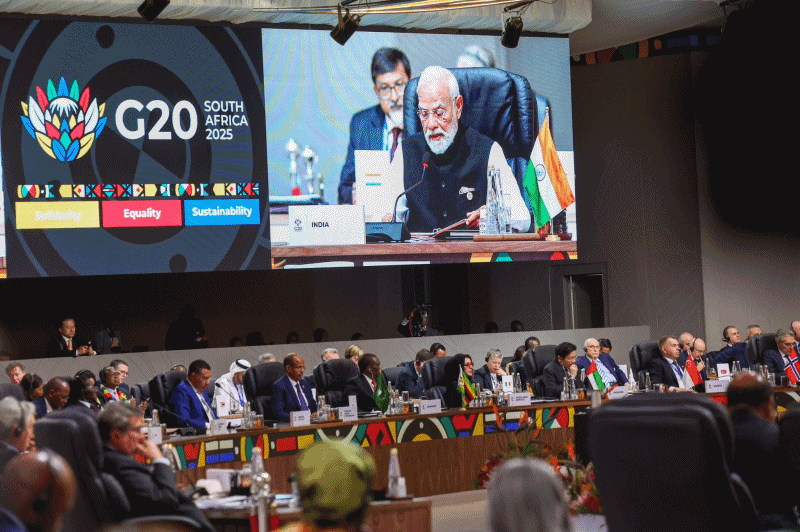
Prime Minister Narendra Modi has called for a profound rethinking of global development parameters. Addressing the first session of the G20 Leaders’ Summit in Johannesburg, South Africa, on Saturday, Mr. Modi noted that while the G20 has long shaped global finance and growth, prevailing models have deprived large populations of resources and driven the over-exploitation of nature, challenges felt acutely in Africa. He also noted that some historic decisions from the New Delhi Summit have been carried forward.
Emphasising that the G20 was meeting on African soil for the first time, he said it was important to reshape the parameters of development to reduce global imbalances and protect the environment. He highlighted India’s civilizational philosophy of Integral Humanism, which focuses on harmony between progress and the planet, and urged member nations to consider its relevance in steering future global development.
He appreciated the South African presidency’s work in skilled migration, tourism, food security, AI, digital economy, innovation and women’s empowerment, and called for greater representation of the Global South in global governance structures.
He highlighted the concept of Integral Humanism, rooted in India’s civilisational wisdom, as a guiding principle to harmonise progress with the planet.
Giving shape to the vision of ‘One Earth, One Family, One Future’, he also presented four key proposals during his remarks.
Mr. Modi proposed for establishing a Global Traditional Knowledge Repository under the G20. Built on the Indian Knowledge Systems, this initiative would served a global platform for traditional knowledge and help preserve humanity collective wisdom for future generations.
The Prime Minister proposed a G20 Africa-Skills Multiplier Initiative, aimed at preparing one million certified trainers in Africa over the next decade and enable large-scale skill development through a train-the-trainers model across multiple sectors-boosting local capacity and long-term development.
He also proposed the creation of a G20 Global Healthcare Response Team, emphasising the need for trained medical experts from G20 countries who can be rapidly deployed during health emergencies and natural disasters. This, he said, would strengthen global health security and emergency response capacities.
In order to address the growing threat of drug trafficking, including dangerous substances such as fentanyl, he suggested launching a G20 Initiative on Countering the Drug-Terror Nexus.
This highlights addressing drug trafficking as a threat to public health, stability and security, while also bringing together financial governance and security tools for effective actions and target a major source of Terror financing.
The Prime Minister further urged member nations to work together to dismantle this destructive economy. This is the first time that G20 Summit is being held in Africa.
India priorities reflected in G20 Leaders Declaration
India managed to echo the key outcomes of the Indian G20 presidency in the G20 South African Summit: Leaders Declaration as well as ensured that the issues and priorities of the Global South are reflected. The key outcomes from India’s point of view are as below
- Terrorism in all its forms and manifestations has also been condemned. [para 6]
- On technology, the transformative potential of digital public infrastructure has been highlighted. Further, the New Delhi commitments to harness the potential of digital and emerging technologies including AI, has been reiterated. Safe, secure, and trustworthy artificial intelligence development, deployment and use has been reaffirmed. [para 45]
- There was a push for strong language on empowerment of women and girls and in this regard, one of the key outcomes of India’s G20 presidency, women-led development has been encouraged. [para 101]
- Strengthening disaster resilience and response is the key priority of the South African presidency. The outcomes of the Disaster Risk Reduction Working group initiated by the Indian presidency have been reinforced in the declaration. Further, Coalition for Disaster Resilient Infrastructure (CDRI) has been recognised in this context. [para 9]
- The Deccan High-level Principles on Food Security and Nutrition has been reinforced in the context of food security. [para 39]
- In health, the role of traditional and complementary medicine has been recognised, echoing the New Delhi Leaders’ declaration. [para 104]
- One of the most significant achievements was on climate finance wherein we managed a more ambitious language than last year. In addition to recognising the need to scale up climate finance from billions to trillions of dollars, the declaration highlights that the needs of developing countries to implement their nationally determined contributions are estimated at USD 5.8–5.9 trillion for the pre-2030 period. [para 94 and 95] The importance of embracing sustainable production and consumption patterns and mainstreaming Lifestyles for Sustainable Development (LiFE) has been recognised.[para 26]
- India also pushed for a call to reform the United Nations Security Council that improves its representation. [para 83]
- In addition, language from the New Delhi Leaders’ declaration finds resonance across the document on various other matters.