
Last Updated on May 12, 2026 11:34 pm by INDIAN AWAAZ
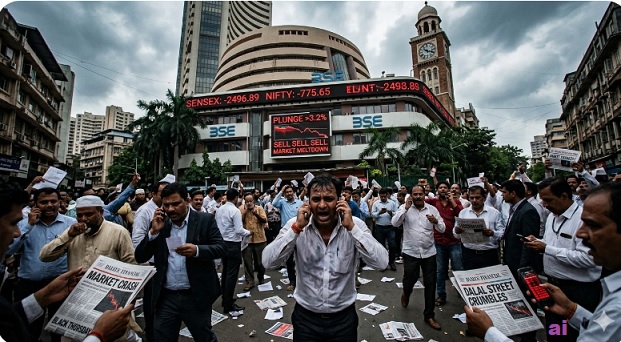
Sensex Crashes 1,456 Points; IT Stocks Sink After OpenAI’s $4-Billion Enterprise Push Raises Competitive Concerns
By Our Business Correspondent
Indian equity markets witnessed another brutal sell-off on Tuesday, with benchmark indices extending losses for a fourth straight session as investors grappled with mounting geopolitical uncertainty, surging crude oil prices, record weakness in the rupee and renewed fears over disruption in the global technology services sector.
The sharp decline reflected growing nervousness across global financial markets after concerns resurfaced over the stability of the fragile ceasefire between the United States and Iran. Rising tensions in West Asia triggered fears of prolonged disruption in global energy supplies, pushing Brent crude above the psychologically important $107-a-barrel mark and intensifying inflationary concerns for import-dependent economies such as India.
Investor sentiment was further dented by sustained foreign institutional outflows and sharp weakness in information technology stocks following the launch of a new enterprise-focused artificial intelligence venture by OpenAI. The company’s announcement of a $4-billion AI deployment initiative sparked concerns that large-scale automation and enterprise AI transformation could disrupt traditional outsourcing and IT consulting business models dominated by Indian technology firms.
The sell-off dragged the benchmark indices sharply lower. The 30-share BSE Sensex plunged 1,456.04 points, or 1.92%, to close at 74,559.24, while the Nifty 50 tumbled 436.30 points, or 1.83%, to settle below the key 23,400 level at 23,379.55.
The latest decline has deepened the ongoing market correction. Over the past four trading sessions, the Sensex has fallen nearly 2.5%, while the Nifty has slipped more than 2.1%, reflecting increasing investor caution amid a volatile global macroeconomic backdrop.
Heavyweight stocks including Reliance Industries, HDFC Bank and ICICI Bank emerged as major drags on the indices, contributing significantly to the day’s losses.
Broader markets witnessed even sharper selling pressure, indicating widespread risk aversion beyond frontline blue-chip stocks. The BSE MidCap index declined 2.56%, while the SmallCap index slumped 2.95%, highlighting aggressive profit-booking across sectors.
Market breadth remained extremely weak, with declining shares vastly outnumbering advancing stocks. On the BSE, more than 3,400 stocks ended lower against fewer than 900 gainers, underlining the broad-based nature of the sell-off.
Volatility indicators also surged. India VIX, often referred to as the market’s “fear gauge,” climbed nearly 4% to 19.28, reflecting heightened uncertainty among traders and institutional investors.
Oil, Currency and Bond Markets Add to Pressure
Currency markets added to investor anxiety as the Indian rupee weakened sharply near the 95-per-dollar level, reflecting persistent demand for the U.S. dollar amid rising oil import costs and capital outflows. A weaker rupee raises concerns over imported inflation, especially as crude prices continue to climb.
Bond yields also edged higher, with the yield on India’s 10-year benchmark government security rising to 7.05%, signalling expectations of tighter financial conditions and inflationary pressures.
In commodity markets, Brent crude futures surged more than 3% to $107.45 a barrel as geopolitical tensions in West Asia fuelled fears of supply disruptions. Rising crude prices are particularly significant for India, which imports the bulk of its energy requirements.
IT Sector Under Severe Pressure
Technology stocks remained at the centre of the market rout after OpenAI unveiled its new OpenAI Deployment Company aimed at enterprise AI integration, workflow automation and digital transformation services.
Investors fear that rapid advancements in generative AI and enterprise automation could accelerate disruption in the global IT outsourcing industry, posing long-term challenges for Indian technology companies that rely heavily on traditional software services and consulting contracts.
The Nifty IT index slumped nearly 4%, making it the worst-performing sector of the day. Major losers included LTIMindtree, Tech Mahindra, HCL Technologies, Infosys and Tata Consultancy Services, all of which recorded steep declines.
Stock-Specific Action
Among individual stocks, One MobiKwik Systems plunged 11% despite reporting a turnaround to quarterly profitability, as investors remained cautious over growth sustainability in the competitive fintech sector.
Paradeep Phosphates gained after reporting revenue growth despite a decline in quarterly profit, while Satin Creditcare Network rallied sharply after posting a more than seven-fold jump in net profit.
On the losing side, Indian Hotels Company, G R Infraprojects, Aurionpro Solutions and Manorama Industries witnessed heavy selling despite reporting mixed quarterly earnings.
Global Uncertainty Continues to Dominate Markets
Global markets remained volatile as investors monitored geopolitical developments and inflation risks. European equities weakened after U.S. President Donald Trump reportedly described the Washington-Tehran ceasefire as being on “massive life support,” raising fears of renewed conflict in the oil-rich region.
Although Wall Street ended marginally higher overnight, supported by gains in select technology shares, analysts believe global markets are entering a phase of elevated volatility due to geopolitical tensions, energy market disruptions and uncertainty surrounding interest rates and inflation.
Market experts warned that unless crude prices stabilise and geopolitical tensions ease, emerging markets such as India could continue to face pressure from foreign fund outflows, currency weakness and rising input costs in the coming weeks.