
Last Updated on August 4, 2025 8:22 pm by INDIAN AWAAZ
R. Suryamurthy
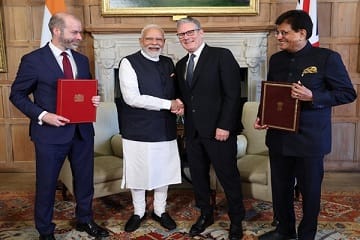
India’s newly signed free trade agreement with the United Kingdom has triggered sharp criticism from civil society groups and trade analysts, who say the deal offers modest export returns while ceding significant ground on regulatory and development policy fronts.
The Comprehensive Economic and Trade Agreement (CETA), signed on July 24, is being promoted by both governments as a major breakthrough in post-Brexit trade diplomacy. But the Forum for Trade Justice, a coalition of more than 100 organisations, says the deal marks an unprecedented erosion of India’s strategic autonomy in areas ranging from health and data to industrial policy.
“The projected export gain is negligible, yet the concessions are sweeping,” the forum said in a statement.
Access to medicines narrowed
The pact’s intellectual property provisions are among the most contentious. The agreement reportedly weakens India’s ability to issue compulsory licences, a key tool for enabling access to affordable generic medicines. Critics argue this undermines India’s longstanding position at the World Trade Organization and dilutes its leverage under the TRIPS Agreement.
The new rules also reduce transparency by limiting disclosure on patent working and promoting harmonisation with developed-country patent systems. Public health advocates warn this could lead to ‘evergreening’—an extension of patent monopolies—on critical drugs.
Digital sovereignty compromised
The digital chapter marks a significant shift in India’s policy stance. For the first time, India has agreed to forgo its right to demand source code disclosures from foreign tech firms—a key mechanism for security auditing and AI regulation.
The agreement also allows open commercial access to government-held data, with restrictions on how India can regulate its use. Analysts warn this could erode India’s data sovereignty and expose national datasets to unregulated international exploitation.
“This is not just a digital trade concession—it’s a surrender of policy tools in a critical frontier sector,” said Parminder Jeet Singh, an independent researcher on digital policy.
Public procurement liberalised
In a major policy departure, the Indian government has opened up its central procurement market to UK bidders, offering national treatment even in areas covered by the “Make in India” initiative. Observers say this will dilute domestic industry protections and weaken employment-linked policy tools, particularly for MSMEs and rural enterprises.
By contrast, UK’s own procurement from foreign suppliers remains limited, raising questions over the reciprocal value of the arrangement.
Industrial sectors exposed
The auto and whisky sectors—both key contributors to employment and exports—face steep tariff cuts. Import duties on UK vehicles will drop from 110% to 30% in the initial years and fall further over 15 years. Tariffs on whisky will fall from 150% to 40% over a decade.
Industry groups warn these reductions could hurt job creation and long-term industrial growth. Meanwhile, the agreement’s promised gains in agricultural and industrial exports may not materialise due to unresolved non-tariff barriers, including the UK’s GI regime and its carbon border tax.
Asymmetry in projected benefits
According to the UK government’s own estimates, India is expected to gain £3.7 billion in annual exports by 2040—about 0.44% of its current annual exports—while the UK stands to gain nearly 1.5 times more. Critics argue the asymmetry in projected outcomes underscores the lopsided nature of the agreement.
“India has locked in policy liberalisation now, but the economic benefits are speculative and back-loaded,” said one Delhi-based trade expert.
Future FTAs at risk
Analysts also warn that India’s concessions in CETA could weaken its negotiating stance in future trade deals, particularly with the EU and the United States. Provisions on source code, data access, and procurement could now be treated as precedents by other developed partners demanding equal treatment.
The inclusion of labour, environment, and gender clauses—aligned with developed country templates—also introduces external oversight over India’s domestic regulatory framework.
Transparency concerns persist
The negotiation process has faced criticism for its lack of transparency and limited stakeholder consultation. While the UK Parliament is set to review the deal under its CRaG Act, there is no corresponding mechanism in India.
Civil society groups have called for parliamentary debate and a reassessment of the deal before implementation.