
Last Updated on December 9, 2025 11:56 pm by INDIAN AWAAZ
Treasury Benches Defend EC; Call Accusations Politically Motivated
ANDALIB AKHTER
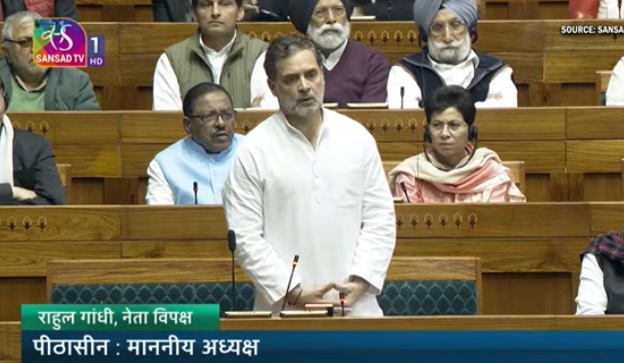
Rahul Gandhi Leads Fierce Opposition Charge as Lok Sabha Debate on Electoral Reforms Sparks Political Firestorm on Tuesday. The debate escalated into one of the most politically charged confrontations of the session, with Leader of Opposition Rahul Gandhi accusing the Union government and the Election Commission of undermining India’s democratic foundations. What began as a routine parliamentary debate soon widened into a deeper clash over institutional credibility, the legality of the Special Intensive Revision (SIR) of electoral rolls, and the future of electoral transparency.
Gandhi’s intervention—delivered in characteristic directness and wrapped in symbolism—became the defining moment of the debate, drawing sharp counterattacks from the treasury benches and intensifying the already polarised political atmosphere.
Rahul Gandhi Accuses Government of “Capturing” Institutions
Setting the tone early in the discussion, Rahul Gandhi launched a sweeping critique of the BJP-led Union government, alleging that India’s autonomous institutions were being systematically brought under political influence. Wearing khadi in what was widely read as a nod to grassroots democratic values, Gandhi asserted that India’s democracy “derives its moral force from its people,” and warned that no government has the authority to manipulate the mandate of citizens.
He extended his attack beyond the government, accusing the RSS of exerting unchecked influence across key sectors including education and investigative agencies. “The Election Commission of India is also captured,” Gandhi said, arguing that the poll body was being used as a political instrument. “The government is using the EC to destroy democracy,” he declared, framing the debate as a battle for institutional integrity.
Gandhi’s remarks triggered an uproar from BJP MPs but also solidified a unified stance among Opposition parties, who rallied around concerns about voter roll deletions, electoral transparency, and the independence of the Election Commission.
Opposition Flags Voter Deletions and Duplicate Entries
A major flashpoint in Gandhi’s speech was the ongoing Special Intensive Revision of electoral rolls, which Opposition parties claim is being carried out without clear legal justification. Gandhi cited the case of Bihar, claiming that 1.2 lakh duplicate photos had been found in voter lists, raising serious questions about the integrity of the process.
He demanded reforms that would ensure fairness, including machine-readable voter lists accessible to all political parties at least a month before polling. Gandhi also criticised provisions that allow the destruction of CCTV footage from polling stations, arguing that such opacity weakens public trust.
Earlier, Congress MP Manish Tewari had initiated the debate by questioning the EC’s rationale for conducting SIRs across multiple states. Tewari insisted that either VVPAT slips should be fully counted or the country should revert to paper ballots—a suggestion echoed by several Opposition leaders through the day.
BJP Hits Back: “Opposition Has a Problem Only After Losing Elections”
The BJP responded aggressively to Gandhi’s allegations. Law and Justice Minister Arjun Ram Meghwal defended the SIR, pointing out that similar exercises were conducted repeatedly during Congress rule without dispute. He praised India’s electoral system as a model of equality, noting that universal adult franchise has been a cornerstone since Independence.
Meghwal highlighted reforms introduced by the Modi government, including the Nari Shakti Vandan Adhiniyam, which reserves one-third of seats for women, calling elections a “festival of democracy” carried out in accordance with the principles laid down by B.R. Ambedkar.
BJP MP Nishikant Dubey went a step further, accusing the Opposition of benefiting politically from “infiltrator votes,” and alleging that Congress had historically influenced the appointment of Chief Election Commissioners for partisan gain. He dismissed concerns over SIR as “politics of fear” aimed at masking recent electoral setbacks.
Other BJP members, including PP Chaudhary and Sanjay Jaiswal, reiterated that the Opposition’s objections to EVMs surfaced only after election losses. They cited the party’s own electoral victories during the UPA era, when EVMs were never questioned.
Opposition Seeks Overhaul of Electoral Process
Several Opposition MPs supported Gandhi’s call for institutional reform. Samajwadi Party leader Akhilesh Yadav argued that the Election Commission must function impartially, suggesting India should return to ballot papers, following examples of countries like Germany and the United States. Trinamool Congress MP Kalyan Banerjee criticised the pressure placed on Booth Level Officers during SIR, claiming many had lost their lives due to the workload.
Shiv Sena (UBT) MP Anil Desai and CPI(M)’s Amra Ram also demanded stronger checks, including corporate funding restrictions, independent verification of VVPAT slips, and government financing of political parties to prevent undue influence.
RJD’s Abhay Kumar Sinha raised concerns about electoral practices in Bihar, demanding transparent verification of voting data. NCP (SCP) leader Supriya Sule highlighted the nexus of violence and corruption that often surrounds elections, calling for structural reforms.
Treasury Benches Defend EC; Call Accusations Politically Motivated
Countering the Opposition narrative, JD(U) leader Rajiv Ranjan Singh defended the EC’s conduct, saying India’s electoral process is globally recognised for impartiality. He mocked the Opposition for questioning EVMs only post-defeat. TDP’s Lavu Shri Krishna Devarayalu called for a unified electoral roll for national, state, and local elections—a proposal echoed by several ruling MPs.
Shiv Sena’s Shrikant Shinde positioned India as the “mother of democracy,” arguing that its transparent elections were a testament to institutional resilience.
Debate to Continue as Speaker Adjourns House
With several members still waiting to participate, the Lok Sabha Speaker adjourned the House, stating that remaining MPs would be given an opportunity to speak on Wednesday.
Yet, even as the debate pauses, one thing is clear: Rahul Gandhi’s sharp offensive has placed electoral integrity at the center of national political discourse, setting the stage for an intense continuation of the debate over the future of India’s democratic framework.