
Last Updated on August 24, 2025 12:09 am by INDIAN AWAAZ
By Andalib Akhter / New Delhi
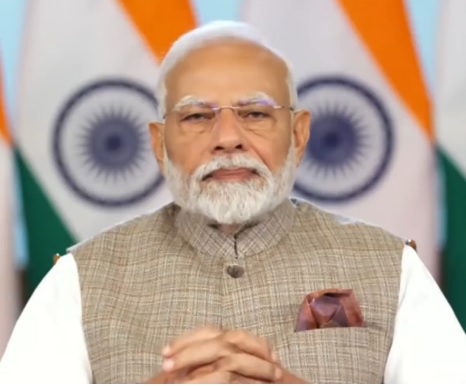
At a time when the global economy is grappling with sluggish growth, trade disruptions, and inflationary pressures, India is projecting confidence in its economic trajectory. Speaking at the Economic Times World Leaders Forum in New Delhi, Prime Minister Mr. Narendra Modi underscored that India’s fundamentals remain strong and the country is poised not just to sustain growth but to emerge as a major driver of the global economy.
Mr. Modi pointed out that India is currently the fastest-growing major economy and is on course to soon become the world’s third-largest economy, contributing nearly 20 percent of global growth in the near future. He attributed this resilience to a decade of macroeconomic stability—citing declining fiscal deficit, robust foreign exchange reserves, stronger banks, and record participation by domestic investors in capital markets. Inflation and interest rates, he added, remain at manageable levels, further strengthening India’s growth outlook.
The Prime Minister highlighted that 22 lakh formal jobs were created in June 2025 alone, the highest ever in a single month, while key sectors are witnessing transformative growth. Delhi Airport has joined the elite Hundred-Million-Plus Club of global airports, and India’s solar PV module manufacturing capacity has risen from just 2.5 GW in 2014 to an impressive 100 GW in 2025.
Pointing to renewed global faith in India, Mr. Modi welcomed the recent decision by S&P Global Ratings to upgrade India’s credit rating after nearly two decades. “India, through its resilience and strength, continues to be a source of global confidence,” he remarked.
Reflecting on past policy failures, the Prime Minister said that India had long “missed the bus” in critical areas such as semiconductors and advanced telecom technology. However, he underlined that since 2014, the approach has shifted to ensuring India is not just a participant but a leader. He cited the indigenous 5G stack as an example, developed and deployed at record pace, while work on Made-in-India 6G is already underway. The first domestically manufactured semiconductor chip, he announced, will hit the market by the end of this year.
Turning to the space sector, Mr. Modi emphasized reforms that opened the domain to private players, boosting innovation and investment. India, which conducted only 42 missions between 1979 and 2014, has launched more than 60 in the past eleven years. With over 300 space start-ups, a ₹1,000 crore venture capital fund, and new capabilities such as space docking, India is preparing to establish its own space station.
The Prime Minister also drew attention to sweeping legislative reforms, including Jan Vishwas 2.0 which decriminalized over 300 minor offences, and a landmark simplification of Income Tax laws to make them citizen-friendly. Historic changes in shipping and mining laws have been introduced to unlock India’s blue economy. He also promised that by Diwali, the GST system will be simplified, lowering prices and easing compliance.
Exports have emerged as another strong pillar of India’s economy. Mr. Modi said that last year, India exported ₹4 lakh crore worth of agricultural products, doubled automobile exports to ₹1.2 lakh crore, and scaled up electronics exports to ₹3.25 lakh crore compared to just ₹35,000 crore in 2014. India is also gearing up to export electric vehicles to 100 countries.
Reiterating that research and innovation are central to India’s aspirations, he noted that R&D spending has more than doubled since 2014, patent filings have increased 17 times, and schemes worth over ₹1.5 lakh crore have been approved to support private-sector innovation.
“India is not aiming for incremental change but quantum leaps,” Mr. Modi declared, emphasizing that reforms today are not reactive but proactive. He stressed that India’s march toward becoming a developed nation by 2047 rests on Atmanirbhar Bharat, measured through speed, scale, and scope.
Concluding his address, the Prime Minister said: “India is no longer a country that misses opportunities. Today, India has the strength not only to seize them but to shape the future course of the global economy.”