
Last Updated on August 27, 2026 12:02 pm by INDIAN AWAAZ
Andalib Akhter
Eighty years after Independence, India continues to grapple with the shameful persistence of manual scavenging, untouchability, slavery, and patriarchy. Despite constitutional guarantees of equality and dignity, thousands of Dalit women remain trapped in degrading occupations, forced to clean dry latrines and handle human excreta with bare hands.
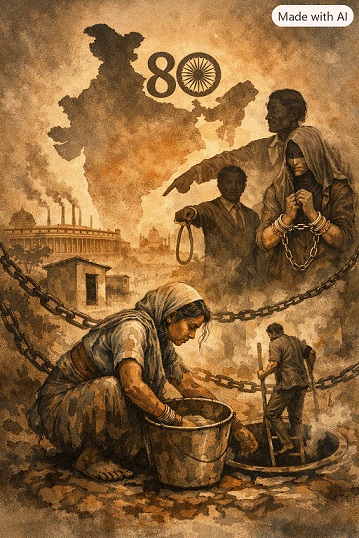
Manual scavenging is not an isolated practice. It is deeply intertwined with caste hierarchies, gender oppression, and systemic denial of rights. The persistence of this inhuman work reflects how caste and patriarchy continue to dictate who cleans, who suffers, and who remains invisible in India’s social order.
A Long Legislative Journey
For nearly half a century after 1947, dry latrines remained part of India’s sanitation system. Local bodies and households routinely employed Dalit women and children to manually remove human waste — a direct violation of the Constitution’s promise of dignity.
It was only in 1993 that India enacted its first law against manual scavenging, prohibiting the construction of dry latrines and employment of scavengers. Yet enforcement remained weak. Two decades later, the Prohibition of Employment as Manual Scavengers and their Rehabilitation Act, 2013 sought to strengthen protections and provide rehabilitation. Still, deaths in sewers and septic tanks, along with the continued existence of dry latrines, expose the gap between law and lived reality.
The Denial of Reality
In 2024–25, a nationwide survey claimed that no manual scavengers existed in any district of India. Yet, ground reports tell a different story. Dalit women in Uttar Pradesh, Madhya Pradesh, Bihar, and Jammu & Kashmir continue to be forced into this degrading work. Their existence is denied by the State, rendering them invisible in official records, even as they risk their health and dignity daily.
These women are not passive victims. They are leading the democratic fight against caste oppression, demanding recognition, justice, and freedom. Their struggle reminds us that India cannot claim true independence while its most marginalized citizens remain shackled.
The Fight Ahead
India at 80 must confront a hard truth: freedom is incomplete while caste decides who cleans our waste. No citizen should be born into an occupation, forced to clean another’s excreta, or sent into a sewer to die. Ending manual scavenging is not the responsibility of the affected community alone — it is a collective fight for justice, equality, and humanity.
As a year-long campaign begins to free India from this shame, solidarity is essential. Citizens, activists, and institutions must unite to dismantle caste-based slavery and patriarchal oppression. The vision is clear: an India where dignity is universal, where sanitation does not mean exploitation, and where freedom is not selective but absolute.
On 1 September 2026, at the Press Club of India, New Delhi, voices will rise to demand: End Manual Scavenging. End Untouchability. End Slavery. Smash Patriarchy.
This is not just the fight of Dalit women. It is the fight of every Indian who believes in equality. To stand aside is to accept injustice; to stand together is to reclaim freedom.