
Last Updated on December 31, 2025 10:31 pm by INDIAN AWAAZ
Zakir Hossain from Dhaka
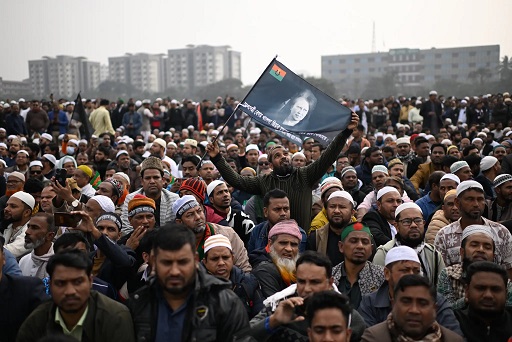
Bangladesh on Wednesday witnessed an unprecedented outpouring of grief as millions of people from across the country gathered in Dhaka to bid farewell to former prime minister and BNP chairperson Begum Khaleda Zia, a towering figure of the country’s democratic movement. The three-time prime minister was laid to rest with full state honours beside her late husband, martyred president Ziaur Rahman (Bir Uttam), at Zia Udyan in the Sher-e-Bangla Nagar area of the capital.
The burial took place around 4.30–4.40 pm after her body was lowered into the grave by family members, including her elder son and BNP acting chairman Tarique Rahman. Following the burial, a smartly turned-out contingent drawn from the Bangladesh Army, Navy and Air Force rendered a state salute with three gunshots as the bugle played the Last Post. Floral wreaths were placed at the grave on behalf of President Mohammed Shahabuddin and Chief Adviser Muhammad Yunus, followed by tributes from Tarique Rahman and the chiefs of the three services. Special prayers were then offered for the eternal peace of the departed soul.
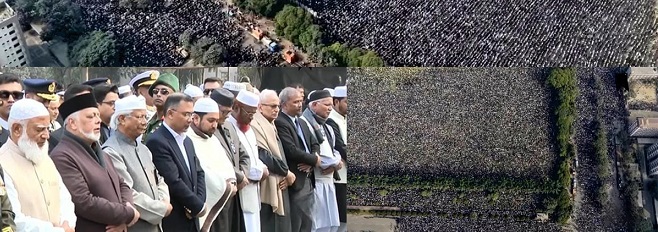
Earlier in the day, millions of mourners joined the funeral (Namaz-e-Janazah) of Khaleda Zia, held at Manik Mia Avenue adjacent to the National Parliament at 3 pm. The funeral prayers were conducted by Baitul Mukarram National Mosque khatib Mufti Mohammad Abdul Malek, while BNP standing committee member Nazrul Islam Khan read out a brief biography of the former prime minister.
Chief Adviser Muhammad Yunus, Chief Justice Zubayer Rahman Chowdhury, Tarique Rahman, senior advisers of the interim government, BNP secretary general Mirza Fakhrul Islam Alamgir, standing committee members, leaders of various political parties, and senior civil and military officials attended the prayers alongside foreign dignitaries. Many mourners broke down in tears as they offered prayers seeking forgiveness for a leader they described as uncompromising and resilient.
From Tuesday night, roads leading to Manik Mia Avenue were choked with people travelling from “every hook and corner” of the country by buses, trains, launches and metro rail. Scenes of deep sorrow unfolded as thousands wept openly, turning the area around the national parliament into a sea of humanity.
Diplomats from 32 countries attended the janaza, including US Chargé d’Affaires Megan Boldin, British High Commissioner Sarah Cooke, Chinese Ambassador Yao Wen, EU Ambassador Michael Miller, Russia’s Chargé d’Affaires Ekaterina Semenova, Japanese Ambassador Saida Shinichi, Canadian High Commissioner Ajit Singh, Australian High Commissioner Susan Ryle and Swiss Ambassador Reto Siegfried Renggli. Envoys from the Netherlands, Libya, the Philippines, Singapore, Palestine, South Korea, Myanmar, Italy, Sweden, Spain, Indonesia, Norway, Brazil, Morocco, Iran, Algeria, Brunei, Thailand, Qatar, Denmark and Malaysia were also present. BIMSTEC secretary general Indra Mani Pandey and World Food Programme acting country representative Simone Lawson Parchment joined the prayers.
India was represented by external affairs minister S Jaishankar, marking the most senior Indian visit since the overthrow of former prime minister Sheikh Hasina, Khaleda Zia’s long-time political rival. Senior officials from Pakistan, including National Assembly Speaker Sardar Ayaz Sadiq, also attended.
In a televised address, Chief Adviser Yunus announced three days of state mourning and a one-day general holiday. Khaleda Zia, Bangladesh’s first woman prime minister, died at 6 am on Tuesday at the age of 80 after a prolonged illness while undergoing treatment at a hospital in Dhaka.
In a statement, Tarique Rahman said the country was mourning “the loss of a guiding presence that shaped its democratic aspirations”. He said his mother had “endured repeated arrests, denial of medical care, and relentless persecution”, but added that “her resilience was unbreakable”.
Khaleda Zia’s death comes at a politically sensitive time for Bangladesh, which has been witnessing renewed tensions and protests in recent weeks. Yet on Wednesday, political divisions appeared to blur as the nation united in mourning a leader widely regarded as a central figure in Bangladesh’s turbulent democratic journey.