
Last Updated on November 25, 2025 6:03 pm by INDIAN AWAAZ
“Indian shipyards are vital pillars of our emerging Blue Economy”
By Andalib Akhter
India has called on international partners to harness the vast potential of its rapidly expanding shipbuilding industry and collaborate on developing the next generation of maritime capabilities.
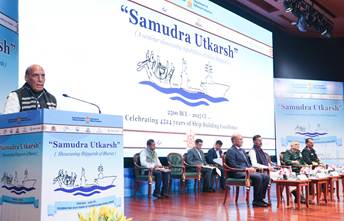
The appeal was made by Defence Minister Rajnath Singh during his keynote address at Samudra Utkarsh, a major seminar organised by the Department of Defence Production in New Delhi on November 25, 2025. The event showcased the technological strength and manufacturing capacities of Indian shipyards to a global audience of industry leaders, defence officials, and foreign delegates.
The Defence Minister emphasised that India is ready to help shape the “maritime century” by “building not only ships, but trust; not only platforms, but partnerships.” He stressed that India’s shipbuilding industry—consisting of dynamic private players and robust Public Sector Undertakings—has evolved into a strategic pillar that protects national interests both in the region and around the world.
Highlighting India’s integrated, end-to-end shipbuilding ecosystem, Mr Rajnath Singh noted that the nation is among the few in the world capable of handling all stages of ship development indigenously—from concept design and modular construction to outfitting, repair, refit, and full life-cycle support. This ecosystem is strengthened by thousands of MSMEs supplying critical components such as propulsion systems, sensors, advanced electronics, and combat technologies.
The Defence Minister underscored that India’s technological maturity is reflected in several world-class naval platforms. These include the country’s first indigenous aircraft carrier INS Vikrant, the Kalvari-class submarines, and a fleet of modern destroyers and stealth frigates. These platforms, he said, are not just symbols of military capability but also proof of India’s growing prowess in automation, digital design, and systems integration.
He added that Indian shipyards are increasingly making their mark in the commercial and dual-use maritime sectors as well. They have developed high-end passenger and cargo vessels, pollution-control ships, coastal ferries, and sophisticated research platforms—including the world’s most advanced deep-sea mining support vessel built for ISRO and the National Institute of Ocean Technology. The private sector, he said, has transformed into a “force multiplier,” manufacturing green-fuel ships, LNG carriers, Ro-Ro vessels, and other high-efficiency commercial vessels for domestic and international clients.
“We are capable of delivering everything—from aircraft carriers to advanced research vessels and energy-efficient commercial ships,” Mr Rajnath Singh said, adding that India is positioned to become a global hub for shipbuilding, repair, and maritime innovation in the coming decade.
He noted that every vessel under construction for the Indian Navy and Coast Guard today is being built in Indian shipyards—an achievement that reflects the success of the Aatmanirbhar Bharat vision of Prime Minister Mr Narendra Modi. Supporting this growth are major policy reforms such as the Maritime India Vision 2030, the Maritime Amrit Kaal Vision 2047, the Defence Production & Export Promotion Policy, and the Defence Procurement Manual 2025.
The Defence Minister revealed that the Indian Navy currently has 262 indigenous design and development projects in advanced stages, with shipyards steadily increasing indigenous content—some expected to reach 100 percent before the decade ends. This will ensure that any naval vessel supplied from India faces minimal supply-chain disruptions.
He also expressed confidence that India’s commercial fleet would soon be entirely built domestically. “Our shipyards now operate with modern fabrication lines, advanced material-handling systems, digital shipyard technologies, automated design tools, and model-testing facilities aligned with global benchmarks,” he said.
Calling Indian shipyards crucial pillars of the nation’s emerging Blue Economy, the Defence Minister highlighted their expanding role in building vessels for marine research, environmental monitoring, fisheries management, and maritime law enforcement across India’s extensive coastline and Exclusive Economic Zone. He pointed to the growing shift toward green and sustainable shipbuilding practices, citing the industry’s adoption of eco-friendly technologies that support climate-resilient maritime growth.
The Defence Minister also recalled India’s recent Humanitarian Assistance & Disaster Relief (HADR) missions, including Operation Samudra Setu during the COVID-19 pandemic, Operation Brahma during the Myanmar earthquake of 2025, and the high-risk medical evacuation conducted this year by INS Vikrant from MV Heilan Star. These missions, he said, exemplify how Indian-built ships protect borders and save lives.
The rising number of foreign vessels coming to India for complex refits, he said, clearly demonstrates India’s capability, reliability, and cost competitiveness. “We aim to become the preferred repair and sustainment hub for the entire Indo-Pacific region,” he asserted.
Reflecting on the seminar’s theme—“2500 BCE – 2025 CE: Celebrating 4,524 Years of Shipbuilding Excellence”—Mr Rajnath Singh said it represented not just industrial growth but a civilisational heritage stretching from the ancient docks of Lothal to modern shipyards in Mumbai, Goa, Visakhapatnam, Kolkata, and Kochi.
Minister of State for Defence Mr Sanjay Seth called Samudra Utkarsh a landmark showcase of India’s capabilities, driven by PM Modi’s vision and the Defence Minister’s leadership. He stressed the need for continuous innovation, skill development, collaboration, and export competitiveness to propel India into the ranks of major shipbuilding nations.
Secretary (Defence Production) Mr Sanjeev Kumar praised shipyards as pillars of India’s industrial strength, saying they have transformed into modern, globally competitive facilities driven by automation, digitalisation, and efficient processes.
During the event, the Defence Minister released a coffee-table book titled Shipyards of Bharat – Infrastructure, Capability, Outreach along with two compendiums—Samudra Navpravartan and a 10-year AI roadmap for Indian shipyards.
The Defence Minister and the Minister of State for Defence also visited exhibitions by shipyards displaying new infrastructure and expansion plans. Sessions on warship and submarine building, autonomous systems, and commercial repair were held. Senior military leadership, including Chief of Defence Staff General Anil Chauhan and Navy Chief Admiral Dinesh K Tripathi, attended the event.
Additional info from PIB