
Last Updated on September 1, 2026 11:25 pm by INDIAN AWAAZ
Andalib Akhter / New Delhi
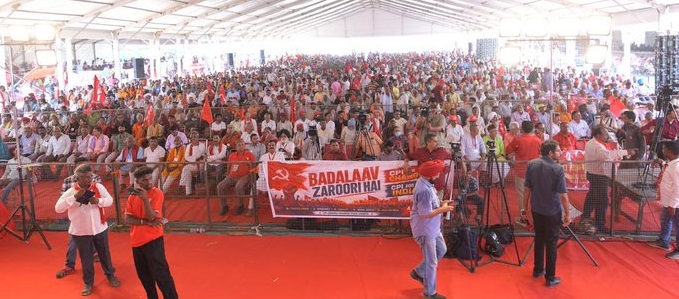
The Communist Party of India CPI’s historic “Badlaav Zaroori Hai” rally at Delhi’s Ramlila Maidan turned into a massive assertion of people’s power, drawing thousands of participants from across the country despite floods and adverse weather. The gathering declared that India’s crisis is not about replacing one government with another but about defending the Constitution, secularism, federalism, and the rights of workers, peasants, Adivasis, Dalits, women, and youth.
The party announced a nationwide intensification of its political campaign, including a three-day Jail Bharo Aandolan on December 1, 2 and 3, with a target of mobilising at least five lakh people to court arrest. The CPI also called for October 2 to be observed as Communal Harmony Day and November 7 as Revolution Day, signalling a broader campaign centred on what it described as the defence of the Constitution, secularism, social justice and democratic rights.
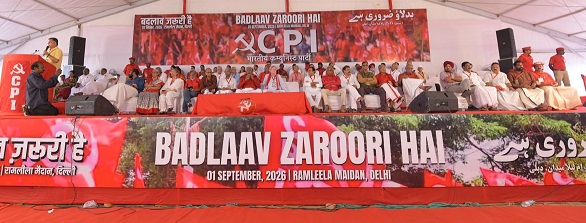
The rally brought together senior CPI leaders, representatives of mass organisations and party leaders from several states. Speakers focused on a wide range of issues, including constitutional institutions, federalism, communalism, unemployment, education, healthcare, workers’ and farmers’ rights, the condition of women, the rights of Dalits and Adivasis and the growing influence of corporate interests.
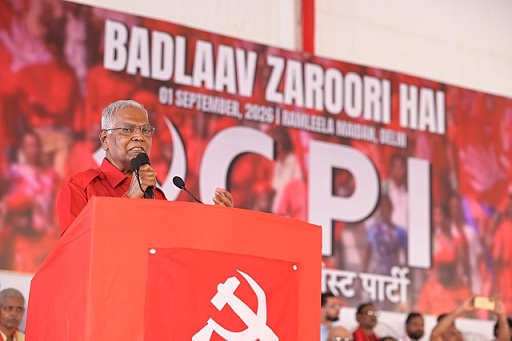
D. Raja: Struggle Is About Constitution and Secular Democracy
In his inaugural address, CPI General Secretary D. Raja saluted the tens of thousands who reached Delhi despite obstacles. He said the repression only proved the people’s determination: “The government and the RSS‑BJP may have tried to stop the mobilisation, but the call for change has become louder than they can imagine.” Raja emphasised that the struggle is about saving the Constitution and defending secular democracy against corporate capture. He urged comrades to return to their states and intensify the movement — reminding them that “the people are the makers of our history.”
Raja argued that attempts to restrict the mobilisation had strengthened rather than weakened the determination of the participants. He said the central issue before the country was the protection of the Constitution, secular democracy and social justice.
According to Raja, citizens could not remain silent while constitutional values were being weakened and public assets were allegedly being transferred into corporate hands. He urged party workers to return to their respective states and intensify the campaign, saying the CPI would continue to work alongside people and their struggles.
“The people are the makers of our history,” Raja told the gathering.
Amarjeet Kaur Targets Modi Government
Senior CPI Secretariat member and AITUC General Secretary Amarjeet Kaur launched a direct political attack on the Modi government, calling for its removal and arguing that the present crisis went beyond the question of one government replacing another.
Kaur said the CPI viewed the political developments since 2014 as part of a deeper ideological project that, in her assessment, was changing the character of the Indian Republic. She criticised what she described as majoritarian politics and attempts to weaken secularism.
Contrasting the history of workers, peasants and supporters of the Left with the politics of the RSS, Kaur warned against what she characterised as an effort to move society towards a social order associated with the Manusmriti. She called for a political transformation aimed at defending the Constitution, challenging capitalism and advancing towards a socialist system.
Economic Inequality, Education and Healthcare
CPI leader Rama Krushna Panda focused on economic and social inequality, particularly disparities in access to education and healthcare.
He argued that India effectively operates two systems—one accessible to the wealthy and another for the poor. Calling for universal and equal access to education and healthcare, Panda also criticised the absence of a legal guarantee for minimum support price, the Labour Codes and proposed changes to the Mines and Minerals (Development and Regulation) Act, which he said could affect Adivasi rights over “jal, jungle, zameen”.
Panda maintained that political change should not be limited to replacing one political leadership with another but should address the structures that, in the CPI’s assessment, generate inequality. He also called for greater unity among Left and democratic forces and reiterated the party’s plan for a major Jail Bharo movement.
Women, Dalits and Adivasi Rights
CPI Secretariat member Annie Raja placed women’s rights and social justice at the centre of her address. She questioned government claims of women’s empowerment while pointing to the low remuneration received by Anganwadi, ASHA and mid-day-meal workers despite their role in delivering essential public services.
Raja also highlighted the rights and identity of Adivasi communities and opposed displacement from forests and land. She demanded an end to caste discrimination and equal rights for Dalits while raising concerns over what she described as attacks on minorities and the misuse of constitutional and parliamentary institutions.
She invoked the constitutional legacy of B.R. Ambedkar and said women would continue to fight for rights guaranteed under the Constitution.
Federalism and States’ Rights
Palla Venkat Reddy, a CPI Secretariat member from Telangana, raised concerns over what he described as the weakening of India’s federal structure.
He argued that the country’s diversity could be protected only through genuine federalism and respect for the constitutional rights of states. Increasing centralisation of political power, he said, posed challenges not only to democratic institutions but also to the economic and political interests of states.
K. Ramakrishna, another CPI National Secretary, criticised the government over democratic rights, economic distress and what he described as unfulfilled promises made in 2014. He called for the unity of secular, democratic and Left forces to counter what he characterised as authoritarianism and divisive politics.
Youth, Jobs and Artificial Intelligence
The rally also placed considerable emphasis on the concerns of young Indians. AISF President Viraaj Devang said commercialisation of education was making quality education increasingly inaccessible to children from working-class and farming families. He argued that young people needed secure education, employment and democratic rights rather than political slogans.
AIYF General Secretary Sukhjinder Mahesari focused on unemployment and the possible impact of artificial intelligence and technological change on jobs. He called for a comprehensive national employment guarantee law providing meaningful and dignified work to young people and argued that employment should be treated as a constitutional and democratic right.
International Issues and Corporate Influence
CPI National Secretary Dr Bhalchandra Kango linked the party’s domestic political campaign to wider international developments. He condemned the continuing violence in Palestine, attacks on Iran and the war in Ukraine and called for an end to wars.
Kango also criticised the growing influence of corporate interests in India, arguing that government policies favoured big business at the expense of ordinary citizens. He called for a broader struggle against authoritarianism, communalism, imperialism and corporate domination.
The rally also adopted a condolence resolution on the victims of the devastating floods in Nepal and Bihar. CPI senior leader Pallab Sengupta expressed solidarity with affected families who had lost lives, homes, livelihoods and livestock.
CPI Lays Out Future Programme
The rally concluded with the CPI announcing a series of programmes designed to carry the “Badlaav Zaroori Hai” campaign beyond Delhi. October 2, Gandhi Jayanti, will be observed by the party as Communal Harmony Day, while November 7 will be marked as Revolution Day.
The most significant announcement was the proposed nationwide Jail Bharo Aandolan on December 1, 2 and 3, with the CPI calling for at least five lakh people to court arrest over its demands concerning political change and people’s rights.
Rally convenor and CPI National Secretary P. Sandosh Kumar said the participation of thousands despite the difficulties faced in reaching Delhi had itself become a political message. He urged participants to take the campaign back to their states, districts and villages.
The CPI said the Ramlila Maidan gathering marked the beginning rather than the conclusion of its campaign. Its stated objective is to build a wider movement around constitutional democracy, secularism, federalism, social justice and the rights of workers, farmers, women, youth, Dalits and Adivasis.
The party ended the rally with its central political slogan: “Badlaav zaroori hai. Badlaav hokar rahega.”