
Last Updated on May 25, 2026 1:32 pm by INDIAN AWAAZ
By Andalib Akhter / Santosh Kumar Pathak
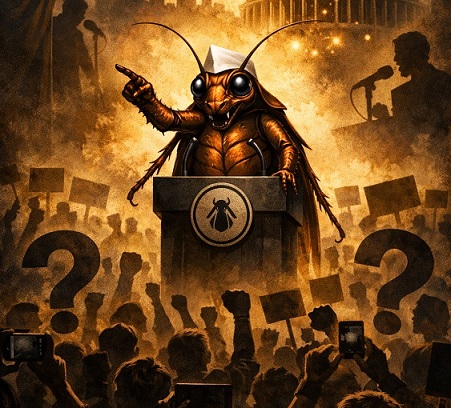
Truth is often stranger than fiction — and modern social media has made that truth even more unpredictable. In a country where political movements are usually built around nationalism, religion, caste, or ideology, a strange new phenomenon has suddenly captured public imagination: thousands of young Indians proudly calling themselves “cockroaches.” What began as an angry reaction to a controversial courtroom remark has rapidly transformed into a viral digital campaign, complete with memes, hashtags, online slogans, and even a so-called political platform named the “Cockroach Janata Party.”
Within days, the campaign exploded across Instagram, X, and YouTube, attracting millions of followers and massive media attention. Supporters claim it represents the frustration of unemployed and ignored youth, while critics suspect it may be a carefully engineered political experiment designed to manipulate public anger. The speed of its rise, the mystery surrounding its founders, and the unusual media amplification have all raised uncomfortable questions: Is this truly a grassroots democratic movement, or is it another sophisticated political narrative crafted for hidden interests? In an era where digital perception often shapes political reality faster than facts themselves, the emergence of the “Cockroach Janata Party” deserves closer scrutiny.
The spark for this digital wildfire was lit on May 15, during a court hearing when Chief Justice of India Justice Suryakant used language and a tone that linked unemployed youth with “cockroaches,” triggering a nationwide storm. Although Justice Suryakant clarified his remarks the very next day, the protests and criticism did not subside.
Seizing on the deep-seated anger of millions of youth frustrated with the government system, an Indian youth named Abhijeet Deepke—originally from Chhatrapati Sambhajinagar in Maharashtra and reportedly operating far from Delhi—channeled this resentment into the creation of the “Cockroach Janata Party” on social media platforms. What followed appeared to be unprecedented in Indian democracy.
Within a remarkably short period, the party’s Instagram account surged toward 23 million followers, nearly two-and-a-half times more than the 9.3 million followers of the ruling Bharatiya Janata Party, which claims to be the world’s largest political organization. However, as the spotlight intensified on Deepke, the momentum was accompanied by turbulence. The party’s X account was allegedly restricted, and claims surfaced that its website had been taken down. As public scrutiny into the party’s origins deepened, Deepke appeared shaken, issuing rapid clarifications and claiming that the official Instagram page had been hacked. Once the account was restored, the controversy deepened further when the party was found to have unfollowed its own controversial founder, Meghnanda.
This rapid sequence of events suggests a complex operation running behind the scenes. The ruling BJP has described the party as a “toolkit” operated by opposition forces from foreign soil, while several senior journalists and intellectuals portray it as a “B-team” designed to split opposition votes. Deepke’s own actions have fueled this skepticism. His selective approach—giving interviews only to journalists perceived as supporters of a particular political camp, and repeatedly following and unfollowing select public figures—suggests a calculated strategy rather than a spontaneous outburst. A digital campaign of this scale requires a sophisticated understanding of both mainstream media and independent YouTube channels, pointing to the likelihood of a larger, well-coordinated team.
This phenomenon highlights a shifting dynamic in Indian political mobilization. While the BJP and the Aam Aadmi Party have mastered the art of creating a political atmosphere through high-voltage campaigns, the Congress Party—the country’s oldest political outfit—appears to have struggled to run and popularize mass movements on a similar scale. Curiously, while prominent independent journalists are giving significant space to the Cockroach Janata Party on their YouTube channels, mainstream television media is offering it even greater coverage, raising questions about why a newly emerging phenomenon is receiving such extensive, cross-platform attention.
The current atmosphere mirrors the Anna Hazare–Arvind Kejriwal anti-corruption movement, where critics were quickly labeled as corrupt or counter-revolutionary. Today, anyone questioning the Cockroach Janata Party faces immediate pushback from a specific ecosystem of commentators and journalists who ask what problem anyone could possibly have with the movement. Yet, as the old saying goes, “Once bitten, twice shy”. The foundational condition of any democracy is the freedom to ask questions, and no organization can place itself above scrutiny without casting doubt on its ultimate intentions.
While the widespread anger among Indian youth regarding unemployment and governance is undeniable, history shows that such public resentment has previously been co-opted by individuals looking to advance their own political fortunes with grand promises that were never fulfilled.
As the Cockroach Janata Party continues to gain traction, the public must approach it with caution. For any movement to bring genuine democratic reform, it must be deeply rooted in authentic domestic grievances rather than digital theater. Before blindly trusting any new political phenomenon, the critical question remains: Which political party or leader stands to gain the most from this new campaign?