
Last Updated on August 13, 2025 3:09 pm by INDIAN AWAAZ
Humaira Jawed /Kolkata
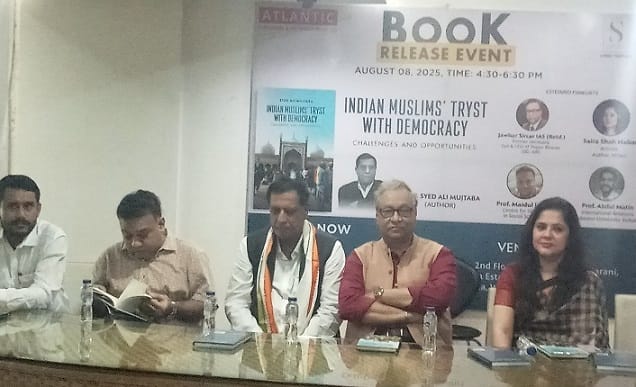
— At the launch of the book Indian Muslims’ Tryst with Democracy: Challenges and Opportunities at ICCR Library, Kolkata, academics and public figures underlined that meaningful improvements in government schools and hospitals could significantly uplift India’s Muslim community, especially its poorest segments.
Professor Abdul Matin of Jadavpur University stressed that socio-economic realities leave many Muslims dependent on failing public services. “We keep saying Muslims lag in education — but how do we fix it? When families earn only ₹8,000–₹10,000 a month, they cannot afford private schools. They rely on government schools, which have deteriorated so much that students rarely move up in life,” he said.
Matin pointed out that this crisis is not limited to rural Bengal but also affects Muslim-majority urban areas such as Metiabruz, Khidirpur, Topsia, Park Circus, and Raja Bazar. Once-active Kolkata Municipal Corporation schools, he noted, have shut down, worsening access. The state’s public education system, weakened by years of political interference, has hit all low-income communities hard — with Muslims among the worst affected.
He also painted a bleak picture of healthcare: “In rural Bengal, people travel overnight and queue from midnight for a doctor’s appointment. We must revive mohalla-level schools and clinics.”
Jawhar Sircar, former Rajya Sabha MP and bureaucrat, urged the community to prioritise education over religious symbolism and to resist being reduced to a political vote bank. He encouraged Muslims to join democratic, secular movements fighting to restore India’s plural ethos. On the caste census, Sircar advised patience, saying its 2026 release could be a “game changer” for the community.
Political activist and CPM leader Saira Shah Halim spoke bluntly about systemic discrimination, citing examples from both Delhi and Kolkata. On housing bias, she noted: “People say Muslims are ghettoised — but do they have a choice?” She also criticised the absence of certain MPs, including secular leaders, during critical parliamentary debates on Muslim concerns such as the CAA and the abrogation of Article 370.
From a historical and political perspective, Prof Maidul Islam of the Centre for Studies in Social Sciences, Calcutta, traced a steady decline in Muslim political representation — in the Lok Sabha since 1980 and in the Bengal Assembly since 2011. He alleged that parties deliberately withhold tickets from Muslim candidates, echoing warnings made decades ago by B.R. Ambedkar. The lack of progressive leadership, he argued, further limits the community’s advancement.
The book itself — Indian Muslims’ Tryst with Democracy — offers a detailed examination of these socio-political dynamics, combining historical insight with policy recommendations. Described by speakers as “a guide for collective action,” it lays out both the challenges and the concrete opportunities available for India’s Muslims to achieve equitable development.
You can order a copy from Atlantic Publishers & Distributors Pvt. Ltd 7/22, Ansari Road, Darya Ganj, New Delhi – 110002. Email- [email protected] – Phone: 011-40775252 Website: www.atlanticbooks.com