
Last Updated on February 13, 2026 1:02 am by INDIAN AWAAZ
Zakir Hossain from Dhaka
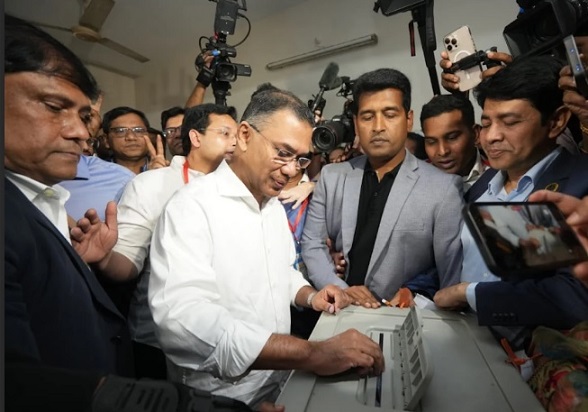
After a prolonged phase of political turbulence, Bangladesh appears to be moving back towards democratic rule through the ballot. The country on Thursday voted in its 13th general election amid a festive atmosphere, with early trends showing the Bangladesh Nationalist Party (BNP) in the lead. This has also revived speculation over whether BNP chairperson Tarique Rahman could emerge as the country’s next Prime Minister.
According to preliminary data from the Election Commission, voter turnout stood at around 60 per cent. Polling was held peacefully from 7.30 am to 4.30 pm across the country. Voting took place in 299 of the 300 parliamentary constituencies, with polling in Sherpur-3 suspended due to the death of a candidate.
Counting began at individual centres immediately after voting ended. At the time of filing this report, trend results showed the BNP leading in 91 seats, while the Jamaat-e-Islami-led alliance was ahead in 38 seats. The Election Commission said these figures could change until the final results are declared.
Many voters described the election atmosphere as being akin to an “Eid celebration”. Chief Adviser of the interim government, Muhammad Yunus, also expressed satisfaction over the conduct of the polls. “This is possibly the most peaceful and festive election in the country’s history. Through this, the journey of a new Bangladesh has begun,” Yunus said.
The election comes in the backdrop of dramatic political developments over the past year. In July 2024, a student-led movement triggered the fall of Sheikh Hasina’s government after 15 consecutive years in power. Hasina subsequently left the country and took refuge in India. An interim government, headed by Nobel laureate economist Muhammad Yunus, was then formed to oversee the transition and conduct the elections.
This election introduced several firsts. Alongside the parliamentary polls, a referendum on political reforms was also held. Postal voting was introduced for the first time, and international observation reached an unprecedented scale, with around 500 foreign observers, including teams from the European Union, present in Dhaka.
The political landscape has also undergone a major shift. Following the imposition of a ban on the Awami League, the contest was largely confined to the BNP-led alliance and the Jamaat-e-Islami-led bloc.
BNP chairman Tarique Rahman has called for the swift declaration of results, warning that delays could create confusion among the public. While the party has described the overall polling as peaceful, there were reports of sporadic clashes in a few areas. On polling day, BNP leader Mohibuzzaman Kochi was killed in an incident that has since drawn attention.
As the country awaits the final results, the central question remains: is Bangladesh’s political wheel finally turning in a new direction after 18 months? The answer, observers say, will become clear in the next few hours.