
Last Updated on November 5, 2026 10:34 pm by INDIAN AWAAZ
From Ghaziabad and Hyderabad to US politics
Andalib Akhter
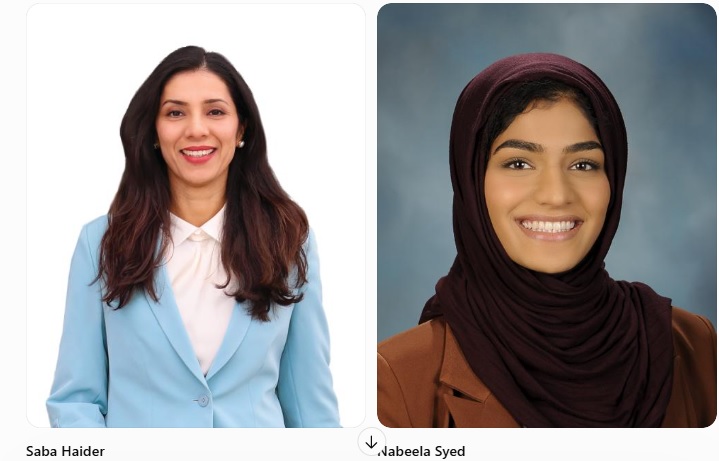
The success of two Indian-origin Muslim women in the November 3 US midterm elections has brought an inspiring story of education, migration, grassroots activism and political representation into focus. Saba Haider and Nabeela Syed have registered significant victories in Illinois, marking an important moment for South Asian and Muslim representation in American politics.
While Haider, an alumna of Aligarh Muslim University (AMU), has become the first South Asian immigrant woman elected to the Illinois General Assembly, 27-year-old Nabeela has won a seat in the Illinois State Senate, emerging as one of the youngest Muslim women to enter the state legislature.
Their victories are particularly significant against the backdrop of continuing debates in the United States over immigration, racial diversity, religious identity and minority representation. Both women have demonstrated how people from immigrant backgrounds are increasingly moving beyond community activism to positions of legislative responsibility.
For India, their achievements carry a special significance. Haider’s journey began in Ghaziabad, Uttar Pradesh, while Nabeela’s family traces its roots to Hyderabad.
Saba Haider: From AMU gold medallist to Illinois legislator
Saba Haider’s victory in Illinois House District 84 represents a remarkable journey from the classrooms of India to the political corridors of the American Midwest.
The Democratic candidate secured approximately 71.8 per cent of the vote, defeating her Republican opponent, retired Navy commander Brian Scopa. Her victory is particularly noteworthy as she becomes the first South Asian immigrant woman elected to the Illinois General Assembly.
For the academic community in India, her achievement has a special connection with Aligarh Muslim University. Haider holds an MSc in Wildlife Sciences from AMU, where she graduated with a gold medal.
Born and raised in Ghaziabad, Haider grew up in a family that placed considerable emphasis on education. Her father, Syed Ali Haider, served as a senior engineer with the Uttar Pradesh Jal Nigam, while her mother was associated with education and managed a private school.
She completed her schooling at Holy Child School in Ghaziabad before pursuing a Bachelor of Science degree from R.G. Girls College, where she also earned a gold medal. She subsequently pursued postgraduate studies in science before moving to the United States around two decades ago with her husband, a software engineer now working with the World Bank.
However, settling in a new country did not mean withdrawing from public life. Haider became involved in community initiatives and local governance in Illinois. Her political journey gathered momentum when she was elected to the DuPage County Board, where she worked on local issues and engaged with residents from diverse backgrounds.
She subsequently secured the Democratic nomination for Illinois House District 84, winning more than 63 per cent of the vote in the March primary. Her decisive performance in the November general election consolidated her position as a significant new face in Illinois politics.
The district includes communities such as Naperville, Aurora, Oswego, Montgomery, Boulder Hill and Plainfield. Her strong mandate across this diverse constituency reflects her ability to build support beyond Indian-origin and immigrant communities.
Her victory prompted celebrations at her ancestral home in Chitragupta Vihar, Ghaziabad. For her family and the people who watched her grow up, the result was a moment of immense pride.
Her journey from a science student in India to an elected legislator in the United States demonstrates how academic achievement, community participation and political commitment can open doors to public leadership.
Nabeela Syed: Hyderabad roots, Senate victory at 27
At just 27, Nabeela Syed has achieved a significant breakthrough in American politics by winning Illinois State Senate District 26. She defeated Republican candidate Darby Hills with approximately 57 per cent of the vote.
Her family roots trace back to Hyderabad. Her parents migrated from India to the United States in the 1980s. She grew up in Palatine, Illinois, and has visited Hyderabad several times during her childhood.
A graduate of the University of California, Berkeley, she holds degrees in Political Science and Business Administration. Before entering elected office, she worked in digital strategy for a non-profit organisation involved in civic engagement and participated in political campaigns.
Her political breakthrough came in 2022, when, at the age of 23, she defeated Republican incumbent Chris Bos to win a seat in the Illinois House of Representatives from District 51. The victory made her the youngest woman elected to the Illinois General Assembly and one of the first Muslim and South Asian women to serve in the state legislature.
She was re-elected in 2024 and subsequently built a profile around healthcare affordability, education, women’s health, prescription drug costs and democratic participation.
Among her legislative initiatives were measures concerning generic medicine prices, access to breast cancer screening, paid leave for organ donors and allowing 16-year-olds to pre-register to vote.
Her religious identity has also been part of her public journey. Nabeela has spoken about discrimination faced by Muslims in the United States and the challenges of being a Muslim woman in public life. She has also taken strong positions on international issues, describing Israel’s war on Gaza as genocide and opposing US support for Israel.
Her election to the Senate marks another important step in her political career and reflects the growing participation of younger Americans from immigrant families in legislative institutions.
A wider significance for Indian-origin communities
The two victories, achieved through different political journeys, reflect a broader transformation in American politics. Indian-origin communities are increasingly moving from participation in civic and electoral processes to contesting elections and securing positions in legislative institutions.
For Muslim women, these achievements carry an additional significance. Their representation comes at a time when questions of religious identity, immigration, racial equality and the place of Muslim communities in American society remain important subjects of political debate.
Haider’s success demonstrates the possibilities for first-generation immigrants who build political careers through community engagement and local governance. Syed’s rise illustrates how younger Americans from immigrant families are using their education, political awareness and grassroots connections to influence public policy.
Both have built their political careers around issues affecting ordinary residents, including healthcare, education, affordability and community welfare. For India, their achievements are also a reminder of the expanding contribution of the Indian diaspora to public life and democratic institutions across the world.