
Last Updated on September 15, 2026 10:47 pm by INDIAN AWAAZ
Our Business Correspondent
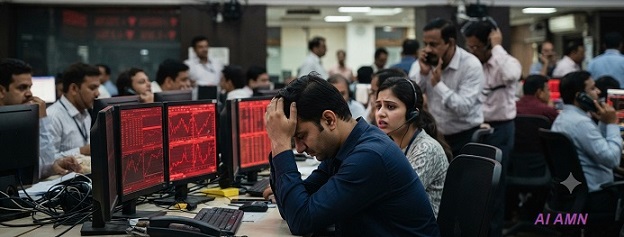
Indian equities came under heavy selling pressure on Tuesday as a combination of surging crude oil prices, rising global bond yields, a weaker rupee and caution ahead of the US Federal Reserve’s policy decision overwhelmed early gains. The sell-off was broad-based, with financials, metals, consumer durables and other rate-sensitive sectors bearing the brunt, while information technology stocks emerged as a notable exception.
The Sensex fell 777.94 points, or 1.04%, to 74,003.82, while the Nifty 50 declined 279.50 points, or 1.19%, to 23,118.60. The Nifty ended at its lowest closing level in five months, slipping below the psychologically important 23,150 mark. The sharp reversal from early gains underscored the market’s heightened sensitivity to global interest rates and energy prices.
The domestic market had opened on a relatively firm note, helped in part by strength in technology stocks. However, gains failed to hold as investors reassessed the implications of oil prices above $100 a barrel, elevated US Treasury yields and the prospect of tighter monetary conditions. A market-close assessment confirmed that crude and bond yields were the dominant drivers of the day’s risk-off move.
Brent crude for November delivery rose $1.57, or 1.49%, to $107.25 a barrel, adding to concerns about imported inflation and corporate costs. The rise in oil prices has become particularly important for India because higher crude prices can widen the import bill, put pressure on the rupee and feed into transportation, manufacturing and consumer prices.
Global rates add to pressure
The other major source of concern was the US bond market. The US 10-year Treasury yield rose to 5.015%, while the Indian 10-year government bond yield increased to 7.086%, from 7.021% in the previous session.
The move in US yields came ahead of the Federal Reserve’s policy announcement scheduled for Wednesday, September 16. The current US federal funds target range is 3.50%-3.75%, following the Fed’s July decision to keep rates unchanged. Markets have been closely assessing whether persistent inflationary pressures, particularly from energy, could encourage the central bank to maintain or tighten its restrictive policy stance.
For equity investors, higher bond yields increase the relative attractiveness of fixed-income assets and raise the discount rate applied to future corporate earnings. This can be particularly negative for expensive growth stocks and highly leveraged businesses.
The rise in Indian bond yields also signals increasing concern about the domestic inflation outlook. A sustained oil shock could complicate the Reserve Bank of India’s monetary policy calculations, especially if higher fuel and transportation costs begin feeding more decisively into core inflation.
Inflation picture worsens
India’s wholesale inflation rate increased to 9.92% in August 2026, from 9.78% in July, driven by higher prices of fuel and power, manufactured products and food. Fuel and power inflation jumped to 22.93%, while inflation in manufactured products rose to a series high of 8.37%. Food inflation based on the wholesale food index increased to 7.05%, from 6.65% in July.
Retail inflation also accelerated to 4.82% in August, from 4.45% in July. While the CPI reading remained within the RBI’s mandated 2%-6% tolerance band, it was above the central bank’s 4% medium-term target. Rural inflation stood higher than urban inflation, adding to concerns about household purchasing power.
The combination of higher wholesale and retail inflation with expensive crude presents a more complicated backdrop for Indian businesses. Manufacturers face higher input costs, while consumers may become more cautious if food, transport and household expenses rise.
Broad-based sell-off
Market breadth reflected the intensity of the decline. On the BSE, 1,190 shares advanced against 3,292 declines, while 221 shares remained unchanged.
The broader market suffered even larger losses than the headline indices. The BSE 150 MidCap index declined 2.17%, while the BSE 250 SmallCap index fell 2.40%. This indicates that investors were reducing risk across market segments rather than simply rotating out of a few large-cap stocks.
The India VIX rose 7.99% to 13.27, pointing to a rise in expectations of near-term volatility.
Among the major Nifty drags, State Bank of India fell 2.78%, ICICI Bank declined 2.10% and Reliance Industries dropped 1.77%. Weakness in banks and energy-linked heavyweights had an outsized impact on the benchmark.
IT stocks buck broader market trend
Information technology stocks bucked the overall market trend, with the Nifty IT index gaining 2.19%.
HCL Technologies rose 3.95%, Infosys gained 3.79%, Mphasis advanced 3.62%, TCS climbed 2.28%, Tech Mahindra rose 2.26%, LTM gained 1.67% and Wipro advanced 1.55%. Oracle Financial Services Software also closed higher.
The strength came as investors reassessed concerns that rapid advances in artificial intelligence could sharply disrupt traditional IT services. Recent comments from technology-industry leaders calling for greater caution around the pace of frontier AI development appeared to ease some of those fears.
However, the move should be viewed in the context of the broader technology debate rather than as evidence that AI-related disruption risks have disappeared. The global technology sector itself remained under pressure amid concerns over AI investment, semiconductor valuations and the sustainability of the current pace of development.
Tata stocks rally on Tata Sons listing prospects
One of the strongest company-specific themes of the session was the rally in Tata Group shares following the Reserve Bank of India’s decision to reject Tata Sons’ application to surrender its Certificate of Registration as a Core Investment Company.
The RBI’s September 11 decision keeps Tata Sons within the regulatory framework applicable to an NBFC-Upper Layer, effectively bringing its potential stock-market listing back into sharp focus. Tata Sons had sought deregistration after repaying substantial debt and becoming debt-free. The company had originally been classified as an upper-layer NBFC in 2022, with the earlier three-year listing deadline expiring in September 2025.
Tata Chemicals surged 20%, while Tata Investment Corporation gained 9.85%. TCS rose 2.28%, while Tata Motors Passenger Vehicles gained 0.83%.
The RBI decision is significant for investors because a potential Tata Sons listing could have implications for the valuation and capital structure of the wider Tata conglomerate. Tata Sons reported total assets of about Rs 2.01 lakh crore as of March 2026, well above the Rs 1 lakh crore threshold relevant under the revised upper-layer framework.
The development is also important for the Shapoorji Pallonji Group, which holds a substantial stake in Tata Sons and has historically favoured a listing.
Company-specific moves
Diamond Power Infrastructure was locked in a 5% upper circuit after announcing a Rs 179.43-crore contract from Adani Electricity Mumbai.
KEC International slipped 0.14% despite announcing new orders worth Rs 1,303 crore across its businesses. Its transmission and distribution division won orders involving a 400-kV transmission line in northern India, 380-kV transmission lines in Saudi Arabia and supply contracts for towers, hardware and poles in the Americas.
Afcons Infrastructure rose 3.59%, adding to the infrastructure theme despite the broader market weakness.
Aurobindo Pharma declined 1.18% after announcing final US FDA approval for Beclomethasone Dipropionate HFA Inhalation Aerosol.
HeidelbergCement India fell 2.87% after announcing a 50-year Mine Development and Production Agreement with the Madhya Pradesh government for the Sukha-Satpara Limestone Block.
Afcom Holdings fell 6.91% after announcing a long-term aviation fuel supply agreement with Hindustan Petroleum Corporation for Jet A-1 fuel.
Jubilant FoodWorks slipped 0.90% following the resignation of Virender Singh Sehrawat, executive vice-president and head of integrated supply chain, from the company’s senior management.
New listing sees sharp intraday swing
Shares of Pranav Constructions made a strong debut on the BSE, opening at Rs 162, a 30.65% premium to the Rs 124 issue price. However, the stock subsequently came under pressure and ended at Rs 129.60, still 4.52% above the issue price.
The stock touched an intraday high of Rs 164.50 and a low of Rs 129.60. Market data confirmed the Rs 124 issue price and the Rs 162 debut.
The Mumbai-focused redevelopment company’s IPO had attracted substantial investor demand. Its business is concentrated largely in redevelopment projects in the Mumbai region.
IPO demand remains strong
Primary-market activity remained robust despite the weakness in secondary equities.
Veegaland Developers received bids for 15,32,74,397 shares against 1,13,07,692 shares on offer, taking subscription to 13.55 times by 5 pm on September 15. The issue, which opened on September 10, closes on Tuesday. Its price band is Rs 130-Rs 140 a share, with a minimum bid of 107 shares.
Manika Plastech received bids for 17,76,05,976 shares against 2,13,86,919 shares on offer, translating into subscription of 8.30 times. The issue opened on September 11 and closes on September 16. Its price band is Rs 40-Rs 43, with a minimum bid of 348 shares.
The strong subscription levels suggest that primary-market appetite remains considerably more resilient than secondary-market sentiment, although investors are likely to become increasingly selective if volatility persists.
Currency and commodities
The rupee weakened to around Rs 95.92 against the US dollar, compared with the previous close of Rs 95.54. The decline came amid elevated crude prices and a stronger dollar.
The US Dollar Index rose 0.12% to 99.60, adding to pressure on emerging-market currencies.
MCX gold futures for October 5 delivery declined 0.56% to Rs 1,50,380, as investors balanced safe-haven demand against higher US yields.
The combination of a weaker rupee and expensive crude remains a key risk for the Indian economy. Higher dollar-denominated energy costs can increase the import bill and potentially worsen inflationary pressures.
Global markets remain fragile
Global equities also remained under pressure. Asian markets fell sharply, while European equities mostly traded lower. US stock futures pointed to a weak opening after Wall Street declined in the previous session.
The Dow Jones Industrial Average fell 0.29% to 52,421.17, the S&P 500 declined 0.48% to 7,619.94, and the Nasdaq Composite slipped 0.56% to 26,186.41.
Selling was particularly visible in semiconductor and AI-linked technology shares as investors reassessed the pace of AI investment and development.
At the same time, renewed concerns over Middle East energy supplies have pushed oil prices higher. With Brent trading above $100, the market is increasingly concerned that an extended energy shock could keep inflation elevated and constrain the ability of central banks to ease monetary conditions.
Outlook
For Indian equities, the immediate focus is likely to remain on crude oil, the rupee, bond yields and the Federal Reserve’s policy decision. The sharp fall in mid- and small-cap stocks and the jump in India VIX suggest that risk appetite has weakened materially.
The Nifty’s close at 23,118.60 also places greater attention on the 23,000 level as the next important psychological support. A sustained rise in oil prices, particularly if accompanied by further weakness in the rupee and higher domestic bond yields, could keep pressure on equities.
At the same time, the relative resilience of IT stocks and strong IPO subscriptions show that investors have not abandoned equities altogether. Instead, the market appears to be moving into a more selective phase in which earnings visibility, balance-sheet strength and sector-specific catalysts are likely to determine performance.
The key risk for the broader market is that an oil-driven inflation shock could simultaneously pressure corporate margins, consumer demand and interest-rate expectations. Until there is greater clarity on crude supplies and the US monetary policy path, volatility is likely to remain elevated.
Disclaimer: Stock market investments are subject to market risks. Please consult with a certified financial advisor before making any investment decisions.