By Nava Thakuria / Guwahati
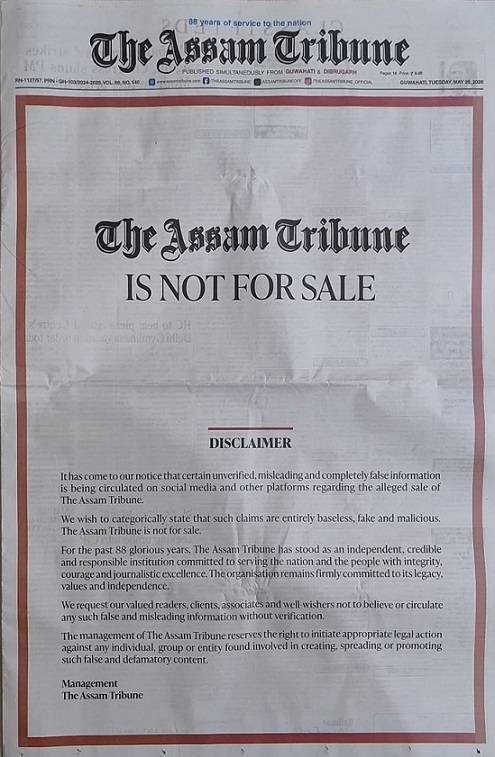
Have you ever seen a newspaper management publish an advertisement on its front page declaring that the paper is “Not For Sale”? Using the most valuable space in the publication — traditionally reserved for readers and major news — the owners of The Assam Tribune carried a prominent notice on May 26, 2026, insisting that the respected daily was not being sold.
The unusual move immediately raised questions. Why did the present management of The Assam Tribune feel compelled to issue such a dramatic public clarification instead of simply dismissing social media rumours with a brief statement? Was it an overreaction to reports circulating in alternative media, or an attempt to conceal something more significant?
In a strongly worded advertisement carrying the emphatic line, “The Assam Tribune is Not For Sale,” the management claimed that widespread speculation on social media regarding the alleged sale of the newspaper was completely baseless. The statement asserted: “For the past 88 glorious years, The Assam Tribune has stood as an independent, credible and responsible institution dedicated to serving the nation and its people with integrity, courage and journalistic excellence.”
The notice further warned that the management reserved the right to initiate legal action against any individual, group or organisation found to be creating, circulating or promoting what it described as defamatory and unfounded content.
The controversy intensified during the fourth week of May 2026 when social media platforms were flooded with claims that the iconic newspaper had already been sold to industrialist Gautam Adani, chairman of the Adani Group, for nearly ₹421 crore. Soon, several prominent voices amplified the speculation. Many alleged that the management had for some time been unable to pay employees regularly and that more than 75 former employees of the Tribune media house were still awaiting settlement of their legal dues, forcing them to approach the courts.
At the same time, many social media users expressed sadness and concern over the deteriorating financial condition of one of the Northeast’s most trusted media institutions.
The oldest media group in Northeast India has indeed been facing serious financial difficulties — a fact also acknowledged in official statements issued by the Assam Tribune Employees’ Union. The union accused the management of delays in salary payments and post retirement dues. Employees organised protests inside the office premises and also addressed press conferences, claiming that the Assam government’s Information and Public Relations Department owed the organisation substantial advertisement revenue.
The management echoed similar concerns, maintaining that it urgently required the release of pending dues amounting to several lakhs of rupees.
Amid these troubling developments, the management handed over responsibility for its sister publication, Dainik Asam, to the owner of another media house. The new management, which assumed charge of the Assamese daily on September 17, 2025, reportedly refused to accept liability for more than 75 employees associated with the newspaper.
The previous management should ideally have settled the dues of the retrenched employees immediately, but that did not happen. Eventually, the affected workers sought legal recourse, and according to reports, a court recently directed the management to clear their pending payments.
Founded in 1939 by noted Assamese entrepreneur Radha Govinda Baruah, the Guwahati based media house earned a reputation for credible journalism in the region. It may be recalled that Tribune House was among the first newspaper establishments in India to implement the recommendations of the Majithia Wage Board in 2010.
Just before distancing itself from Dainik Asam, the current ownership group quietly discontinued its seven decade old tabloid Asam Bani. The mainstream weekly had earlier been merged with Dainik Asam as a Sunday supplement. However, the buyer did not take ownership of the weekly publication, effectively bringing it to an abrupt and silent end.
Asam Bani last appeared as a supplement on September 12, 2025, yet the Tribune management never issued any official statement regarding its closure.
Over the decades, the Tribune media group witnessed and reported on several critical socio political developments in Assam, including movements related to education, the anti infiltration agitation, the rise of separatist militancy, social unrest and the emergence of regional politics. Throughout these turbulent phases, the organisation projected itself as being committed to the interests of Assam’s indigenous population.
However, the Covid19 pandemic severely affected the newspaper industry across Assam, causing major declines in circulation and advertising revenue and pushing many publications into a struggle for survival.
Media observers argue that while Tribune House historically maintained credibility in news reporting and editorial standards, these principles have increasingly been compromised in recent years.
In 2019, The Assam Tribune extensively covered protests against the Citizenship Amendment Act (CAA), giving significant space to demonstrations opposing the Central government’s move to provide political support to persecuted Hindu, Sikh, Buddhist and Christian minorities from Muslim majority Pakistan, Bangladesh and Afghanistan.
Critics argue that such coverage contributed to prolonged unrest in Assam’s Brahmaputra Valley, where a dominant narrative emerged claiming that the new citizenship law would dilute the Assam Accord, the agreement that ended the anti-foreigners agitation in 1985.
Observers also recall a series of allegedly partisan reports published by The Assam Tribune ahead of the Guwahati Press Club elections nearly six years ago. Those reports, which reportedly contained personal attacks against the then club secretary, damaged the newspaper’s hardearned reputation for neutrality and credibility.
Although the current financial condition of the Tribune media house is undoubtedly alarming, critics argue that the crisis cannot be blamed solely on the Covid19 pandemic. They claim that unchecked misuse of editorial freedom by certain individuals within the newsroom further aggravated the situation.
According to these critics, some media professionals within the institution allegedly enjoyed organisational privileges while simultaneously contributing to internal discord and instability. Meanwhile, the management remained a silent spectator — for reasons best known to itself.
(The writer is a senior journalist and commentator from Northeast India.)