
Last Updated on May 19, 2026 7:07 pm by INDIAN AWAAZ
Andalib Akhter / New Delhi
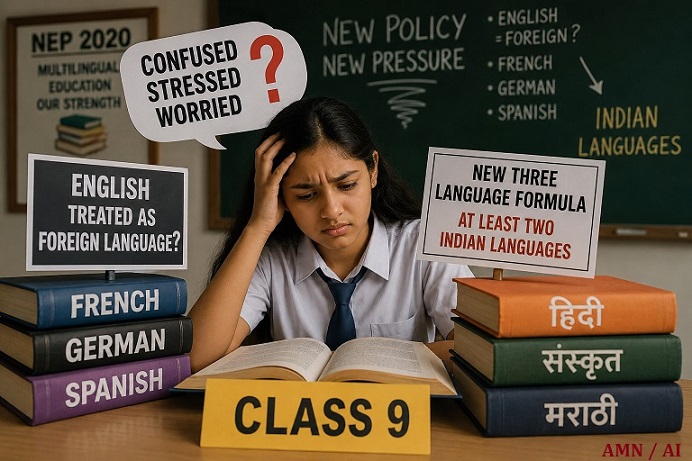
The implementation of the revised three-language formula under the National Education Policy (NEP) by the Central Board of Secondary Education has triggered confusion and anxiety among students and parents across the country, particularly among Class 9th students who had already finalized their subject combinations at the beginning of the academic session.
Under the revised policy, students are now required to study three languages, with at least two being Indian languages. Foreign languages such as French, German, or Spanish can only be offered if the remaining two languages are Indian. The move has sparked widespread concern because English, despite being the primary medium of instruction in thousands of schools, is effectively being treated on par with foreign languages under the new framework.
For many students, the decision has come as a shock midway through their academic planning. Several schools had earlier assured students that they could continue with foreign languages they had studied since middle school. However, following the latest circular, many institutions have reportedly asked students to replace foreign languages with another Indian language, forcing them to begin learning an entirely new language from scratch at a crucial academic stage.
“My daughter studied Hindi till Class 8 while French was her third language. We were told she could continue French in Class 9, so she invested considerable effort in it and even received a proficiency award. Now suddenly French has been removed and students may have to take up another Indian language like Sanskrit, Urdu, or a regional language from the beginning. This creates unnecessary academic pressure,” said a concerned parent.
Another parent, requesting anonymity, said that such major academic changes should be introduced gradually and with proper communication. “Students shape their academic interests over several years. Sudden policy shifts create uncertainty and stress not only for children but also for parents,” the parent added.
A major point of debate surrounding the policy is the classification of English as a “foreign” language. Critics argue that English has long been deeply embedded in India’s education system and cannot be viewed in the same category as languages like French or German. From NCERT textbooks to CBSE study material to question papers all are published in English. Interstingly even the original draft of Indian Constitution was published in English. The language continues to play a central role in Indian academic and administrative life.
Students and parents argue that while promoting Indian languages is an important cultural objective, treating English as an external or foreign language ignores educational realities. Many fear the policy could burden students academically while also creating confusion in schools that have followed multilingual teaching systems for years.
Education experts believe the transition could have been smoother had schools and parents been consulted beforehand. With admissions and subject selections already completed in many institutions, parents are now demanding clarity from CBSE and the Education Ministry to ensure students do not suffer because of sudden policy implementation.