
Last Updated on February 11, 2026 1:44 pm by INDIAN AWAAZ
By R. Suryamurthy
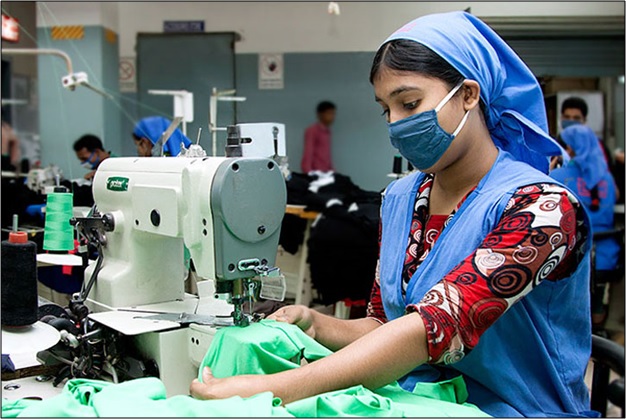
The United States–Bangladesh Agreement on Reciprocal Trade, signed on February 9, is being sold as a market-access deal for an export-dependent economy facing the loss of trade preferences. But viewed through a political economy lens, the pact does more than adjust tariffs. It repositions Bangladesh’s garment industry—the backbone of its economy—as an instrument within a wider U.S. strategy that links trade access, supply-chain control and regulatory influence.
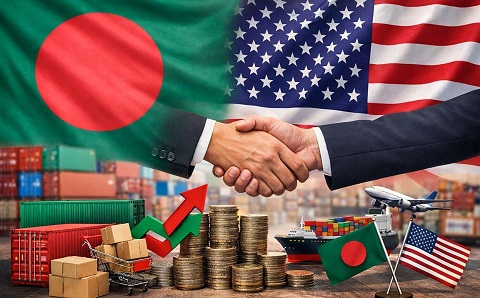
At the centre of the agreement is a recalibration of power rather than parity. Washington will lower its reciprocal tariff on Bangladeshi goods to 19% and offer zero reciprocal duty on garments made using U.S.-origin cotton and man-made fibres. Dhaka, in return, has committed to wide-ranging tariff cuts, guaranteed purchases of U.S. agricultural and energy products, and deep compliance obligations spanning labour, data flows and intellectual property.
For Bangladesh, where garments account for about 80% of exports and underpin employment, foreign exchange earnings and political stability, the textile clause carries disproportionate weight. It arrives just months before the country’s scheduled graduation from Least Developed Country (LDC) status in November 2026—a transition that will gradually strip away preferential access in key markets and expose exporters to higher tariffs.
The government has framed the deal as a hedge against that transition. Critics argue it instead locks Bangladesh into a dependent adjustment path that favours U.S. commercial and strategic interests.
The tariff arithmetic illustrates the asymmetry. Most Bangladeshi garments exported to the United States will continue to face a high effective duty—around 31%, combining the 12% most-favoured-nation tariff with the new 19% reciprocal levy. Only garments meeting the U.S.-input condition escape the reciprocal duty.
That condition matters politically because it collides with the structure of Bangladesh’s production economy. Over two decades, the garment sector has been organised around European demand, not American sourcing rules. In 2024, Bangladesh exported $50.9 billion in garments globally, but only $7.4 billion went to the U.S. More than 63%—about $32.3 billion—went to the European Union under unconditional duty-free access. Supply chains, investment decisions and labour arrangements reflect that reality.
Input dependence sharpens the constraint. Bangladesh imported $16.1 billion in textile inputs last year, largely from China and India. The U.S. supplied just $274 million, almost entirely raw cotton. India dominates cotton yarn; China dominates fabrics. These upstream inputs, not raw fibre, sustain Bangladesh’s factory floor. Shifting to U.S. fibres at scale would require new investment in spinning and fabric capacity, raising costs and altering long-standing regional trade ties.
In political economy terms, the zero-duty clause functions less as export liberalisation and more as a disciplining mechanism. Market access is made conditional on reorienting supply chains toward U.S. producers, particularly cotton exporters. The incentive structure nudges Bangladesh to internalise U.S. upstream interests within its export model, effectively transferring part of the value chain—and leverage—upstream.
What Bangladesh gives in return extends well beyond textiles. Dhaka has agreed to reduce duties and provide preferential access for U.S. industrial and agricultural goods, with no quotas unless mutually agreed. It has committed to purchasing about $3.5 billion in U.S. farm products and $15 billion in U.S. energy products over 15 years. It has also accepted binding obligations on labour standards, forced-labour bans, customs digitisation, intellectual property enforcement and cross-border data flows.
These provisions matter because they expand the terrain of U.S. influence from the border to the factory floor and regulatory state. Labour and environmental clauses, while framed as standards, also create enforcement hooks. Digital trade commitments constrain policy space in data governance. Intellectual property rules tilt the balance toward rights holders in advanced economies. Together, they embed Bangladesh more deeply into a U.S.-centred rule-making framework.
Supporters of the agreement argue that this is the price of remaining integrated into global markets. Chief Adviser Muhammad Yunus has called the deal a “historic turning point”, emphasising that even small tariff differentials can shape sourcing decisions in a hyper-competitive apparel market. Former World Bank economist Zahid Hussain has estimated potential gains of up to $2 billion in redirected orders.
But critics counter that these projections underestimate structural rigidities and overstate buyer responsiveness. With the European Union already absorbing nearly two-thirds of Bangladesh’s garment exports at zero duty, the incentive to reconfigure production for a smaller, more conditional U.S. market is limited. The likely immediate effect, analysts say, is an increase in U.S. cotton exports rather than a step-change in Bangladeshi apparel shipments.
The deal’s timing adds another political layer. Signed days before Bangladesh’s general election, it has drawn accusations of opacity and haste. Economist Anu Muhammad has warned that the combination of import commitments, compliance costs and long-term energy purchases risks deepening external dependence and exposing Bangladesh to balance-of-payments pressures if export gains fall short.
Regionally, the agreement has geopolitical spillovers. In India, opposition leaders have framed it as a competitive threat to textile hubs and cotton-linked livelihoods, arguing that Bangladesh’s conditional zero-duty access undermines India’s position in the U.S. market. Yet the rivalry narrative may obscure a larger reality: the U.S. is using reciprocal tariffs to pit suppliers against each other while extracting concessions from all.
In this sense, the U.S.–Bangladesh deal is less about bilateral trade balances and more about supply-chain governance. It reflects Washington’s broader shift from preference-giving to conditional access, where tariffs, standards and sourcing rules are used to reassert influence in global production networks.
For Bangladesh, the political economy challenge is stark. The country must manage LDC graduation, preserve the competitiveness of a labour-intensive sector, and avoid excessive dependence on any single market or supplier. The new agreement offers a narrow route to U.S. market relief, but at the cost of reduced policy autonomy and deeper alignment with U.S. commercial priorities.
Whether that trade-off proves sustainable will depend not on the headline tariff cut, but on how much restructuring Bangladesh’s garment economy can absorb—and how much leverage it is willing to cede in exchange for conditional access.