
Supreme Court intervention comes following protests and concerns over their structure and enforcement
Syed Ali Mujtaba
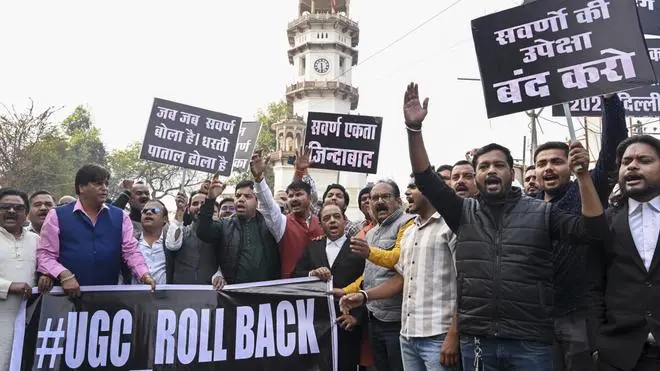
Even as Supreme Court has styed implementation of the University Grants Commission (UGC) Equity Regulations 2026, the Guidelines have ripped open the underbelly of Upper Caste politics in India. Protests were out in the open by the upper caste Hindus against the UGC equity regulation that acknowledges the victimization of the marginalized sections of the Indian communities in the campuses of higher learning.
The UGC has recognized that caste-based discrimination is taking place within educational campuses, particularly against Scheduled Castes, Scheduled Tribes, and Other Backward Communities.
Data tabled in the Lok Sabha reveals that complaints of caste discrimination in university campuses have increased from about 173 cases in 2016–17 to over 350 in the 2023–24 academic year. Another data says that more than 13,500 SC, ST, and OBC students have dropped out of the IITs and IIMs, and other central university campuses over the past five years.
Another data reveals the chronic underrepresentation of the marginalized communities in faculty positions in the central universities. Among the Scheduled Castes category, nearly two-thirds of the professor posts sanctioned are vacant. In the Scheduled Tribes category, 83% of the sanctioned posts remain vacant. In the OBC category, of the 423 professor posts, only 84 have been filled. These are not marginal gaps but structural absences that shape everyday academic life in the Indian university campuses.
Rohith Vemula Case
Rohith Chakravarthi Vemula was a PhD scholar at the University of Hyderabad who committed suicide on January 17, 2016. His death drew national attention and pointed to the alleged systemic discrimination imposed by the caste Hindus against the marginalized communities in India. His parents, Rohith Vemula and Payal Tadvi, filed a petition in the court complaining about the atrocities committed against their groups in the university campuses. This prompted the Supreme Court to direct the UGC to implement the 2012 anti-discrimination rules.
What is UGC’s Equity Regulation 2026?
The UGC has introduced the Equity Regulations 2026 to address caste-based discrimination faced by students from reserved categories in Higher Educational Institutions (HEIs). The UGC’s new rules mandate that all universities and colleges should establish an Equal Opportunity Centre (EOC) along with campus-level equity committees tasked with inquiring into complaints of discrimination and prompt remedial measures. These committees must include representatives from Scheduled Castes, Scheduled Tribes, Other Backward Classes (OBCs), persons with disabilities, and women.

The objective of the UGC equity regulation was to move beyond the 2012 guidelines and create a binding, institutional mechanism for grievance redressal and control the growing incidence of discrimination against the marginalized section of society.
In response, the upper-caste Hindu groups went for widespread protests against the UGCs’ move to introduce ‘equity in higher education.’ The protesters argue that the regulations fail to provide an explicit grievance mechanism for the students belonging to the upper caste who are in the general category, and say this may deepen inequality in the university campuses.
Sensing the growing anger among the upper caste youth, the BJP government indulged in a firefighting exercise. It made Education Minister Dharmendra Pradhan clarify that the UGC regulations are court-mandated, constitutionally sound, and subject to judicial oversight—seeking safety in legality rather than political conviction.
The Apex Court gave the reason that the regulation was sweeping in nature. This is yet another instance where the Supreme Court went back on its own ruling and changed its tone to support the sentiments of the few at the expense of further marginalization of the downtrodden communities of India.
BJP on Backfoot
The UGC’s Equity Regulations have left the BJP government with no other option than to put its foot in its mouth. It can’t afford to alienate upper-caste that’s pushing the Hindutva cart with fire and zeal to make a Hindu Rashtra. Neither can the BJP retract from the constitutional protections of the marginalized communities that have been historically wronged.
The vengeance with which the upper caste opposed the UGC regulations far exceeds the actual scope and purposes of the regulation for which it was meant. The upper-caste Hindu called it a civilizational threat to the Santam Dharma. They raised an alarm that deeply remains entrenched in their superiority of the upper cate as enshrined in the Manusmriti.
The UGC equity regulation controversy has put the BJP in a bind. The option before it was to do a tightrope walking and it did somehow. The party has spent years courting OBCs and Dalits to show the solidarity of the Hindus against the Muslims. It cannot antagonize their sentiments, a cry for equity. At the same time, the BJP remains glued to its upper caste, which remains the vanguard of its Hindutva project.
The Equity Regulations of the UGC have left the BJP to make a hard choice. Ultimately, the saffron party tilted the balance in favor of upper-caste even if that means denying equity to the marginalized sections of society.
In sum, what the UGCs’ equity controversy tries to communicate is that the upper caste superiority remains paramount in the Indian society. The government of the day never wants to create a playing field for all the communities in India. It continues to deny the equity quotient, hook or crook, to some 85% of society. The irony is that this 15% of the social group has been successful in their diabolical design.
One of the recent examples of upper caste domination was seen when they objected to Muslim’s admission in a medical college based on their merit. The medical college in Jammu, run by the Vashino Devi Trust, has admitted Kashmiri students who scored highly in the NEET exam. This was not tolerated by the upper caste group, and they saw to it that the college is permanently closed and no Muslim student could ever become a doctor.
The message from the UGC controversy is that the upper caste Hindu group wants to maintain its power, privileges, and superiority in India. It wants to discriminate against the marginalized communities and continue with the system that has been operational in India since time immemorial.
We like it or not, this is a new normal in India where a section of Indians do not want the equity rule to be applied, particularly in the campuses of higher learning, and also in the Indian social structure.