
Last Updated on January 29, 2026 1:44 pm by INDIAN AWAAZ
R. Suryamurthy
India has revised its potential economic growth rate upward to 7.0%, citing sustained public investment, improving supply-side conditions and stronger state-level deregulation, even as it warned that a fractured global order, coercive trade policies and volatile capital flows pose rising risks to macroeconomic stability, the Economic Survey 2025–26 said on Thursday.
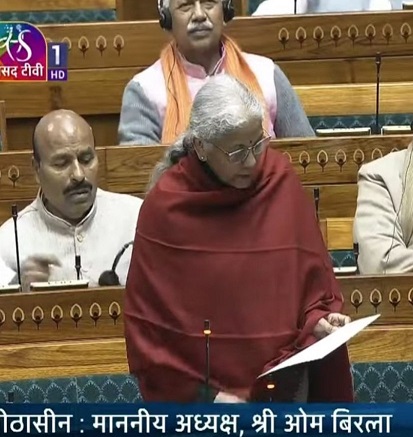
The Survey, tabled in Parliament by Finance Minister Nirmala Sitharaman, said the economy is likely to sustain real GDP growth of over 7% in FY26, with momentum expected to extend into FY27, supported by infrastructure expansion, subdued core inflation and a healthier banking system .
However, it cautioned that India’s strongest macroeconomic performance in decades is unfolding against a global backdrop that “no longer rewards macroeconomic success with currency stability, capital inflows or strategic insulation,” as geopolitics increasingly dictate trade and finance flows .
Rupee underperforms despite strong fundamentals
The Survey flagged the underperformance of the rupee in 2025, attributing it to India’s structural dependence on foreign capital inflows to finance its merchandise trade deficit, even as services exports and remittances provide partial offsets .
While macro fundamentals remain strong — including low external liabilities, comfortable liquidity, robust credit growth and healthy corporate balance sheets — the rupee’s valuation “does not accurately reflect India’s stellar economic fundamentals,” it said, noting that currency weakness has made foreign investors cautious .
India’s vulnerability to capital flow disruptions could persist beyond a single year, the Survey warned, particularly in an environment of geopolitical turbulence and financial market fragility.
Three global scenarios for 2026
The Survey outlined three global scenarios for 2026, assigning nearly 80–90% probability to outcomes marked by either managed disorder or a disorderly multipolar breakdown.
In the base case, global growth holds up but remains fragile, with episodic shocks, financial stress and trade frictions requiring active state intervention. In a more adverse scenario, strategic rivalry intensifies, sanctions proliferate, supply chains are realigned under political pressure and capital flows become more volatile .
A third, lower-probability but high-impact scenario involves a systemic shock cascade, combining financial stress from leveraged artificial intelligence investments, geopolitical escalation and liquidity contraction — a situation the Survey said could have consequences worse than the 2008 global financial crisis .
Fiscal consolidation with emerging state-level risks
On fiscal policy, the Survey said the Union government met its FY25 fiscal deficit target of 4.8% of GDP, better than the budgeted 4.9%, and reiterated its commitment to reduce the deficit to 4.4% in FY26, marking a sharp consolidation from the pandemic-era peak of 9.2% in FY21 .
India also received credit rating upgrades from three agencies in 2025, including S&P’s upgrade to BBB — its first major upgrade in nearly two decades — reflecting improved fiscal credibility and growth prospects .
However, the Survey expressed concern over rising revenue deficits and unconditional cash transfers by several state governments, warning that weak fiscal discipline at the state level could raise sovereign borrowing costs as global investors increasingly assess general government finances, not just the Centre’s balance sheet .
India’s 10-year government bond yield, at around 6.7%, remains higher than peers such as Indonesia despite similar credit ratings, partly reflecting these concerns, it said.
Cost of capital and the external constraint
The Survey argued that India’s high cost of capital is not merely a function of policy rates or inflation, but a structural outcome of running persistent current account deficits and relying on foreign savings .
To lower capital costs durably, India must transition into a surplus-generating economy, driven by competitive manufacturing exports, rather than relying predominantly on services exports, it said.
While services exports have grown faster — with total exports rising at a compounded annual rate of 9.4% since 2020, compared with 6.4% for merchandise exports — the Survey stressed that services alone cannot anchor long-term currency stability or force systemic upgrades in state capacity .
Manufacturing, trade pacts and strategic resilience
Highlighting the strategic importance of manufacturing, the Survey said India’s recently concluded free trade agreement with the European Union, pending ratification, could expand market access for labour-intensive exports while integrating India more deeply into European manufacturing and technology ecosystems .
However, it warned against excessive protection of upstream industries, arguing that high tariffs raise costs for downstream exporters and undermine competitiveness. Instead, it called for lowering input costs, improving logistics, scaling up MSMEs and reducing regulatory friction.
An “entrepreneurial state” approach
The Survey made a strong case for reimagining state capacity, advocating an “entrepreneurial state” that can act under uncertainty, structure risk and course-correct rapidly, rather than relying on compliance-driven governance .
It cited early examples such as mission-mode programmes in semiconductors and green hydrogen, procurement reforms and state-level deregulation compacts as signals of this shift.
Ultimately, the Survey said India faces a strategic choice between short-term comfort and long-term resilience in an increasingly hostile global environment, calling for policy credibility, administrative discipline and delayed gratification to sustain growth and strategic influence.
“India must run a marathon and sprint simultaneously,” it said, warning that the terrain has changed, old rules no longer apply and new ones are yet to be fully formed .