
Last Updated on January 2, 2026 4:49 pm by INDIAN AWAAZ
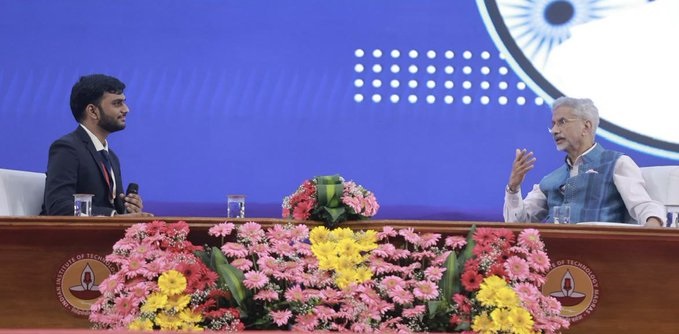
“Always a pleasure to interact with our youthful talent. Encouraging to see their keen interest in world affairs” EAM
AMN / CHENNAI
External Affairs Minister Dr. S Jaishankar today stressed that New Delhi has the right to defend itself against terrorism from hostile neighbours. He said persistent cross-border terrorism undermines goodwill and nullifies benefits such as water-sharing arrangements, as cooperation cannot coexist with violence.
Speaking at the inauguration of Shaastra 2026- IIT Madras Techno-Entertainment fest here, EAM said that no one can dictate how India exercises its defence. He said that India will do whatever is required to defend itself.
The External Affairs Minister outlined India’s neighbourhood policy, stressing that New Delhi has the right to defend itself against terrorism from hostile neighbours. He said persistent cross-border terrorism undermines goodwill and nullifies benefits such as water-sharing arrangements, as cooperation cannot coexist with violence.
Explaining India’s broader outlook, Jaishankar referred to Vasudhaiva Kutumbakam, saying Indian foreign policy views the world as a family and focuses on problem-solving through national strengths and partnerships.
On regional developments, he spoke about Bangladesh, mentioning his recent visit to Dhaka for the funeral of former prime minister Khaleda Zia. He noted that India supports stable neighbours and believes India’s economic growth acts as a rising tide, benefiting the region, including Bangladesh, during its election period.
At IIT Madras, Jaishankar addressed questions that ranged from India’s global positioning to the role of technology in shaping international relations. The students, representing one of India’s premier institutions of science and engineering, brought curiosity and candor to the dialogue. Jaishankar, in turn, offered clarity and pragmatism, weaving together geopolitics with the aspirations of young India.
Jaishankar’s IIT Madras interaction was more than a Q&A—it was a microcosm of India’s evolving diplomacy, where global strategy meets youthful energy. For India, the message is clear: the future of foreign policy lies not only in negotiation rooms but also in classrooms.
Edited by Andalib Akhter