
Last Updated on December 29, 2025 5:50 pm by INDIAN AWAAZ
AMN / NEWS DESK
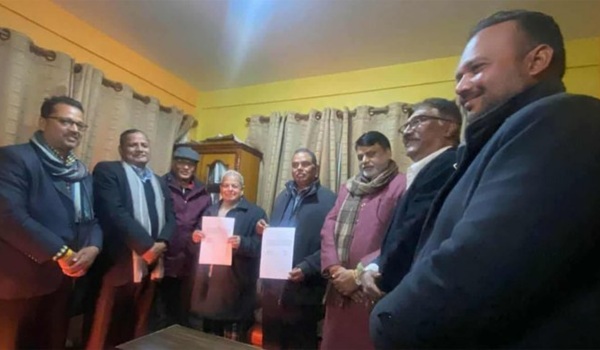
In a significant political development ahead of Nepal’s upcoming parliamentary elections, Upendra Yadav-led Janata Samajwadi Party (JSP) and Mahanth Thakur-led Loktantrik Samajwadi Party (LSP) have formally reunited. The two Madhesh-based parties signed an agreement to merge, marking a major realignment in Madheshi politics.
The reunification is aimed at consolidating forces to strengthen the federal democratic republican system and advance key agendas such as federalism, identity recognition, proportional inclusion, and social justice. While the decision to merge has been finalised, discussions are still underway on crucial aspects including the new party’s name, election symbol, and organisational structure.
However, the move has also exposed internal divisions within the broader Janata Samajwadi Party. A faction led by Ashok Rai is reportedly preparing to reunite with the CPN-UML, leading to a split among party leaders over future political alignment—either with Madhesh-based forces or the larger communist bloc.
The current developments echo earlier divisions within the JSP. In 2021, leadership disagreements prompted Mahanth Thakur to break away and form the Loktantrik Samajwadi Party. Subsequently, in mid-2022, tensions between Upendra Yadav and Ashok Rai deepened, culminating in a formal split when Rai’s faction registered a separate party, distinct from Yadav’s JSP-Nepal.
Sources now indicate that Ashok Rai’s faction is engaged in ongoing talks with the UML, while also maintaining communication with Janardan Sharma’s Pragatisheel Loktantrik Party, adding another layer of complexity to Nepal’s evolving political landscape.