
R. Suryamurthy / NEW DELHI
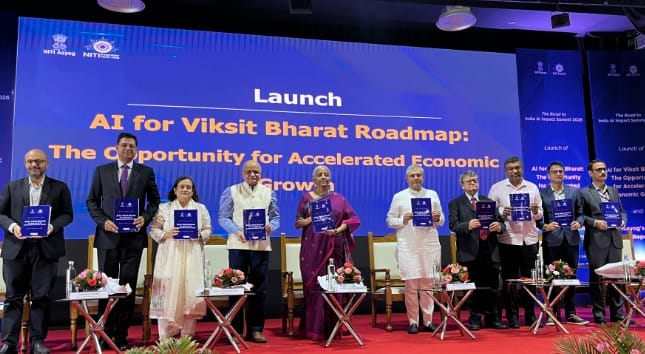
India has staked its ambition of sustaining 8% annual economic growth on a sweeping integration of artificial intelligence (AI) across key sectors, with NITI Aayog releasing a detailed roadmap that positions AI as the country’s “decisive lever” for accelerated development.
The report, AI for Viksit Bharat: The Opportunity for Accelerated Economic Growth, argues that AI could add $500–600 billion to India’s GDP by 2035 through productivity gains in industries such as banking and manufacturing. A further $280–475 billion could come from breakthrough innovation in pharmaceuticals, automotive and frontier technologies, according to the analysis.
At the core of the strategy is the IndiaAI Mission, a five-year programme with a budget exceeding ₹10,000 crore. It will deploy over 38,000 GPUs through a federated compute network, build India-specific large language models, and create anonymised public datasets to fuel innovation. AI skilling initiatives are also planned, with courses rolled out across universities and dedicated AI labs in Tier 2 and 3 cities.
The report identifies four major outcomes India must target by 2035: becoming the global “data capital,” developing an adaptable AI-skilling ecosystem, driving sectoral adoption in manufacturing, finance, pharmaceuticals and automotive, and future-proofing jobs in an increasingly automated economy.
Banking alone could see a $50–55 billion boost from AI-enabled credit decisioning, fraud detection, and personalised customer engagement. Manufacturing could capture $85–100 billion in additional value by deploying smart factories, predictive maintenance, and intelligent product design. Pharmaceuticals may shift from being largely generic-driven to innovation-led, with AI cutting drug discovery timelines by up to 80%. In automotive, the report foresees India emerging as a hub for software-assisted vehicles and AI-enabled component design.
But the document also warns of risks: legacy IT systems, data quality gaps, a shortage of skilled AI professionals, and potential regulatory bottlenecks. Without decisive policy action and industry-wide collaboration, it says, India could fall short of capturing its full share of global AI value.
Calling for urgency, the roadmap urges government, industry, and academia to work in tandem to build sovereign AI infrastructure, reskill the workforce, and create globally aligned standards. “The path to 8% growth runs through decisive AI adoption and innovation,” the report states, framing AI as central to India’s Viksit Bharat vision by 2035.