
Last Updated on August 26, 2025 7:23 pm by INDIAN AWAAZ
R. Suryamurthy
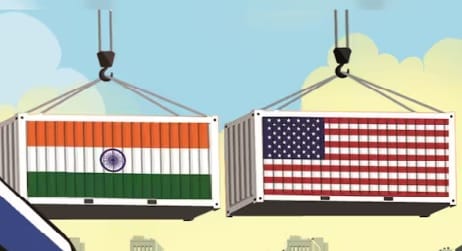
India’s export engine is bracing for its sharpest external shock in years after Washington announced an additional 25% tariff on a broad range of Indian goods, raising total duties on most categories to a prohibitive 50% from August 27.
The Federation of Indian Export Organisations (FIEO) on Tuesday sounded alarm bells, warning that the move could render 55% of India’s exports to the US — worth $47–48 billion — uncompetitive, triggering order cancellations, factory shutdowns, and job losses across labour-intensive sectors.
“This is a setback of serious proportions. Our exporters are staring at a pricing disadvantage of 30–35% against competitors from Vietnam, Mexico, China, and Bangladesh,” said FIEO president S C Ralhan. “Without immediate government intervention, India risks losing its hard-won foothold in the US market.”
A $37 Billion Hole in Trade
A parallel assessment by the Global Trade Research Initiative (GTRI) paints a stark picture: two-thirds of India’s $86.5 billion shipments to the US will now face 50% tariffs, slashing exports by as much as 43% in FY2026. Shipments could fall to $49.6 billion from $86.5 billion last year, a $37 billion shortfall.
While pharmaceuticals, APIs, and electronics worth $27.6 billion remain duty-free, the pain will be concentrated in textiles, gems and jewellery, shrimp, carpets, handicrafts, and furniture — sectors employing millions in clusters such as Tiruppur, Surat, Bhadohi, and Jodhpur.
GTRI projects a 70–80% collapse in shipments in these categories, with U.S. buyers already shifting to cheaper suppliers in Southeast Asia, Latin America, and Africa.
Sectors Under Siege
Textiles and Apparel: Exports worth $10.8 billion will face tariffs of nearly 64%. Units in Tiruppur, Noida, Bengaluru, and Ludhiana are freezing production lines as buyers pivot to Bangladesh, Vietnam, and Mexico.
Gems and Jewellery: $10 billion in shipments face duties of 52%. Surat’s polishing units and Mumbai’s SEEPZ SEZ risk mass layoffs. Jaipur’s gemstone units could lose 35,000 jobs.
Seafood (Shrimp): India’s $2.4 billion shrimp exports will attract a 60% total duty, a devastating blow to Andhra Pradesh and Visakhapatnam farms, with Ecuador and Vietnam poised to grab market share.
Carpets and Handicrafts: With US shares exceeding 40–60%, artisanal hubs in Bhadohi, Srinagar, Jodhpur, and Moradabad face cancellations and an existential crisis as Turkey, Nepal, and Vietnam step in.
Leather and Footwear: Agra, Kanpur, and Tamil Nadu clusters are under stress, with brands relocating orders to Southeast Asia.
Agriculture exports including basmati rice, spices, and tea are also exposed, giving Pakistan, Thailand, and Kenya fresh openings.
Economic Fallout
The tariff shock, GTRI calculates, could trim India’s GDP growth from 6.5% to 5.6% in FY2026. However, resilience in global services exports — projected to rise 10% to $421.9 billion — provides a cushion. Overall exports (goods + services) may still grow modestly to $839.9 billion, highlighting India’s diversified base.
Yet the employment fallout in labour-intensive industries could be severe. “We are talking about hundreds of thousands of livelihoods across Tiruppur, Surat, Bhadohi, Jodhpur, and coastal Andhra Pradesh,” said a senior trade economist.
FIEO’s Demands: Liquidity Lifeline and FTAs
FIEO has urged the government to roll out a multi-pronged relief package. Its recommendations include:
Immediate interest subvention schemes and export credit support, particularly for MSMEs.
Moratorium on loans (principal and interest) for one year and a 30% automatic enhancement of credit limits, modeled on earlier ECLGS packages.
Expansion of PLI schemes and investment in cold-chain and logistics infrastructure to reduce structural costs.
Aggressive trade diversification via fast-tracked FTAs with the EU, GCC, Latin America, and Africa, with early-harvest deals for vulnerable sectors.
Enhanced focus on Brand India, global quality certifications, and innovation-led exports.
Strategic Choices Before India
Analysts argue that India must combine immediate firefighting with long-term positioning. “A ₹15,000 crore interest equalisation fund, wage support in hubs like Tiruppur and Surat, and targeted credit lines for shrimp and jewellery are urgent. But equally, India needs to reconfigure its trade strategy,” said Ajay Srivastava, co-founder of GTRI.
That means exploring “India+1” strategies by setting up manufacturing bases in tariff-neutral zones such as Mexico, UAE, and Africa, while investing in higher-value exports like sustainable seafood, designer jewellery, and premium apparel.
Diplomatic engagement with Washington remains critical. “While the tariffs may be rooted in U.S. domestic politics, India must push for dialogue. The costs of inaction are too high,” one senior official said.
The U.S. tariff escalation is a stress test for India’s export resilience. The blow to labour-intensive sectors is immediate and sharp, but the wider trade engine, powered by services and diversified markets, remains intact. Whether India emerges weakened or repositioned will depend on how swiftly New Delhi moves with relief, reforms, and global outreach.
“The next few months are decisive,” Ralhan cautioned. “If we don’t act now, competitors will cement their hold and India will take years to reclaim lost ground.”