
Last Updated on April 26, 2026 8:20 pm by INDIAN AWAAZ
Will BJP Outmanoeuvre TMC, or Will Mamata’s Grip Prove Unshakable?
By Aafreen Hussain in Kolkata
West Bengal’s political theatre is once again at its dramatic best—high stakes, louder speeches, and an audience that knows every twist in the script.
On one side stands the Bharatiya Janata Party (BJP), still chasing its long-standing ambition to capture power in the state. On the other is the All India Trinamool Congress (TMC), firmly rooted in Bengal’s political soil and led by Mamata Banerjee, a leader who has turned resilience into an art form.
The inevitable question remains: Is this finally BJP’s moment, or just another well-publicized attempt?
Leadership vs Machinery: Who Holds the Advantage?
Under Mamata Banerjee, TMC has built a powerful narrative around regional pride and welfare-driven governance. She remains arguably the most dominant political figure in the state.
Meanwhile, BJP has deployed its biggest names. Prime Minister Narendra Modi and Home Minister Amit Shah are campaigning aggressively, turning the contest into a high-voltage national spectacle.
But a critical question persists:
Can star power from Delhi truly substitute grassroots depth in Bengal—or is it political tourism packaged as strategy?
Strategy or Spectacle: Who’s Playing Smarter?
This election resembles less a governance debate and more a high-speed chess match.
- TMC leans on local networks, welfare schemes, and cultural identity
- BJP pushes national narratives, central leadership, and promises of “change”
Yet, both strategies face uncomfortable questions:
- Is “change” compelling if voters aren’t deeply dissatisfied?
- Can “continuity” sustain momentum without fatigue setting in?
Every rally, every statement, every accusation appears meticulously calculated—or perhaps not as much as it seems.
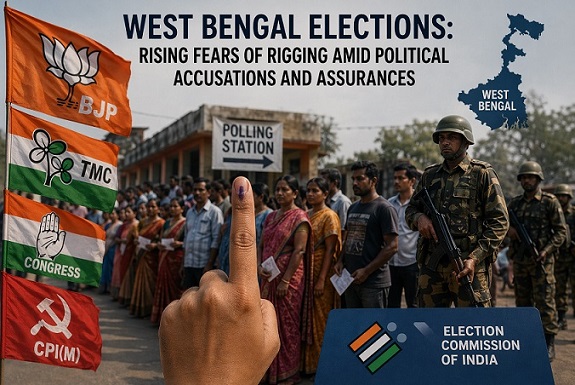
Election Commission Under the Lens
The Election Commission of India once again finds itself under scrutiny. Opposition parties raise concerns, the Commission reiterates neutrality, and voters are left wondering:
Is the playing field truly level, or has perception become more powerful than reality? If trust itself becomes a campaign issue, the implications could extend far beyond this election.
The Voter’s Mind: Predictable or Perplexing?
This is where the narrative becomes less certain—and more intriguing.
- Rural voters appear to acknowledge TMC’s welfare outreach
- Urban and younger voters seem more receptive to BJP’s messaging
But are these divisions still meaningful?
Do voters still behave in predictable blocs, or are they quietly rewriting electoral rules while parties rely on outdated assumptions?
West Bengal has a long history of surprising observers—especially those who claim to fully understand it.
Results Day: Answers or More Questions?
All eyes are on May 4. The verdict will settle some debates—but likely spark many new ones.
- Will TMC once again prove that regional dominance outweighs national ambition?
- Or will BJP finally crack Bengal’s political code?
And perhaps the most ironic question:
Will the result truly settle the debate—or simply shift it to a new battleground?
Democracy’s Final Word
This election is about more than seats—it is about narratives, strategy, and competing visions of governance. The BJP vs TMC contest has evolved into a test of perception, endurance, and political intelligence.
In the end, despite all the speeches, slogans, and speculation, one truth remains unchanged: The people of West Bengal will deliver the only verdict that matters.
And when they do— will it be a surprise, or exactly what everyone claims they predicted all along?