
Last Updated on December 9, 2025 1:59 am by INDIAN AWAAZ
Staff Reporter / New Delhi
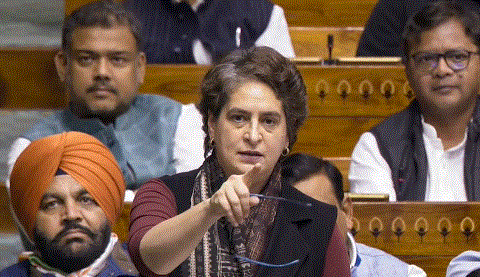
Senior Congress leader Priyanka Gandhi Vadra on Monday sharply questioned the motives behind the renewed debate over Vande Mataram, arguing in the Lok Sabha that the Narendra Modi government had deliberately revived an old issue to shape its political narrative ahead of the upcoming West Bengal Assembly elections.
She said that the controversy was yet another attempt to divert national attention away from unemployment, rising prices, and the broader governance challenges India faces today.
Responding to Prime Minister Narendra Modi’s earlier criticism of the Congress, Vadra delivered an extensive speech that blended historical references with pointed observations on present-day politics. She reaffirmed that Vande Mataram is deeply embedded in India’s national consciousness and belongs to all citizens. Bringing such an emotionally significant national symbol into the realm of partisan conflict, she said, was a “grave mistake” and a needless provocation.
Vadra outlined what she described as the government’s “threefold purpose” behind raising the issue. First, she said, the ruling party wants to inject the debate into the West Bengal election campaign. Second, it seeks to reopen old allegations against freedom movement leaders. And third, the controversy serves as a convenient distraction from current crises that the government “no longer has the capacity to confront.” She argued that the Modi government has lost confidence and that its policies have weakened the country, adding that even members of the ruling party appear aware of this but remain silent.
Taking strong exception to the Prime Minister’s remarks about the form of the national song approved by the Constituent Assembly, Vadra said his comments amounted to disrespecting towering figures such as Mahatma Gandhi, Subhash Chandra Bose, Jawaharlal Nehru, Rajendra Prasad, Sardar Patel, Rabindranath Tagore and B. R. Ambedkar. She said questioning their collective decisions reflected an “anti-Constitutional mindset.”
Vadra also countered Modi’s repeated criticism of Nehru, suggesting that the government compile a comprehensive list of its grievances against India’s first Prime Minister and debate them in Parliament once and for all. After settling that chapter, she said, lawmakers should return to addressing the concerns of ordinary citizens—women’s safety, inflation, joblessness, and other urgent matters.
She accused the government of governing through spectacle and election-oriented strategies rather than genuine policy engagement. “Your politics is politics of distraction,” she said, adding that Vande Mataram represents the aspirations of citizens whose needs the government continues to ignore.
Throughout her speech, Vadra repeatedly referenced West Bengal, often responding sharply to interruptions from treasury benches. When some members objected as she quoted from a letter by Bose, she retorted that they did not want to hear Bose’s words because the Bengal polls were approaching. She added that the Opposition would continue to resist the ruling party’s ideology regardless of electoral setbacks.
Offering a detailed chronology of Vande Mataram’s evolution, Vadra said Bankim Chandra Chattopadhyay wrote the first two stanzas in 1875 and added four more in Anandmath in 1882. Communal tensions in the 1930s led to debates over the additional stanzas. She read from correspondence between Bose, Nehru and Tagore to show that leaders then rejected communal interpretations while affirming the original stanzas’ significance. She noted that the same two stanzas were unanimously accepted in 1950 as the national song, with no objections from any Constituent Assembly members, including Shyama Prasad Mukherjee and Ambedkar.