
Last Updated on November 19, 2026 11:29 pm by INDIAN AWAAZ
By Our Correspondent / News Desk
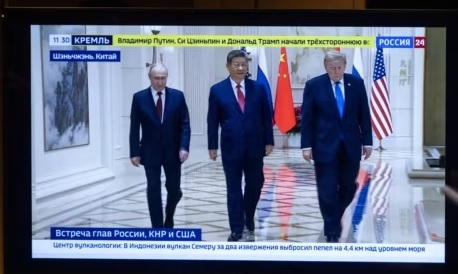
The presidents of the United States, China and Russia concluded their unprecedented trilateral summit in Shenzhen on Thursday with a four-point declaration calling for greater international cooperation, reforms to the United Nations, expanded production and supply of refined petroleum products, dialogue on nuclear risks and curbs on what they described as the misuse of international judicial jurisdiction.
US President Donald Trump, Chinese President Xi Jinping and Russian President Vladimir Putin held their first-ever three-way summit at Kylin Villa on the sidelines of the Asia-Pacific Economic Cooperation (APEC) summit, bringing together the leaders of the world’s three major powers at a time of heightened geopolitical tensions, energy uncertainty and growing concerns over nuclear security.
The declaration, titled Declaration Towards Peace, outlined areas where the three countries said they could cooperate despite their differences over global conflicts, strategic competition, trade and security. The document covered energy supplies, international institutions, nuclear dangers and the role of international legal bodies.
However, the meeting did not produce any major breakthrough on the conflicts in Iran or Ukraine, which remain among the most consequential challenges to global security and energy stability. The declaration was broadly framed and did not spell out detailed mechanisms, timelines or binding commitments for implementing its proposals.
According to reports by the Associated Press and Radio Free Europe/Radio Liberty, the meeting lasted around an hour and ended without a detailed public briefing by the three leaders. The outcome was largely a statement of shared positions rather than a concrete agreement to resolve ongoing conflicts.
A rare diplomatic platform for three major powers
The meeting marked an unusual diplomatic moment, bringing together leaders of countries with substantial military capabilities, global economic influence and permanent seats on the United Nations Security Council.
In his opening remarks, Trump stressed that the three nations carried a responsibility to cooperate on major international security challenges. He referred to their nuclear arsenals and argued that the three powers were uniquely positioned to work towards reducing the number of nuclear weapons worldwide and lowering the risks of their use.
Trump presented the summit as an opportunity to initiate a new dialogue on issues that have remained difficult to resolve through conventional diplomatic channels. The emphasis on engagement reflected his argument that direct communication between major powers could create opportunities to address disputes and prevent escalation.
Xi called for peaceful relations among major powers, warning that cooperation could contribute to global stability while confrontation could lead to uncertainty and disorder. His remarks underscored China’s position that dialogue and respect for differing national interests were essential to managing international relations.
Putin, meanwhile, proposed discussions on global and regional economic relations, energy security and broader international cooperation. He also stressed the shared responsibility of the three countries in maintaining international peace and strengthening the international legal framework.
The three leaders sought to present the meeting as an avenue for dialogue at a time when relations among major powers remain strained by competing geopolitical interests, military tensions and economic rivalries.
Energy cooperation and petroleum supplies
Energy security emerged as one of the central elements of the declaration, with the three countries outlining plans to increase the production and supply of refined petroleum products for the benefit of international markets.
The proposal comes amid disruptions to energy flows, volatile oil prices and concerns about the vulnerability of supply chains to geopolitical tensions. Greater availability of refined petroleum products could help ease supply pressures if the proposal translates into additional production and exports.
However, the declaration did not specify the volume of petroleum products to be added to global markets, the countries’ respective production targets, the destinations of additional supplies or a timeline for implementation.
The significance of the energy component will therefore depend on whether the three governments follow the declaration with practical arrangements, commercial commitments and coordinated action.
The three countries are major players in global energy markets, although their roles differ across crude oil production, refining capacity, consumption and international trade. Their cooperation could potentially influence market availability and supply-chain stability, but the immediate impact on oil prices or energy costs remains uncertain.
Energy cooperation is also closely linked to broader geopolitical concerns, particularly the security of maritime routes, the impact of regional conflicts and the risks of disruptions to oil and gas shipments.
UN reforms and international institutions under scrutiny
The declaration also called for reforms to the United Nations, reflecting the three countries’ shared view that international institutions need to respond to changing geopolitical and economic realities.
The UN, established after the Second World War, remains the principal multilateral forum for addressing international conflicts, humanitarian crises, global development and security concerns. However, its structure, particularly the composition and functioning of the Security Council, has faced repeated calls for reform from countries seeking a greater voice in global decision-making.
While the three leaders expressed support for reform, the declaration did not provide a detailed blueprint outlining which institutional changes they would support, how the reform process should proceed or what changes they envisaged in the functioning of the UN system.
The call nevertheless carries diplomatic significance because the United States, China and Russia are all permanent members of the Security Council and possess veto powers that can shape decisions on major international security issues.
Their ability to reach a common position on institutional reform could influence wider discussions on multilateral governance. At the same time, differences over the distribution of power, representation and the scope of reform could complicate efforts to translate the declaration into a broader international consensus.
Nuclear risks and proliferation concerns
Nuclear security was another major issue discussed at the summit, with the leaders agreeing to maintain dialogue on reducing nuclear risks and preventing the proliferation of nuclear weapons.
Trump had placed nuclear arms reduction among his priorities ahead of the meeting, arguing that the three major nuclear powers could play an important role in reducing the global nuclear threat. The discussions were particularly significant amid concerns over the erosion of arms-control arrangements, rising strategic competition and the possibility of miscalculation between nuclear-armed states.
The proposed dialogue could provide a platform for discussing risk reduction, communication mechanisms, arms-control principles and measures aimed at preventing accidental or unintended escalation.
However, the declaration did not announce a new nuclear disarmament treaty, specific reductions in warheads, restrictions on weapons systems or a formal negotiating timetable. It also did not establish a binding framework for nuclear arms control.
The absence of concrete commitments means that the outcome is best viewed as an opening for continued diplomatic engagement rather than a substantive arms-control agreement.
The challenge remains considerable, as the three countries have different strategic priorities, nuclear doctrines, security concerns and approaches to arms modernisation. Any meaningful progress would require sustained negotiations and greater clarity on the scope of future discussions.
Dispute over international judicial jurisdiction
The declaration also addressed the International Criminal Court (ICC) and other international judicial institutions, with the three leaders opposing what they described as the abuse of jurisdiction by such bodies.
The issue reflects longstanding disagreements over the authority of international courts, their jurisdiction over national leaders and officials, and the relationship between international legal obligations and national sovereignty.
The ICC, established under the Rome Statute, investigates and prosecutes individuals accused of genocide, crimes against humanity, war crimes and the crime of aggression under specified conditions. Its jurisdiction and enforcement powers have remained contentious, particularly when investigations involve political leaders or countries that are not parties to the Rome Statute.
The three leaders’ position on jurisdictional limits is likely to attract attention because of the continuing international debate over accountability, immunity and the authority of global institutions to investigate alleged violations.
The declaration, however, did not spell out a legal reform proposal, a mechanism to change the ICC’s mandate or specific steps to be taken by the three governments.
The issue is therefore likely to remain a subject of political and legal debate rather than result in immediate changes to the functioning of international judicial bodies.
Conflicts remain outside the declaration’s framework
Despite the emphasis on peace and cooperation, the declaration did not directly address the principal conflicts that have contributed to international instability.
The Iran conflict, its implications for regional security and energy supplies, and Russia’s war in Ukraine remain unresolved. Although the issues were part of the wider diplomatic backdrop to the summit, the joint declaration did not outline a negotiated settlement, ceasefire arrangement or specific steps towards ending either conflict.
The absence of concrete proposals on these issues underscored the limitations of the meeting, given the sharply differing interests and positions of the three governments.
The summit nevertheless provided an opportunity for direct engagement among leaders whose decisions can have far-reaching consequences for international security, energy markets, trade and the global economy.
A beginning rather than a breakthrough
The four-point declaration may provide a foundation for further diplomatic engagement, particularly on nuclear risk reduction, energy security and the future of multilateral institutions. Its significance, however, will ultimately depend on whether the stated areas of cooperation lead to sustained negotiations and practical initiatives.
The meeting also highlighted the importance of maintaining communication among major powers at a time when geopolitical competition, regional conflicts and economic uncertainty are increasingly interconnected.
For the international community, the key question will be whether the declaration translates into tangible progress on the issues it identifies or remains largely a diplomatic statement of intent.
The unprecedented gathering brought Trump, Xi and Putin to the same negotiating table, but turning their stated commitment to peace and cooperation into measurable outcomes will require considerably more than a single summit.