
Last Updated on August 26, 2026 5:50 pm by INDIAN AWAAZ
By Prof (Dr) M Rahmatullah, AJKMCRC, JMI
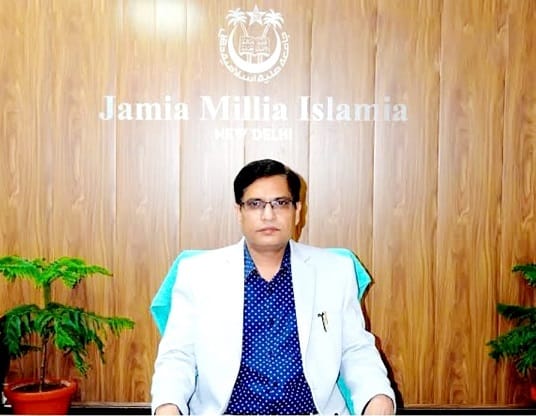
Jamia Millia Islamia (JMI) is currently experiencing a phase of renewed institutional energy, shaped by the leadership of Vice-Chancellor Prof Mazhar Asif. A pivotal decision in this transformation was the appointment of Prof Md Mahtab Alam Rizvi as Registrar in November 2024. Far from being a conventional bureaucrat, Prof Rizvi brings to the role a rare blend of scholarship, administrative acumen, and institutional experience.
Scholar Turned Administrator
Prof Rizvi’s career spans international relations, strategic studies, West Asian politics, peace and conflict resolution, and energy security. He previously directed the Nelson Mandela Centre for Peace and Conflict Resolution at JMI and was associated with the Manohar Parrikar Institute for Defense Studies and Analyses. His academic depth equips him to navigate the complexities of university administration, making him uniquely suited to the Registrar’s demanding office.
The Registrar’s Crucial Role
At a central university like JMI, the Registrar’s responsibilities extend across admissions, examinations, recruitment, promotions, service matters, statutory bodies, and financial procedures. Prof Rizvi’s academic orientation allows him to approach these challenges with sensitivity to the human dimension behind administrative files. His office has become the bridge between the university’s academic vision and its administrative execution.
One of Prof Rizvi’s defining contributions has been ensuring timely disposal of matters. For faculty awaiting promotions, students needing certificates, or departments requiring approvals, delays can be critical. His people-oriented style has helped foster transparency and responsiveness, aligning with the modern expectation of student-friendly governance.
Examinations and Admissions
The 2026 admission cycle tested JMI’s administrative machinery with thousands of applications and entrance exams across multiple cities. Under Prof Rizvi’s coordination, end-semester examinations covering 280 programmes were successfully conducted, with results for nearly 25,000 students declared on schedule. His role here was not about individual credit but about enabling smooth institutional functioning.
Jamia’s expansion into emerging fields—renewable energy, biotechnology, management, and social sciences—has required extensive administrative groundwork. Prof Rizvi’s office has been central to approvals, staffing, infrastructure, and financial arrangements, ensuring that academic innovation is matched by administrative readiness.
Bridging Academics and Administration
Having been both a teacher and researcher, Prof Rizvi understands faculty concerns while adhering to statutory frameworks. This dual perspective reduces the traditional gap between academic and administrative wings. His prior leadership at the Nelson Mandela Centre further honed his skills in institutional coordination.
Prof Rizvi has also represented JMI in collaborations, such as the MoU with the School of Planning and Architecture, Delhi, focusing on sustainable urban planning. Such initiatives highlight the evolving role of Registrars as facilitators of external engagement and academic networking.
His research on West Asia, India-Iran relations, and energy security has given him international exposure, valuable for JMI’s growing global profile. This wider vision strengthens Jamia’s efforts to enhance international collaborations and research visibility.
The Vice-Chancellor’s Strategic Choice
Vice-Chancellor Prof Mazhar Asif’s decision to appoint Prof Rizvi reflects confidence in his ability to translate vision into action. Together with other key administrators and faculty, Prof Rizvi is helping steer Jamia towards efficiency, growth, and academic vibrancy.
The Road Ahead
For Prof Rizvi, the challenge is not merely managing Jamia but advancing it while preserving its historic legacy. His journey from scholar to administrator demonstrates that academic insight and administrative responsibility can converge to strengthen institutional development. Ultimately, Jamia’s progress remains a collective effort—led by the Vice-Chancellor, supported by the Registrar, and sustained by faculty, staff, and students.
Views expressed in this article is Author’s personal..