
Last Updated on August 25, 2026 11:49 pm by INDIAN AWAAZ
Demand for government grants to hospitals attached to private Unani medical colleges
Staff Reporter / Dehradun
The All India Unani Tibbi Congress has called for the establishment of at least one government Unani medical college in every state to strengthen education, research and healthcare services under the traditional system of medicine.
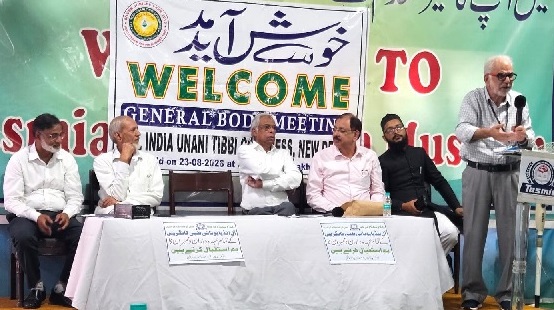
The demand was raised at the national general body meeting of the All India Unani Tibbi Congress, held at the Tasmia Campus in Dehradun under the chairmanship of its national president, Professor Mushtaq Ahmed.
Former Principal of A&U Tibbia College, Karol Bagh, New Delhi, Professor Mohammad Idris, attended the meeting as a special invitee, while the keynote address was delivered by Dr Syed Ahmed Khan, Secretary General of the All India Unani Tibbi Congress.
The meeting was attended by senior academics, physicians, researchers and representatives associated with Unani medical education from across the country. Among those present were Professor Syed Mohammad Arif Zaidi, National President of the Academic Wing of the All India Unani Tibbi Congress, and Professor Nifasat Ali Ansari, National Secretary of the Academic Wing.
The participants held detailed discussions on the current status of Unani medical colleges, academic standards, infrastructure and the challenges facing institutions providing education and clinical training in the Unani system.
One government Unani college in every state
The meeting recommended that the government ensure the establishment of at least one government Unani medical college in every state. Participants said that the availability of government-run institutions would help expand access to quality Unani medical education while creating greater opportunities for research, clinical training and the development of qualified practitioners.
Prof Mushtaq Ahmed stressed the need for a stronger institutional framework for Unani education and healthcare. He said the expansion of government medical colleges could play an important role in preserving and developing the Unani system while ensuring that students have access to adequate academic and clinical facilities.
The participants also called for greater policy support for Unani medicine under the AYUSH framework, arguing that the system should receive opportunities for development comparable to other recognised systems of traditional medicine.
Grants sought for private college hospitals
Another major demand raised during the meeting was the provision of appropriate government grants to hospitals attached to private Unani medical colleges.
The participants said hospitals linked to medical colleges perform an important role in providing clinical training to students as well as healthcare services to patients. According to the speakers, financial assistance to such hospitals could help improve infrastructure, diagnostic facilities, patient care and the overall quality of clinical education.
They argued that medical colleges cannot function effectively without adequately equipped teaching hospitals, making investment in hospital infrastructure an important component of strengthening Unani medical education.
Focus on academic standards and research
The meeting also reviewed issues relating to the quality of Unani medical colleges and the challenges confronting the sector. Participants emphasised the need to strengthen academic standards, improve teaching infrastructure and encourage research in Unani medicine.
Speakers said that the future development of the system would depend not only on expanding the number of institutions but also on ensuring that existing colleges have adequate faculty, laboratories, hospitals and other facilities required for professional medical education.
They also stressed the importance of creating greater opportunities for research and documentation so that traditional medical knowledge can be studied, evaluated and developed through systematic academic and scientific approaches.
The participants maintained that stronger government support could help Unani institutions contribute more effectively to public healthcare while creating better educational opportunities for students seeking professional training in the discipline.
Participation from experts across India
The meeting was attended by a large number of doctors, academics, Hakims, legal professionals and representatives associated with Unani medicine.
Among those present were Dr Shehnaz Parveen, Advocate Shah Jabeen Qazi, Dr Khurshid Alam, Dr Faheem Malik, Dr Shakeel Ahmed Hapuri, Dr Shamsuddin Azad, Dr Faizan Ahmed Siddiqui, Dr Mahmood Ahsan Siddiqui, Professor Syed Abdul Majeeb, Professor Mohammad Azam Ansari, Dr Mohammad Kashif, Dr Mohammad Abdus Salam, Dr Mahmood Yunus Usmani, Hakim Mazahir Alam, Dr Sabat Ahmed Tyagi, Dr Zaheer Yar Khan, Dr Ghiyasuddin Siddiqui, Dr Shakeel Ahmed, Dr Ehsan Ahmed Siddiqui, Dr Nasir Ali, Dr Mufti Javed Anwar, Hakim Mohammad Murtaza Dehlavi, Hakim Rashadul Islam, Dr Mohammad Rafiq, Dr S.K.L. Hameeduddin, Dr Mohammad Arshad Ghiyas, Hakim Mohammad Arshad Gangohi, Dr Mahmood Alam, Dr Zakiuddin, Dr Mirza Asif Baig, Hakim Yasir A. Qureshi, Dr Syed Mansoor Jamal, Dr Mohammad Danish, Dr Bilal Rizvi, Dr Mohammad Aslam, Dr G.S. Arora, Dr Mohammad Yusuf Ansari, Dr Khabeeb Ahmed, Mufti Mohammad Wasiullah, Mufti Zia-ul-Haq, Shariq Qureshi, Shariq Siddiqui, Israr Ahmed Ujeni, Khalid Khan Bhopali, Zehan Ahmed, Qari Ahmed Qadri and Mohammad Imran Kannauji, among others.
The meeting concluded with a renewed call for stronger institutional and financial support for Unani medical education, research and clinical services, with participants emphasising that expanding government institutions and strengthening teaching hospitals would be essential for the long-term development of the system.